 Politics & Law
Top leader hails friendship association's role in nurturing Việt Nam–Denmark ties
1.
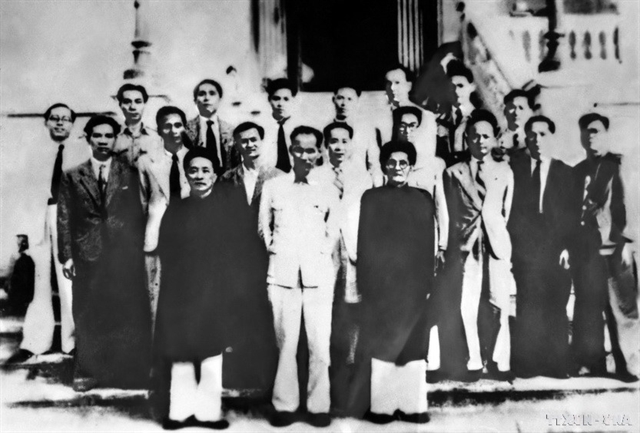 |
| The Government of the Democratic Republic of Việt Nam, elected by the National Assembly's first legislature in November 1946. — VNA/VNS File Photo |
HÀ NỘI — On January 6, 1946, 80 years ago, the entire Vietnamese people, under the astute and creative leadership of the Party and President Hồ Chí Minh, held the nation’s first general election to form the National Assembly (NA) of the Democratic Republic of Việt Nam.
This triumph stemmed from multiple factors, with Hồ Chí Minh playing a pivotal role, particularly through his issuance of electoral decrees of immense significance and enduring relevance.
Hồ Chí Minh’s pivotal role
On September 2, 1945, the Democratic Republic of Việt Nam, the first worker-peasant state in Southeast Asia, was established through the people’s heroic struggle against colonial and imperialist domination, led by the Party.
To consolidate revolutionary gains, the Provisional Government prioritised a nationwide general election for the first NA, laying the foundation for a constitution and a democratic people’s administration.
Just one day after independence, at the Provisional Government’s inaugural meeting on September 3, 1945, Hồ Chí Minh declared: “We have endured monarchical despotism, followed by no less despotic colonialism, leaving us without a constitution or democratic freedoms. We must have a democratic constitution. I propose the Government organise a general election with universal suffrage as soon as possible. All citizens, male and female, aged 18 and above, shall have the right to vote and stand for election, regardless of wealth, religion or ethnicity.”
A week later, Hồ Chí Minh called the first general election for the NA. It stressed the urgency and affirmed legal and practical readiness.
Preparations unfolded urgently amid internal foes, external threats and dire socio-economic conditions. Hồ Chí Minh’s initiative exemplified bold, correct and resolute leadership, reflecting his absolute faith in the people.
Trusting the Government and President Hồ Chí Minh, the people rallied behind the election. Talented, virtuous individuals self-nominated or were endorsed by the masses. Voter and candidate lists were publicly posted, sparking lively debates to select worthy representatives and minimise opportunists.
In Hà Nội, 118 people’s committee chairs and all village delegates petitioned to exempt 'Uncle Hồ' from running, deeming him the eternal President. On December 15, 1945, he replied gratefully: “As a citizen of the Democratic Republic of Việt Nam, I must follow election rules. Having stood in Hà Nội City, I cannot elsewhere. I sincerely thank all compatriots.”
Even remote villages buzzed with enthusiasm, with gongs and drums rallying support. Overseas Vietnamese held rallies and sent telegrams of endorsement. The nation surged with vitality ahead of this historic festival.
A leap in democratic institutions
Alongside decrees, Hồ Chí Minh directed education to ensure public understanding. He wrote articles urging participation nationwide.
In Cứu Quốc (December 31, 1945), he said: “In this general election, anyone wishing to serve the nation may stand; every citizen may vote: regardless of gender, wealth, religion, ethnicity, class or party.”
On January 5, 1946, his “Appeal to the nation to vote” proclaimed, “Tomorrow marks a new path for our nation – a day of joy, the first in Vietnamese history when our people exercise democracy... All voters, go to the polls tomorrow. Joyfully embrace your rights as free, independent citizens.”
That afternoon, he addressed a 20,000-strong rally in Hà Nội at the Việt Nam Academy. Quốc Hội newspaper’s special January 6 edition featured his photo and appeal: “Urging all citizens aged 18 and over to vote today for worthy National Assembly delegates.”
Responding to this sacred call, with iron will to defend newly won independence and pent-up joy, Việt Nam’s people, from plains to mountains, north to south, rural to urban, young to old, turned out en masse on January 6, 1946.
At 7am, Hồ Chí Minh joined thousands of Hanoians at polling station No.10 Hàng Vôi, now Lý Thái Tổ Street. He then visited stations in Hàng Bạc, Hàng Gai, Hàng Trống, Thụy Khuê, Hồ Khẩu Village and Ô Đông Mác, moved by elderly voters carried by grandchildren and blind citizens guided to cast ballots themselves.
The election unfolded vibrantly nationwide, with an 89 per cent turnout, including 91.95 per cent in Hà Nội. Hồ Chí Minh topped the poll with 98.4 per cent in the capital. Of the 333 elected deputies to the first National Assembly, they represented all classes, ethnicities and religions.
This victory marked the revolutionary state’s maturity, ushering in unified institutions: a National Assembly, a Government, a progressive constitution and full legal authority for domestic and international affairs. It affirmed the Democratic Republic of Việt Nam’s legitimacy as a state of, by and for the people.
The success validated the Party’s correct line, Hồ Chí Minh’s leadership and the people’s democratic aspirations. As he said at the opening of the first Assembly: “...the fruit of our ancestors’ sacrifices and our united, courageous struggle, uniting young and old, all religions and ethnicities into an unbreakable bloc for national independence.”
With strategic vision, firm yet flexible in governance and diplomacy, Hồ Chí Minh orchestrated this universal suffrage triumph, a true national festival of independent, free and democratic Việt Nam. For the first time in millennia of feudalism and a century of colonialism, Vietnamese freely chose capable leaders.
Since 1946, Việt Nam has held 15 successful NA elections, but Hồ Chí Minh’s 1946 imprint endures in millions of hearts. His directives and actions remain valuable lessons for building a National Assembly worthy of its role as Việt Nam’s supreme representative and state power body. — VNS
Politics & Law
 Politics & Law
 Politics & Law
 Politics & Law
 Politics & Law
 Politics & Law
 Politics & Law
 Politics & Law
 Politics & Law
 Politics & Law
 Politics & Law
 Politics & Law
 Politics & Law
 Politics & Law
 Politics & Law