 Politics & Law
Customs moves toward data-driven digital management
1.
|
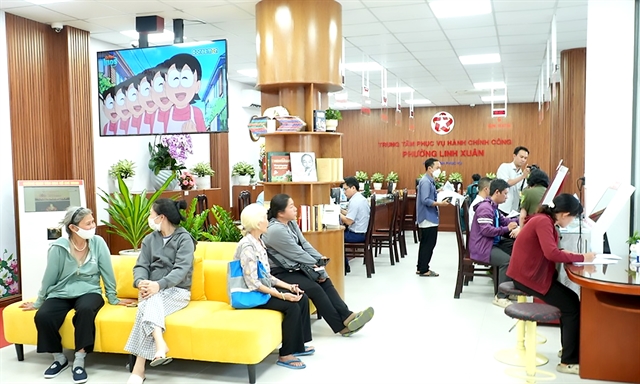
| A modern and well-equipped working space inside the Public Administrative Service Centre of Linh Xuân Ward in HCM City. — VNA/VNS Photo |
HCM CITY — The two-tier local government model goes beyond administrative restructuring, offering HCM City an opportunity to reaffirm its role as the nation’s economic engine.
Six months into implementation, early results have been encouraging, but several gaps have emerged that must be addressed if the model is to become a real driver of sustainable growth.
Standardising and upgrading the workforce
Under the two-tier system, the capacity of grassroots officials is a decisive factor for success. Investing in human resources, particularly at the commune and ward level, is widely viewed as the key to ensuring smooth, effective governance.
After six months, three major capacity gaps have become apparent: limited governance skills, uneven adaptability to digital technologies, and heavy workloads that are gradually eroding creativity among civil servants.
Nguyễn Trường Nhật Phượng, vice chairwoman of the municipal People’s Council, said officials at all levels have made considerable efforts to improve their qualifications to meet new requirements.
However, further improvement is needed to better meet the expectations of residents and businesses, she said.
“The city needs appropriate mechanisms and policies for training and capacity building so that human resources operating the administrative apparatus can be fully utilised in the new development space.”
Experts argue that HCM City needs a large-scale retraining strategy focused on modern urban governance and digital skills.
Public administration expert Nguyễn Tuấn Anh said commune- and ward-level leaders now have greater decision-making authority, making training in strategic thinking, problem-solving, public engagement and inter-agency coordination increasingly essential.
“In the digital era, digital competence should no longer be a supplementary criterion but a mandatory one,” he said, adding that it must include data analysis skills to support decision-making.
Work pressure is another challenge. As administrative files pile up, civil servants tend to prioritise meeting deadlines, leading to rigid working styles and reluctance to propose innovations due to concerns over workload and legal risks.
Nguyễn Thị Mỹ Linh, a civil servant with more than nine years of experience in finance and budgeting at Thủ Đức Ward, said intense pressure leaves little room for creativity.
“As digital transformation progresses and workflows become more streamlined, we hope to have more time to better understand our localities and develop innovative solutions,” she said.
In response, many localities have launched training and capacity-building programmes. Lê Văn Minh, secretary of Diên Hồng Ward’s Party Committee, said the ward would prioritise digital skills training in 2026 alongside socio-economic tasks.
Meanwhile, Thủ Đức Ward People’s Committee chairwoman Nguyễn Thị Mai Trinh said efforts are underway to further accelerate digital transformation to save time and enhance governance capacity.
|
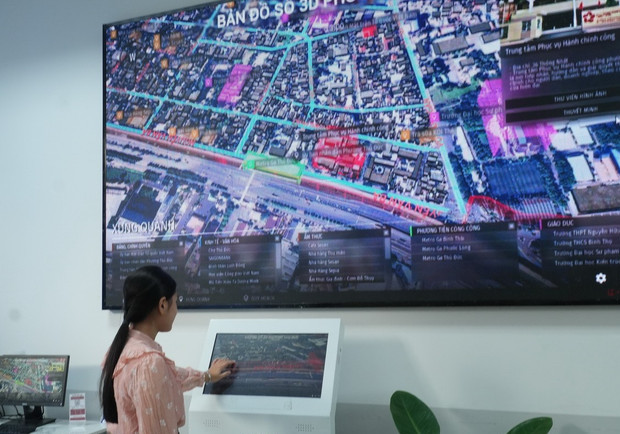
| A resident accesses planning and land-use information via a 3D digital map at the Public Administrative Service Centre of Thủ Đức Ward in HCM City. — VNA/VNS Photo |
A people-friendly government from the grassroots
The city aims to turn each ward and commune into a “laboratory” for administrative reform. Initiatives such as the “people-friendly government” model and home-based administrative services are encouraged to expand beyond pilot areas to generate broader grassroots momentum.
In wards applying the people-friendly model, residents no longer face rigid procedures or physical barriers. Instead, they are welcomed into open, friendly spaces by courteous and attentive public servants.
At Thủ Đức Ward, the introduction of two reception robots that provide application forms and refreshments has left a strong impression on residents and businesses.
The initiative has inspired similar practices elsewhere, including refreshment counters funded through social contributions in Dĩ An and Bình Dương wards.
Tam Thắng Ward has adopted the practice of sending apology letters to residents when administrative dossiers are processed late.
Bùi Thị Hạnh, deputy director of the ward’s Public Administrative Service Centre, said only two land-related cases were delayed in 2025, both of which prompted formal letters explaining the reasons and specifying new deadlines.
Such measures are seen as a significant shift from a “granting” mindset to a service-oriented approach.
Trần Quang Thắng, director of the HCM City Institute for Development Studies, said that when widely applied, the people-friendly government model would become a crucial pillar of grassroots administrative reform.
“When people feel respected and well served, they are more willing to work alongside authorities in broader development initiatives,” he said.
“This is the foundation for building a smart, humane urban government.”
After six months, the city has made early progress in addressing the challenges of governing a megacity through streamlined structures and accelerated digital transformation.
However, the true effectiveness of the new model will be measured not by procedures on paper, but by public satisfaction and the momentum it generates for business growth and innovation. — VNS
Politics & Law
 Politics & Law
 Politics & Law
 Politics & Law
 Politics & Law
 Politics & Law
 Politics & Law
 Politics & Law
 Politics & Law
 Politics & Law
 Politics & Law
 Politics & Law
 Politics & Law
 Politics & Law
 Politics & Law




