 Politics & Law
UK Royal Navy’s patrol vessel pays second visit to HCM City
1.
|
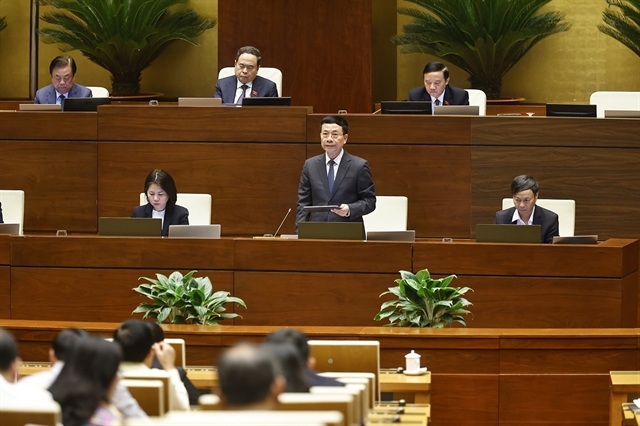
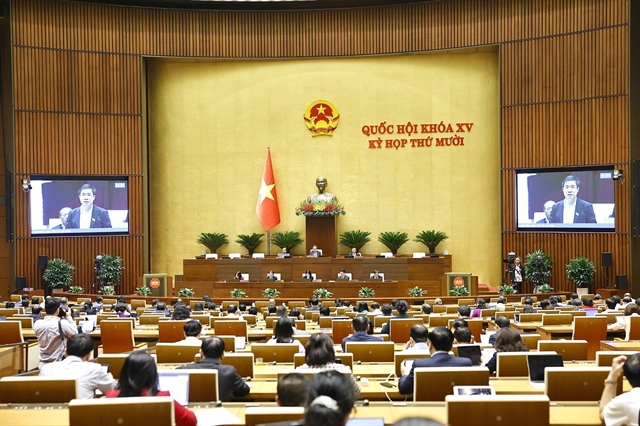
| Minister of Science and Technology Nguyễn Mạnh Hùng responds to questions from NA deputies on Monday. — VNA/VNS Photo |
HÀ NỘI — The National Assembly opened a debate on Monday on how far the country should go in treating data, inventions and creative works as tradable assets, as lawmakers discussed sweeping amendments to the Law on Intellectual Property (AI).
The sharpest debate centred on Article 8a, which establishes a framework for recording IP assets in company books and, crucially, permits to be used in transactions and potentially as collateral for bank loans.
Deputy Nguyễn Hoàng Bảo Trân of HCM City called the change a step forward, that could bring IP into Việt Nam’s financial system. However, she warned that the current drafting 'opens the door too wide' by allowing owners to assign value to their own IP without any obligation to justify it.
Audit practice, she said, shows that vague valuation rules are 'a loophole' easily exploited to inflate asset values, manipulate transfer prices or cause losses when public assets are involved.
Trân urged lawmakers to embed disclosure and transparency requirements and to ensure all IP transactions, including collateralisation, are tied to valuation standards issued by the government, rather than left to the discretion of the owners.
Deputy Phạm Văn Hoà of Đồng Tháp echoed those concerns, citing real cases where IP rights had not been formally recognised but were still recorded as assets and used to obtain bank loans or issue securities.
"Some assets either did not exist or had very low real value, but were nonetheless inflated on paper, creating risks for the financial system," he said.
Minister of Science and Technology Nguyễn Mạnh Hùng defended the strategy.
He said: "IP must become an asset that can be valued, bought and sold, included in financial statements and used as collateral if Việt Nam wants a functioning science and technology market."
He also said enterprises could self-value certain IP, but those internal figures would not be eligible for borrowing and must be kept separate from assets that have met recognition standards.
A second thread of debate centred on what lawmakers described as a widening imbalance between Việt Nam’s press agencies and global digital platforms that aggregate, index and monetise news content.
Under current law, publishers do not enjoy 'related rights' – a class of rights that protect investment in producing content – even though sound-recording producers, broadcasters and performers do.
That gap, Deputy Hoàng Minh Hiếu of Nghệ An argued, leaves newsrooms with 'little leverage' when platforms scrape or repackage their content at scale.
Hiếu urged lawmakers to grant press organisations the right to permit or prohibit copying, storing, indexing, displaying snippets or systematically aggregating news content to build competing services.
Platforms that profit from such uses would be required to share revenue with publishers through negotiation. He noted that similar regimes in the EU, Australia and Canada have delivered tangible results for news organisations.
Any new right, he said, must also include clear limits: non-commercial quotation for research or education, 'pure' linking without republished extracts and uses that do not affect normal commercial exploitation should remain permissible.
The draft law also touches on one of the world’s thorniest questions: how to regulate AI systems that train on vast quantities of text and visual data, often without the knowledge of creators.
Clause 5 of Article 7 would allow organisations and individuals to use legally published texts and datasets that the public can access for the purposes of researching, training and developing AI systems. But they must not copy, distribute or commercially exploit the original works in ways that harm creators’ lawful interests.
Deputy Nguyễn Tâm Hùng of HCM City welcomed the clause but said that the criteria would need further clarification, particularly the test of what constitutes 'harm'.
Deputy Trần Thị Thu Đông of Cà Mau was sceptical of moving so quickly.
Representing writers, artists and creative industries, she warned that an overly broad exception could enable AI developers to 'harvest creative data en masse', undermining incomes and even allowing AI-generated works to compete against human creators.
She noted that global debates remain unsettled: the EU spent years hammering out cautious rules on text-and-data mining, while the US, Japan and Korea continue to readjust frameworks amid lawsuits.
Đông said: "If we introduce such a broad exception now, we risk opening a very wide gate for mass data harvesting, with potentially irreversible damage to authors and creative industries."
Đông urged lawmakers to delay legislating on AI training until Việt Nam can study more mature models abroad.
On a related question, whether AI-generated works should receive IP protection – deputies were divided.
Deputy Phạm Trọng Nghĩa of Lạng Sơn argued that IP rights exist to protect human creativity and that AI should never be considered a rights-holder.
Granting full protection to machine-generated works, he warned, could unfairly disadvantage human creators and accelerate job losses as companies swap skilled workers for near-zero-cost AI systems.
At the same time, he said, some protection may be necessary to incentivise investment, especially for a developing country trying to build its own AI capabilities.
He proposed a conditional model in which AI-generated works qualify for protection only when there is 'significant human creative involvement' in shaping the content.
Ownership and liability would rest with those who train or operate the systems, not the systems themselves.
Beyond the headline disputes, lawmakers pressed for faster, more transparent processing of patent applications – a weak spot for Việt Nam’s innovation system.
Several deputies noted that substantive examination currently takes an average of 30 to 36 months, and in some cases as long as five years, costing businesses valuable opportunities in fast-moving fields.
Trân and others proposed hard deadlines for each stage of the process, plus a fast-track route for small- and medium-sized enterprises, high-tech sectors or patents used in domestic production.
Deputies also called for clear time limits for the Ministries of National Defence and Public Security's approvals for inventions classified as state secrets, warning that open-ended timelines could cause applicants to miss international filing windows.
Minister Hùng said his ministry aims to cut substantive examination to 12 months and introduce a three-month fast-track mechanism, supported by digitalisation, to eliminate a backlog of more than 100,000 applications. — VNS
Politics & Law
 Politics & Law
 Politics & Law
 Politics & Law
 Politics & Law
 Politics & Law
 Politics & Law
 Politics & Law
 Politics & Law
 Politics & Law
 Politics & Law
 Politics & Law
 Politics & Law
 Politics & Law
 Politics & Law