 Opinion
Vietnamese NA President’s China visit facilitates bilateral cooperation: Chinese researcher
1.
Việt Nam News reporter Khánh Dương speaks with international delegates at last week's Quy Nhơn Dialogue on Climate and Transitions in Gia Lai Province about key priorities and lessons from other countries that could help Việt Nam achieve its net-zero emissions target by 2050.
 |
| Moussa Faki Mahamat. |
Moussa Faki Mahamat, special envoy for the Pact for Prosperity, People and the Planet
I believe that committing to the net-zero emissions target and setting clear emission reduction goals are in themselves strong indications of political will to effectively address climate change and its impacts on the planet.
It is true that countries have different geographical characteristics and levels of vulnerability, which means that they need to take different measures and may require additional efforts to achieve their goals. This is why science can help guide the process and support the achievement of these objectives through international cooperation.
Once political will is established, there are international institutions and frameworks that produce reports on climate-related issues. The Conferences of the Parties (COPs), which are held regularly, also generate extensive work on these issues and can provide valuable sources of inspiration for countries such as Việt Nam.
Above all, achieving these objectives depends on the strong political will of the Government to drive the country towards its goals.
 |
| Ana Toni from COP30. |
Ana Toni, chief executive of the 30th Conference of the Parties to the United Nations Framework Convention on Climate Change (COP30) in Brazil
What we have seen in Brazil which may be helpful for Việt Nam is that fighting climate change needs to be a priority not only for the environmental ministry, but for all the different ministries: ministry of agriculture, ministry of science, ministry of finance, ministry of social affairs. So it has to be a whole government approach in order to achieve the goals that we had in Brazil. I suspect that will be the same here in Việt Nam because climate change, in the end, is an economic, social, and development challenge.
I think one of the lessons, especially being in Việt Nam, is about nature-based solutions. There are a lot of nature-based solutions that we can, as South-South countries, learn from each other.
Adaptation is very important. A lot of the adaptation work that Việt Nam is doing or Brazil is doing is sometimes not inside of our Nationally Determined Contributions (NDCs). Combining the fight against climate change with economic growth and development is absolutely key.
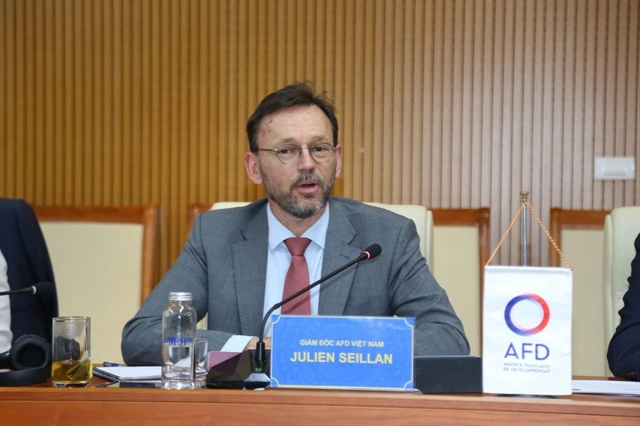 |
| Julien Seillan. — Photo thoibaotaichinhvietnam.vn |
Julien Seillan, director of the French Development Agency (AFD) in Việt Nam
I think the most important question is energy. To achieve the double-digit growth target, Việt Nam has to produce enormous quantity of energy far above what power plants can produce today.
Obviously, the crisis the whole world went through during the past months since the Ormuz-Detroit crisis showed that it was of interest of everyone to move from fossil-based energy to renewable energy.
Việt Nam did not stay behind waiting for that information. Việt Nam already began that race. I think Việt Nam has to make everything possible to facilitate renewable production, transmission and distribution. — VNS
Việt Nam commits to net zero targetAt the 26th Conference of the Parties to the United Nations Framework Convention on Climate Change (COP26) in Glasgow in 2021, Việt Nam committed to achieving net-zero emissions by 2050, which is not only a climate commitment but also reflects Việt Nam’s strategic vision of proactively embracing emerging global development trends and working towards building a green, modern and highly competitive economy in the long term.At the Quy Nhơn Dialogue on Climate and Transitions held in early October, Deputy Minister of Agriculture and Environment Lê Trọng Yên said in recent years, the Vietnamese Government has gradually refined its policy and legal frameworks to remove bottlenecks to the green transition. These efforts include policies on investment, science and technology development, carbon market development and the mobilisation of green finance and international funding sources.The green transition is being increasingly implemented across various sectors of the economy, including energy, transport, construction and agriculture, he said.Many localities have leveraged their strengths and potential to actively promote forest planting and restoration, while assessing opportunities to participate in carbon markets in areas such as energy, waste management, transport, crop production, aquaculture, forest protection and development, he said. — VNS
Opinion
 Opinion
 Opinion
 Opinion
 Opinion
 Opinion
 Opinion
 Opinion
 Opinion
 Opinion
 Opinion
 Opinion
 Opinion
 Opinion
 Opinion