 Opinion
Ministry proposes allowing foreign investors to participate in market infrastructure
1.
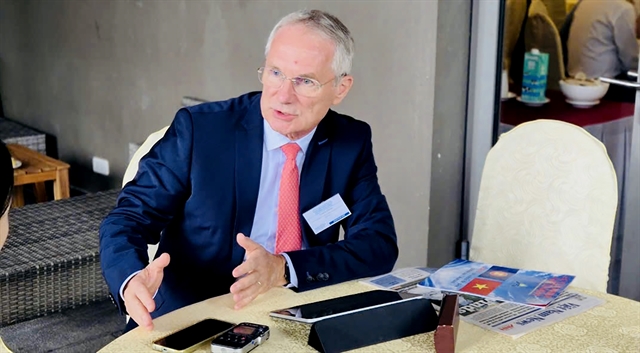 |
| Csaba Kőrösi, former President of the 77th UN General Assembly, speaks to Việt Nam News. — VNS Photo Thanh Tuệ |
Csaba Kőrösi, former President of the 77th UN General Assembly, speaks to Việt Nam News reporter Khánh Dương about Việt Nam’s science and technological efforts and progress in achieving sustainable development.
Việt Nam has placed science, technology, innovation and digital transformation at the centre of its development strategy under Resolution 57. From the UN's perspective, how can these areas help countries like Việt Nam accelerate progress towards the Sustainable Development Goals?
Having looked at the resolution you have mentioned, it is a very encouraging direction.
Việt Nam is already a rapidly developing country with high GDP growth.
Now, I'm sure the real challenge facing Việt Nam is how to turn rapid growth into high-quality growth and how to turn rapid growth into sustainability growth.
If you want to move up the value chain, this requires investment in science and technology, because research and technology development are a risky but rewarding part of the whole development process. Resolution 57 is a big promise.
Secondly, we all know that economic growth alone, in terms of business as usual, will not make a big wonder, a big miracle for any country in the world. The objective is to reduce the material intake, to increase the material and energy efficiency, to reduce the environmental imprint, and to increase the value added by the economy.
All this can only be done through technological change, and technological change can only be achieved through investment in science. Therefore, I have very high hopes that Việt Nam is taking that path.
Việt Nam aims to use science, technology and innovation not only to boost economic growth but also to achieve rapid and sustainable development. What do you see as the key conditions for ensuring that technological progress actually contributes to inclusive and sustainable development?
There are many, and your country is doing already some of them. Some others may come in order to boost sustainable development successfully.
First and foremost, you need updated technologies. Technologies of the 20th century will not make a difference in the 21st century. The 21st century will be determined by the technologies that make the sustainability transformation possible.
The second is high-quality standardised data. The transition to sustainability is very much science-based and data-informed, so you need high-quality, standardised, and real-time data.
The third, if you have all this, is that you will think of how to redirect your investments. Redirecting investments can make a difference in the development of your economy. But it is still not enough.
You will need to have strong regulations that orient companies and the society towards a more sustainable path of development.
Education must integrate the norms of sustainability from the very elementary schools to scientific research institutions.
If all that is in place, you have to make sure that climate neutrality is part of the long-term objective of your country, and comprehensive national wealth accounting is a very strong and powerful tool to make sure that you can track and measure the real transformation your country is doing.
Last but not least, you will need a very strong political and public alignment with the objectives of sustainable development. When all of these come together, it is the best strategy for a country to achieve sustainable development.
I see Việt Nam on track, but there is still a long way to go for all of us.
What role can international cooperation play in helping developing countries such as Việt Nam access advanced technologies, scientific knowledge and financing for sustainable development?
When you are part of the international circulation, it helps you identify and scope the challenges faced by your country.
Your country is not an island. Your country is facing challenges similar to those faced by many other countries, but we all are facing integrated challenges, and it is much easier to identify the scope of the problems through international cooperation.
It's also easier for a country to apply science-based methodology to measure progress in cooperation with other countries, and when it comes to finance, we have to understand the nature of crises our countries are going through.
Finance is a tool for promoting comprehensive solutions.
One of the lessons learned in many other countries in terms of finance is that if the transition to sustainable development is dealt separately from the national budgeting, it will not work.
In international cooperation, you can benefit from international cooperation from actions with others if you have very clear-cut national objectives, and those national objectives, of course, are in harmony with the shared international goals.
International cooperation will be the most helpful if you have the blueprint, and then you invite international partners to cooperate with you.
Last but not least, all decisions on finance are considered investments.
Those countries who perceive finance as a chain of investments are usually more successful than those countries who perceive finance as a kind of aid coming from someone else.
Investments along national strategic plans did lift many countries from poverty. So I see Việt Nam again on the right track.
What lessons from other countries could Việt Nam draw on as it seeks to make science, technology and innovation drivers of sustainable development?
Let's mention some countries that have successfully advanced science and technology to help economic and social development, like Singapore, South Korea, Israel, and Switzerland.
What was their secret? First, clear national priorities.
All these successful countries have chosen certain segments of technology development, as part of the sustainability transformation.
In other words, they identify their own profile in the international cooperation. They identify those niche areas where they could be successful, and they progressed very successfully. When you have strong niche positions in the technology through scientific research, then you can expand your presence in those markets.
I see Việt Nam is looking for those niche areas where to concentrate investments on science and technology.
The lessons learned from Singapore, South Korea, Israel, Switzerland, and maybe some others, are there for us to learn from.
Việt Nam is now in the catch-up phase, and I would like to congratulate your country because you're doing a very good job. — VNS
Opinion
 Opinion
 Opinion
 Opinion
 Opinion
 Opinion
 Opinion
 Opinion
 Opinion
 Opinion
 Opinion
 Opinion
 Opinion
 Opinion
 Opinion