 Opinion
Việt Nam sets four priorities for APEC Finance Ministers’ Meeting in 2027
1.

|
| Dr Âu Thị Hường, director of Semiconductor Source Production at Quandela. Photos courtesy of Dr Âu Thị Hường |
The Communist Party's Resolution 57 identifies science and technology among the breakthrough drivers of national development, while quantum technologies are named as one of 10 strategic technology groups under a decision issued by the Prime Minister earlier this year. Việt Nam News reporters Thanh Tuệ and Khánh Chi speak to Dr Âu Thị Hường, director of Semiconductor Source Production at Quandela in France, to learn more about Việt Nam’s position in the global quantum race.
From your perspective as an expert directly involved in developing and commercialising quantum computers in France, how do you assess the current global quantum race? Which breakthroughs will determine whether this technology can successfully transition from the laboratory into real-world applications?
I believe the global quantum race has entered a distinct new phase. The core question is no longer simply "Who can produce more qubits?" Instead, it has increasingly become "Who can build a system that is large enough, stable enough, manufacturable and capable of solving genuinely useful, real-world problems?"
The decisive breakthroughs over the next few years will not merely be isolated records in qubit count or gate fidelity. The real differentiator will be the capacity to industrialise the technology: scaling up architectures, implementing quantum error correction, engineering system integration, manufacturing with high reliability and reproducibility, interconnecting quantum processors and ultimately demonstrating commercial and practical value in end-use applications.
The chasm between an outstanding scientific experiment and a viable industrial-grade product remains vast.
More importantly, quantum technology is transitioning from a purely scientific pursuit into a multidimensional race encompassing engineering, precision manufacturing and industrialisation.
This evolution also creates strategic openings for countries that are not yet pioneers in full-stack quantum computing, provided they identify and cultivate the right niche capabilities to plug into the global value chain.
|
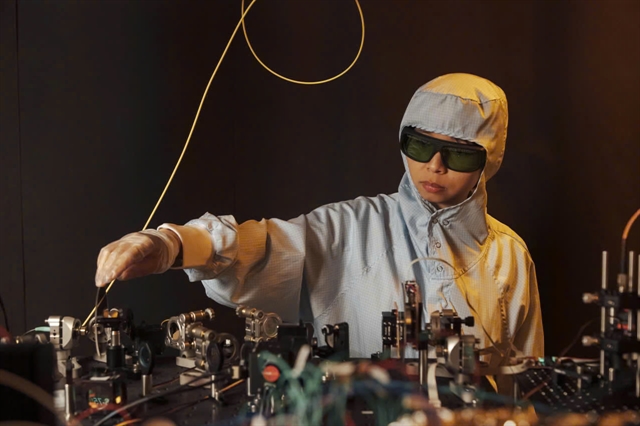
| Dr Âu Thị Hường aligns an optical setup to measure and screen the performance of single-photon chips and the device's quantum protocols. |
Based on your observations and discussions during the recent Gia Lai Quantum Year 2026 events, how do you evaluate Việt Nam’s current level of interest, capability and overall readiness for quantum technology?
Through the activities and my discussions with universities, research institutes, enterprises, regulatory bodies and especially young students, I have observed a marked surge in Việt Nam’s interest in quantum technology. More significantly, quantum is increasingly recognised not just as a domain of fundamental physics research, but as a critical strategic technology for the future.
Việt Nam possesses notable foundation blocks: research teams with solid expertise in specific subfields, a robust community of overseas Vietnamese scientists and engineers in quantum technology, a young generation of students capable of rapid technology adoption and expanding domestic IT, telecommunications and semiconductor industries.
However, interest does not equate to readiness. If I were to assess our position, Việt Nam is currently at the stage of ecosystem formation. Capabilities have begun to emerge, but they remain fragmented. Many research groups operate on a modest scale, and links among research, infrastructure, education and industry are not yet sufficiently robust.
Given our constrained pool of specialised technical talent and investment capital, if institutions operate in silos, we risk both duplicating capital expenditure and scattering teams that urgently need to be brought togther to achieve critical mass.
The pivotal question going forward is not only how much capital Việt Nam commits to quantum technology, but how effectively we organise and orchestrate those resources to forge a cohesive national capability.
Where should Việt Nam begin if it wants to enter the quantum race now, rather than waiting for the technology to mature?
In my view, we should not wait. If we delay building capabilities until quantum technology reaches full maturity, much of the global value chain, intellectual property, technological standards and key human capital will have already been consolidated elsewhere.
However, starting immediately does not mean attempting to build an entire quantum computer from scratch overnight. I envision this process unfolding in three distinct stages: access, absorb and master.
Access means leveraging existing global technologies for education, research and experimentation. On the software side, we can immediately tap into remote, cloud-based quantum computing platforms. On the hardware front, researchers and engineers must be afforded opportunities for direct, hands-on exposure to physical equipment and operational systems.
Absorb means converting that initial access into indigenous capability through talent development, joint research programmes, personnel exchanges and substantive, in-depth partnerships with experienced international institutions.
Master represents the stage where we move beyond mere utilisation to designing, optimising and incrementally developing strategically vital technologies of our own.
To put it in very simple terms: using a system is access; understanding, operating and improving it is absorption; and independently developing a high-value subsystem or component marks the beginning of mastery.
Việt Nam does not need to reinvent the wheel. We must learn rapidly from the global frontier, but we must ensure that acquired knowledge is effectively transformed into genuine domestic capability.
|
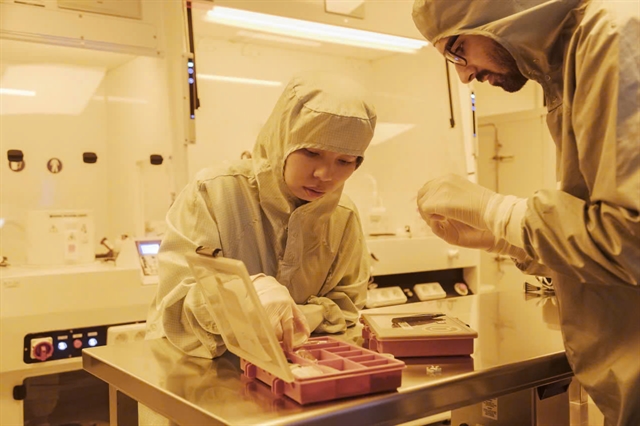
| Dr Âu Thị Hường sorts and inventories semi-finished components in the form of micro-chips before they advance to subsequent stages of the fabrication line. |
Within the quantum value chain, which segments should Việt Nam target to establish a competitive advantage rather than spreading its resources trying to do everything?
After the access and absorption phases, the pivotal follow-up question becomes: What should Việt Nam choose to master?
I do not believe we should aim for self-sufficiency across the entire quantum value chain. Even global leaders rely on international supply networks. Việt Nam should build upon capabilities it has already cultivated or is actively financing, most notably IT and software, telecommunications and semiconductors.
In my view, three directions warrant strategic focus:
First, software, algorithms and applications. This domain allows for an immediate start by leveraging Việt Nam's existing software talent pool, enabling research teams and commercial enterprises to test practical problem-solving on available cloud-based quantum architectures.
Next, quantum technologies that intersect with Việt Nam’s existing industrial strengths. Telecommunications expertise can be extended into quantum communications, while foundations in semiconductors, optics and fabrication can lead into integrated photonics, quantum components and hardware devices.
Finally, industrial manufacturing and integration capabilities servicing the global quantum supply chain. Advanced fabrication, systems integration, packaging, testing, control electronics and specialised precision manufacturing can all become high-value links. However, selecting the right segments requires a sufficiently deep grasp of the core technology and overall system trajectories to anticipate future industrial bottlenecks and demands.
These strategic choices must not be driven by fleeting trends, but governed by clear criteria: What existing foundation does Việt Nam possess? What is the gap relative to international benchmarks? Does actual market demand exist? And can the capability reliably integrate Việt Nam into global value chains?
Ultimately, the strategic question is not "How many things can Việt Nam build on its own?" but rather "Where can Việt Nam secure a distinct competitive edge within the global quantum value chain?"
You previously said that uncoordinated investments across isolated institutions risk dispersing national resources. How should Việt Nam’s quantum ecosystem be organised to generate meaningful collective strength?
We must distinguish between geographic dispersion and strategic dispersion. Việt Nam can have multiple universities, research institutes, enterprises and regional innovation hubs participating concurrently. What must be avoided is every individual institution attempting to construct its own self-contained, end-to-end ecosystem.
Given the capital-intensive nature of specialised equipment and the limited pool of deep-tech talent, siloed investments inevitably lead to duplicate infrastructure, fractured technical teams and depleted resource efficiency.
I therefore advocate establishing a National Quantum Network anchored by a centralised coordination mechanism. Coordination does not mean forcing all activities under a single physical institute or stifling scientific autonomy.
Rather, each institution develops specialised depth based on its comparative advantages, but operates within a coherent national roadmap that defines who delivers what, which facilities are shared, which technologies require deep-target capital allocation and which structural voids genuinely demand greenfield investment.
Within this network, national capability can be conceptualised across five interdependent, progressively deepening tiers: international technology access and core talent cultivation; experimental testbeds and shared-use infrastructure; mastery of targeted subsystems and critical components; specialised advanced infrastructure and industrialisation; and integrated systems, commercial applications and end markets.

|
| Members of the semiconductor quantum chip production team (in blue) at Quandela work under the leadership of Dr Âu Thị Hường (front row, third from left), alongside visiting guest, head of R&D at the Vietnam Quantum Network Dr Nguyễn Lương Quang (in white) touring the cleanroom facility. |
If you could prioritise only three immediate actions for Việt Nam over the next three years to avoid missing the quantum revolution, what would they be?
If limited to three priorities, I would focus strictly on deliverables that produce verified, tangible capabilities within three years, rather than attempting broad coverage across all technological vectors.
Immediately leverage international partnerships while developing a domestic quantum workforce development curriculum.
Establish a National Quantum Capability Map and deploy a unified resource-coordination mechanism.
Select a focused set of flagship programmes and steer them toward measurable milestones within a three-year timeline.
Success should not be evaluated by the volume of academic conferences, memoranda of understanding or academic publications, but by the number of people trained, the industrial and engineering capabilities established, the physical prototypes built, the infrastructure genuinely shared across institutions and the applications deployed in real-world test environments.
The window of opportunity remains open. Quantum technology has not yet matured to the point where every position in the global value chain is locked down. However, the window for an emerging nation to stake out its competitive position will not remain open indefinitely.
Việt Nam does not need to execute everything from the outset. But it must start on a sound footing, establish strong links and demonstrate the sustained commitment required to build proprietary, durable capabilities. VNS
Opinion
.jpg) Opinion
Opinion
 Opinion
 Opinion
 Opinion
 Opinion
 Opinion
 Opinion
 Opinion
 Opinion
 Opinion
 Opinion
 Opinion
 Opinion
 Opinion