 Opinion

AITO Looks Ahead to Europe, Building a Thriving Automotive Ecosystem
1.
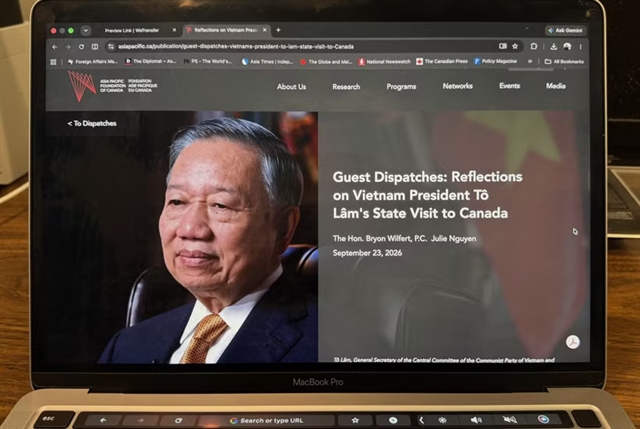 |
| The Asia Pacific Foundation of Canada website published two commentaries by former parliamentarian Bryon Wilfert and researcher Julie Nguyen on the significance of the visit. Photo: Screenshot of the articles |
OTTAWA — The state visit to Canada by General Secretary of the Communist Party of Việt Nam Central Committee and President Tô Lâm and the elevation of Việt Nam–Canada relations to a Strategic Partnership have drawn attention from Canadian media and researchers.
The coverage by Canadian media and researchers shows that the top Vietnamese leader's state visit was seen not only as an important diplomatic milestone but also as an opportunity for the two countries to deepen substantive cooperation, diversify partnerships and seek new drivers of development amid a changing global landscape.
The Canadian Press ran an article titled “Việt Nam’s leader Tô Lâm upgrades Canada to a Strategic Partner”, which was republished by CTV News, noting that the visit came as Canadian Prime Minister Mark Carney was promoting cooperation among middle powers amid mounting economic pressures.
Reporter Dylan Robertson quoted General Secretary and President Lâm as saying during his visit that in a volatile world, trust, responsibility and shared interests in and of themselves are strategic values.
The Canadian Press also cited Vina Nadjibulla, co-founder of the Centre for Strategic Statecraft, who said Canada and Việt Nam share similarities in their efforts to strengthen resilience, diversify partnerships and maintain autonomy while avoiding excessive dependence on or pressure from any major power.
According to Nadjibulla, both countries are seeking to diversify supply chains and reduce overreliance on the US. While Việt Nam has a significant trade surplus with Canada, Canadian businesses have yet to fully tap opportunities in the Southeast Asian market of around 100 million people.
The article also highlighted Việt Nam's role as chair of the Comprehensive and Progressive Agreement for Trans-Pacific Partnership (CPTPP) in 2026 and prospects for stronger cooperation between the CPTPP and the European Union, thereby expanding linkages among middle powers in response to policies that exert economic pressure.
Meanwhile, CBC News published an article by Jennifer Yoon which mentioned potential benefits for Canada from stronger ties with Việt Nam. It noted that the visit could mark a turning point in bilateral relations as Việt Nam has become Canada's largest trading partner in Southeast Asia.
Speaking to CBC, Julie Nguyen, Chair of the Canada–ASEAN Initiatives at the York Centre for Asian Research, said it was time for the two countries to elevate their partnership to the next level to ensure economic resilience and security.
She said that to achieve its goal of becoming a high-income country by 2045, Việt Nam needs to move into advanced manufacturing, science, technology and artificial intelligence (AI) development, noting that all of these products and services could be provided by Canada.
CBC quoted Jeff Nankivell, Oresident and CEO of the Asia Pacific Foundation of Canada, as saying Việt Nam could play an important role in Canada's efforts to conclude a free trade agreement with the Association of Southeast Asian Nations (ASEAN).
According to Nankivell, both countries need to diversify their partnerships in response to the impacts of US tariff policies. In the energy sector, he said Việt Nam is a potential market for Canadian liquefied natural gas, crude oil and nuclear technology, while the two could step up cooperation to meet Việt Nam's growing energy demand.
Television network CityNews covered the welcoming ceremony for the top Vietnamese leader at Rideau Hall, highlighting the historic significance of the visit and noting that bilateral trade has doubled over the past five years.
The report also cited Nankivell on opportunities for energy cooperation and interviewed Julie Nguyen, co-founder and director of the Canada–Việt Nam Trade Council, about the Vietnamese community in Canada and its role in connecting businesses and expanding export markets.
Television reports by The Canadian Press also carried remarks by Prime Minister Carney and General Secretary and President Lâm on new directions for bilateral cooperation.
Carney stressed that the relationship goes beyond trade to encompass education, innovation, security and supply chains. Meanwhile, the Việt Namese leader proposed making science and technology a new pillar of bilateral relations, with priority given to joint research on applied AI, clean energy and maritime technology.
The Hill Times published an opinion article by Vina Nadjibulla titled “Canada–Việt Nam ties are about more than trade”, which wrote that although Ottawa and Hà Nội have different geopolitical positions, both are seeking greater resilience, diversified partnerships and room for manoeuvre in an increasingly competitive world.
According to the author, Việt Nam's foreign policy, based on national interests, self-reliance and flexibility in relations with major powers, offers a perspective of interest as Canada seeks to reduce risks stemming from excessive dependence on the US market. The value of bilateral relations, therefore, lies not only in trade but also in their potential to help both countries strengthen resilience to global changes.
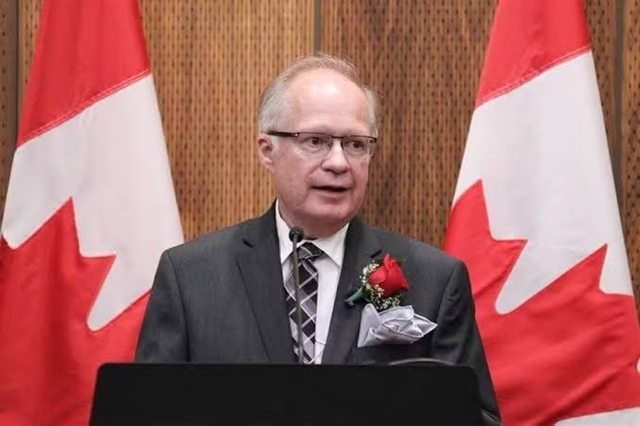
The Asia Pacific Foundation of Canada also published commentaries by former parliamentarian Bryon Wilfert and researcher Julie Nguyen on the significance of the visit.
Wilfert said Canada should seize opportunities from Việt Nam and translate the Strategic Partnership framework into concrete cooperation in agriculture, energy, critical minerals, aerospace, clean technology, semiconductors and education. He also proposed enhancing direct air connectivity to promote trade, investment and people-to-people exchanges.
Meanwhile, Nguyen analysed similarities between Canada and Việt Nam as middle powers seeking to maintain strategic autonomy in relations with larger neighbouring countries. She said Việt Nam's experience in preserving independence, maintaining flexibility in international relations and pursuing long-term development interests offers lessons of interest to Canada. — VNA/VNS
Opinion
 Opinion
 Opinion
 Opinion
 Opinion
.jpeg) Opinion
Opinion
 Opinion
 Opinion
 Opinion
 Opinion
 Opinion
 Opinion
 Opinion
 Opinion
.jpg) Opinion
Opinion