 Opinion
Vietnamese scientist wins ASEAN-US Science Prize for Women
1.
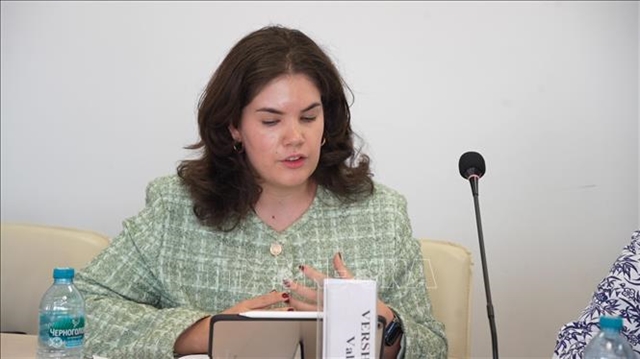 |
| Dr Valeria Vershinina, Deputy Director of the ASEAN Centre at the Moscow State Institute of International Relations (MGIMO) under Russia’s Ministry of Foreign Affairs. — VNA/VNS Photo |
HÀ NỘI — The upcoming state visit to Russia by General Secretary of the Communist Party of Việt Nam Central Committee and President Tô Lâm is expected to reaffirm the unwavering strategic nature of Việt Nam–Russia relations despite external upheavals, said Dr Valeria Vershinina, Deputy Director of the ASEAN Centre at the Moscow State Institute of International Relations (MGIMO) under Russia’s Ministry of Foreign Affairs.
In an interview granted to the Vietnam News Agency, Vershinina said high-level meetings demonstrate the maturity of Russia–Việt Nam dialogue, with substantive cooperation continuously advanced at the expert level.
She highlighted Việt Nam’s growing role as a “strategic link” in the region, noting it is a completely equal member of regional structures and has proactively promoted many important security initiatives, including the establishment of the ASEAN Defence Ministers’ Meeting Plus (ADMM+).
Việt Nam’s role as the country coordinator of the Russia–ASEAN dialogue partnership provides a good opportunity for Moscow to strengthen ties with ASEAN, she said, elaborating that Việt Nam clearly understands both Russia’s position and ASEAN’s interests and priorities.
As the first country to sign a free trade agreement with the Eurasian Economic Union (EAEU), Việt Nam is well placed to help connect and harmonise integration projects across the broader Eurasian and Asia-Pacific spaces. Russia sees Việt Nam as capable of conveying the concept of an Eurasian architecture to the ASEAN public in a natural and non-prescriptive manner while still respecting ASEAN centrality, the expert added.
Against risks of instability in the Asia-Pacific, Vershinina said both Russia and Việt Nam support ASEAN centrality. They also share the view that there are risks capable of undermining the principle of indivisible security and running counter to ASEAN’s core principles of non-interference in internal affairs and respect for territorial integrity.
To maintain an open and inclusive regional architecture, she proposed that the two countries work together to enhance existing ASEAN-led mechanisms such as the ASEAN Regional Forum (ARF), East Asia Summit (EAS) and ADMM+, while promoting practical cooperation roadmaps, including in maritime security and cybersecurity.
To translate high-level political trust into concrete results, Vershinina identified the resumption of construction of Việt Nam’s first nuclear power plant as a “core symbolic” project. In the long term, this project could create jobs, develop high-quality human resources, strengthen energy security and support Việt Nam’s modernisation.
To optimise the bilateral partnership, Russia should focus on targeted projects aligned with Việt Nam’s priorities in innovation and technology, she suggested, stressing that implementation quality and progress matter more than the number of projects.
She also called for modernising the Vietnam–EAEU Free Trade Agreement after a decade of enforcement by updating goods lists, simplifying customs procedures and expanding local-currency payments to reduce reliance on third-country currencies and lower business costs.
In digital transformation, the expert highlighted cooperation potential in AI application to agriculture, smart healthcare and training in machine learning. In cybersecurity, she proposed sharing experience in protecting critical infrastructure such as energy, financial and public services facilities and conducting joint exercises.
Vershinina also noted the rapid expansion of Vietnamese studies in Russia, with Vietnamese-language teaching now offered at major universities including the Higher School of Economics, Moscow State Linguistic University, Russian Foreign Trade Academy and Kazan Federal University. Russian businesses' demand for Vietnamese-speaking specialists is also growing.
She suggested joint Vietnamese-language contests, mutual recognition of certificates and research internships to further encourage young Russians’ interest in Việt Nam.
For the next generation of experts, leading universities like MGIMO and Vietnamese partners should combine AI and digital platforms with traditional teaching methods, she said, adding that online learning cannot replace the value of direct exchanges.
Vershinina said the core message of the top Vietnamese leader’s visit will be the reaffirmation of the partnership’s unwavering strategic nature.
The strength of bilateral ties over the next decade, she went on, will depend not on the number of documents signed, but on the consistency and determination of both sides in turning the agreed projects into concrete results. — VNS
Opinion
 Opinion
 Opinion
 Opinion
 Opinion
 Opinion
 Opinion
 Opinion
 Opinion
 Opinion
 Opinion
 Opinion
 Opinion
 Opinion
 Opinion