 Opinion
Public security ministry proposes new law to tackle online fraud, deepfake identity abuse
1.
|
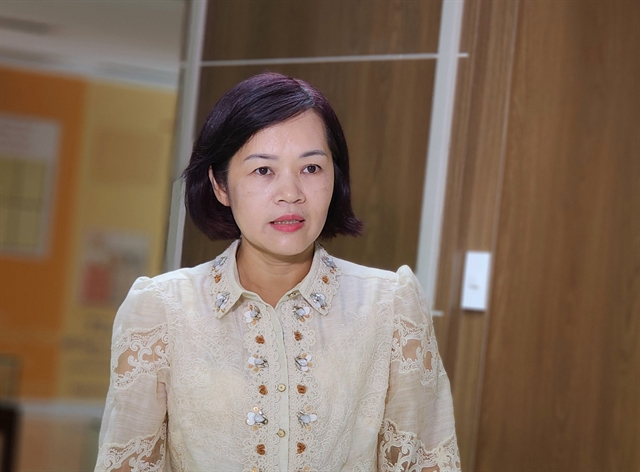
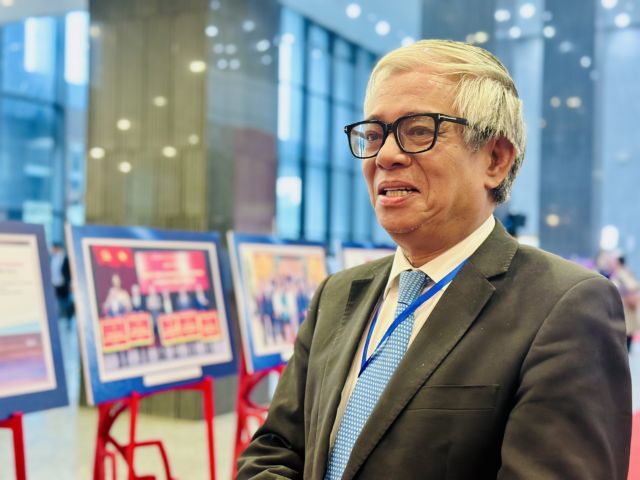
| Trần Việt Hoa, director of the National Archives Centre III. — VNA/VNS Photos Thanh Vân |
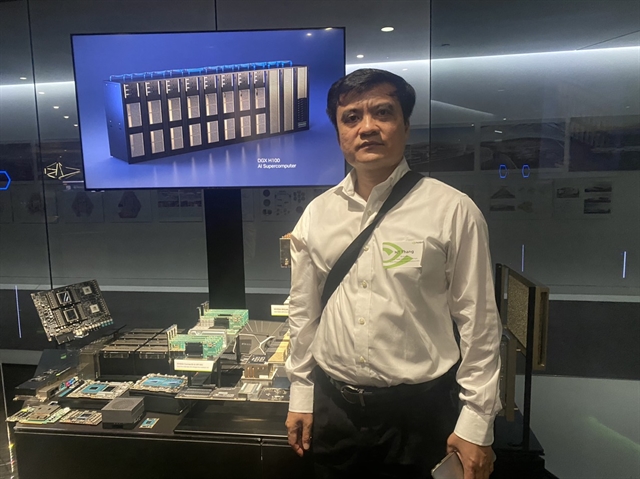
Trần Việt Hoa, director of the National Archives Centre III under the Ministry of Home Affairs' Bureau of State Records Management and Archives, speaks to Vietnam News Agency about the importance of archived records in the search for fallen solders’ identities.
Could you provide an overview of the archival materials related to fallen soldiers and soldiers from the North fighting in southern battlefields, which are currently preserved at the National Archives Center III?
The centre preserves a vast collection of records related to war invalids, fallen soldiers and soldiers from the North fighting in southern battlefields.
These include not just individual personnel files, but also official documents reflecting the Party's and the State's policies toward people with meritorious service over different periods, including many records demonstrating President Hồ Chí Minh's special attention to affairs concerning war invalids and fallen soldiers.
The collection is highly diverse, ranging from commendations and applications or certificates for recognition as fallen soldiers, to directives and verification documents issued by ministries, sectors and local authorities. These records show that the recognition process for fallen soldiers was previously conducted with great rigor through multiple levels of review.
For families, local authorities and Government agencies lacking sufficient or verified information about a fallen soldier, the National Archives Centre III serves as an important place to cross-check and verify information using original State archival records.
In support of the 500-day campaign to intensify the search, collection and identification of the remains of fallen soldiers, the centre has reviewed numerous archival collections related to fallen soldiers, military campaigns and key battlefields. Could you share the preliminary results?
The centre currently manages more than 400 archival fonds, or group of documents from the same source, containing nearly 14,000 shelf metres of records created by central Government agencies, ministries and organisations over different historical periods.
These archives document the Party's and the State's policies toward people with meritorious service, records recognising fallen soldiers, files related to the issuance of the 'Fatherland Acknowledges Your Sacrifice' certificate, commendation documents, materials on military campaigns and battles, wartime logistical support and the implementation of preferential policies.
For those awarded or posthumously awarded the title of Hero of the People's Armed Forces, the archives also preserve reports detailing their achievements and combat records, many of which are housed in the Presidential Office collection. These materials are valuable sources for research, cross-checking and verification.
Notably, the centre manages the files and personal belongings of about 72,000 northern soldiers fighting in the southern battlefields, including original documents such as personal biographies, personnel records, Party membership cards, transfer decisions, volunteer applications to serve in the South, diaries, letters, photographs, medals and decorations. These are invaluable sources for verifying information on fallen soldiers and their families.
Since the campaign was launched on March 15 at the request of the National Steering Committee for the Search, Collection and Identification of the Remains of Fallen Soldiers (Steering Committee 515) and other relevant agencies, the centre has reviewed around 100 paper files and photographic records from the National Assembly, Presidential Office, Prime Minister's Office and various ministries.
It has also cross-checked information related to major battles, including the Hồ Chí Minh Campaign, the 1968 Tết General Offensive and Uprising, and the 1972 Spring-Summer Campaign, to assist in verifying fallen soldiers' identities.
Following the initial review, the centre submitted three sets of archival materials to Steering Committee 515 for data analysis, including records related to identifying fallen soldiers buried in a mass grave at Lê Thị Riêng Park in HCM City.
We hope these archives will not only be safely preserved, but also fully utilised.
Every piece of information provided in a timely manner may become a crucial clue for authorities in verifying the identities of fallen soldiers and fulfilling the long-held wishes of their families.
How are fallen soldiers' records managed at the centre?
The records are not organised under a separate 'fallen soldiers' category. Instead, they are managed according to professional archival principles by the agency that originally created the records.
For example, files concerning the issuance of the 'Fatherland Acknowledges Your Sacrifice' certificate are preserved in the Prime Minister's Office or Government Office collections, because those agencies issued the decisions. Commendation records are stored within the archival collections of the relevant authorities.
Thanks to this systematic archival arrangement, although records are organised by fonds rather than by policy category, archivists can quickly locate the required files and accurately meet requests from both the public and Government agencies.
One case that has attracted significant public attention is the verification of the records of fallen soldier Huỳnh Văn Quên. Could you elaborate?
Because the archival collections have been scientifically classified and catalogued, the search process did not take much time.
When the centre received a request from Steering Committee 515 concerning personal belongings discovered in a mass grave at Lê Thị Riêng Park, our staff immediately searched the archival system.
In less than 15 minutes, we located a relevant file in the Prime Minister's Office collection containing multiple matching details.
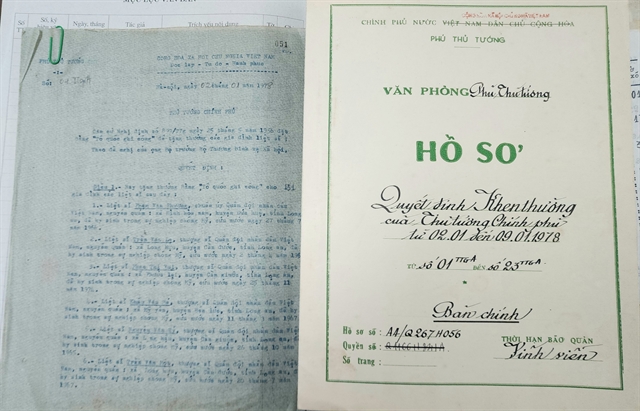
The file shows that on January 2, 1978, Prime Minister Phạm Văn Đồng signed Decision 04-TTgA awarding the 'Fatherland Acknowledges Your Sacrifice' certificate to 131 families of fallen soldiers.
On page five, item 41 lists Huỳnh Văn Quyên, a corporal of the Việt Nam People's Army from Đức Tân Commune, Tân Trụ District, Long An Province, who was killed in action on March 2, 1968.
The centre immediately forwarded this information to the Ministry of National Defence for further comparison with battlefield records and other archival sources.
Although the final conclusion on identity rests with the relevant authorities, locating the original record so quickly has provided an important additional basis for the verification process.
For archivists, every file found is more than a professional achievement. It represents renewed hope for families seeking information about their loved ones who have been missing for nearly six decades.
|
| A commendation file containing the Prime Minister's decision to award the 'Fatherland Acknowledges Your Merit' certificate to the families of fallen soldiers, including Decision 04TtgA honouring the family of martyr Huỳnh Văn Quên. |
Has the centre compiled statistics on the number of fallen soldiers' records it holds?
At present, we compile statistics according to archival standards by archival fonds, shelf length, number of files and number of pages rather than by the names of individual fallen soldiers.
However, it can be said that nearly all individuals officially recognised by the State as fallen soldiers and awarded the 'Fatherland Acknowledges Your Sacrifice' certificate have records preserved either at the centre or elsewhere within the national archival system.
Looking ahead, establishing a dedicated database of fallen soldiers' records is essential.
Instead of today's manual process involving identifying the year of sacrifice, locality and issuing authority before searching through the archival system, future searches will become much faster and more comprehensive.
How does the centre assist families searching for information about fallen relatives?
Around War Invalids and Martyrs' Day on July 27 every year, the number of search requests increases significantly. Aside from serving visitors directly at the reading room, the centre also receives inquiries via email, social media and other online channels.
Many families contact us seeking records related to people with meritorious service, including memorabilia, information on fallen soldiers, decisions awarding the 'Fatherland Acknowledges Your Sacrifice' certificate, medals and decorations.
In many cases, families provide only limited initial information. Our staff then promptly checks and cross-references the archives to determine whether relevant records exist.
Quite a few families have finally obtained information they had been searching for over many years.
For us, every recovered file is not merely an archival accomplishment, but also a meaningful contribution to easing the grief of families and honouring those who gave the ultimate sacrifice for the country.
What is the biggest challenge in making use of these archives?
The greatest challenge is that many records have not yet been digitised, meaning most searches still rely on manual methods.
Each request requires archivists to enter the repository, retrieve the original files, review folders one by one and examine individual documents to verify the information.
This is a time-consuming process requiring meticulous care and absolute accuracy, because the information is used to verify fallen soldiers' identities and resolve policies for people with meritorious service.
If the archives were digitised, searches would be much faster while reducing the need to handle original records, thus helping preserve them over the long term.
New technologies like artificial intelligence can support data processing, but final verification must still be carried out by professional archivists to ensure both accuracy and legal validity.
Accelerating digitisation has thus become an urgent priority to improve archival services and support identity verification.
What are the centre's plans for digitising these archival resources?
Digitisation is one of the centre's key priorities. Part of the records of northern soldiers fighting in the South has already been digitised in previous years, and work continues this year with the goal of completing the entire collection next year.
Some records related to fallen soldiers have also been digitised. However, digitisation is carried out by archival fonds rather than by separating fallen soldiers' files, so the workload remains enormous.
Once digitisation is completed and a unified database is established, searches will become much faster and more accurate.
This will not only improve the use of archival records, but also lay the foundation for a comprehensive database supporting the search, recovery and identification of fallen soldiers' remains, while enhancing the implementation of policies for people with meritorious service in the years ahead. — VNS
Opinion
 Opinion
 Opinion
 Opinion
 Opinion
 Opinion
 Opinion
 Opinion
 Opinion
 Opinion
 Opinion
 Opinion
 Opinion
 Opinion