 Opinion
VN-Index extends its losing streak to fourth day
1.
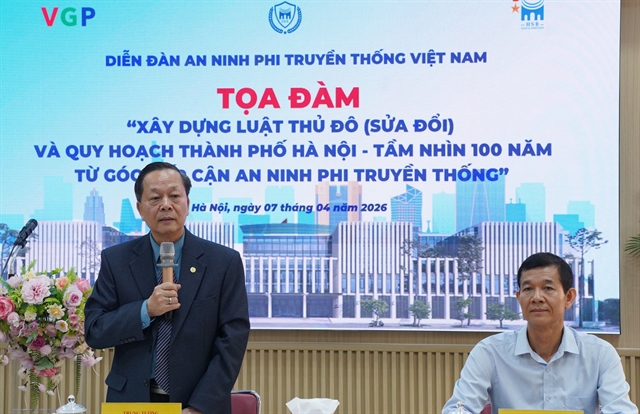 |
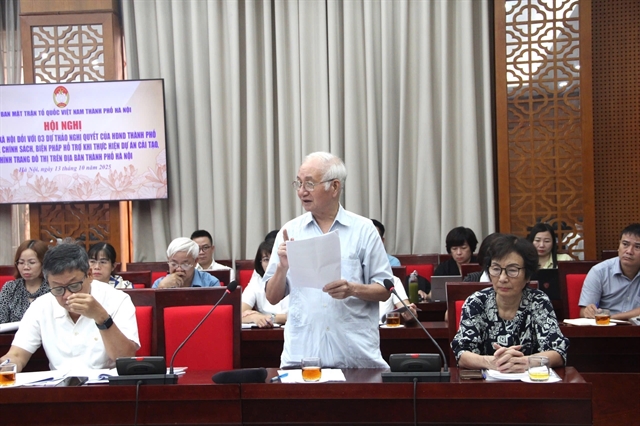
| Nguyễn Xuân Yêm (left), director of the Institute of Non-Traditional Security, speaking at the dialogue. — Photos courtesy of Vietnam Government Portal |
With Hà Nội’s ambitious 100-year master plan under review, experts are urging policymakers to move beyond conventional development thinking and ready the capital for deep uncertainty.
At a recent policy dialogue in Hà Nội, academics and urban designers argued that traditional planning methods are no longer sufficient and that growth alone will not do; resilience must guide the city’s future.
The discussion highlighted a shift in approach, moving from planning for steady expansion to planning for disruption and placing non‑traditional security at the heart of urban strategy.
Nguyễn Xuân Yêm, director of the Institute of Non-Traditional Security
The Capital Law has been approved and is being revised to grant greater authority to Hà Nội, enabling the city to take a more proactive role in its development. Many powers currently under the Government and the Prime Minister will be decentralised, allowing Hà Nội to make faster and more flexible decisions in managing socio-economic development, defence and security.
The draft law is being made public for consultation, including provisions on the authority of the municipal People’s Council and the Chairman of the People’s Committee.
At the same time, Hà Nội has approved a 100-year master plan identifying nine development poles, nine major centres and nine strategic corridors, aiming for balanced growth across the urban system. However, both the legal framework and the master plan must more deeply integrate security considerations, particularly to address four major challenges: urban overcrowding, traffic congestion, environmental pollution and flooding.
A key breakthrough lies in rethinking the administrative centre. The existing core should be preserved, but its role must be recalibrated in the context of super connectivity. The continued concentration of ministries and major institutions in the inner city has slowed the relocation of universities and hospitals, hindering the development of satellite areas.
Clarifying the orientation of administrative centres is essential for more balanced growth. At the same time, safety must be prioritised, particularly in flood prevention, with a shift toward large-scale, long-term solutions instead of fragmented measures.
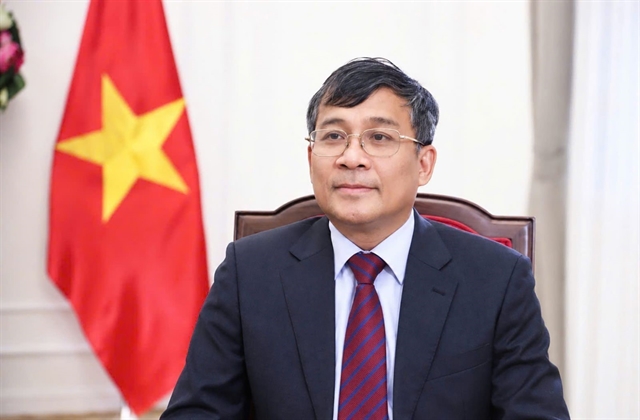
Mai Trọng Nhuận, former director of Vietnam National University, Hà Nội
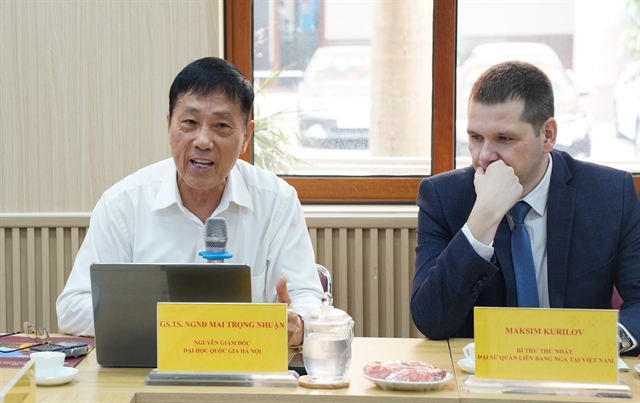 |
| Mai Trọng Nhuận (left), former director of Vietnam National University, Hà Nội. |
Hà Nội is located in an area with significant non-traditional security risks that are often underestimated in planning. Upstream hydropower dams can act as water bombs in extreme scenarios, while the city also lies along the Red River fault zone, where earthquake risks, though low, must still be considered.
In a context of growing uncertainty, traditional planning based on population or traffic forecasts is no longer sufficient, as such models cannot fully capture future disruptions.
Planning should instead focus on resilience, ensuring the city remains safe under extreme conditions rather than assuming risks can be avoided.
Several criteria should guide Hà Nội’s long-term development. Critical political and security infrastructure should be located in areas above 30 metres in elevation. Underground systems, especially metro networks, should serve both transport and emergency shelter functions.
At the same time, Hà Nội should preserve its historic core while restoring river systems to create a more water-adapted urban environment, alongside developing new administrative centres in areas such as Hòa Lạc or Ba Vì.
Overall, the city should move towards a multi-centre, multi-layered model to enhance long-term adaptability.
Trần Ngọc Chính, chairman of the Vietnam Urban Planning and Development Association
Hà Nội must be developed as a multi-functional capital, not only as a political centre but also as a hub for the economy, culture, science and international exchange. Its long-term vision should be a green, cultured, civilised, modern and happy city, with people at the centre.
However, key challenges such as flooding, traffic congestion and environmental degradation remain inadequately addressed. Urban flooding continues to affect transport, public health and the environment.
Traffic pressure is intensifying as the population nears ten million, with millions of vehicles on the road. Despite plans for an extensive metro system, progress remains slow. If the population reaches 20 million, the current model will not cope. A shift to high-capacity public transport and transit-oriented development is essential.
Satellite urban areas must be fully functional rather than dependent on the core. Environmental issues also extend beyond air pollution to water quality and waste, making the protection of river systems vital for sustainability.
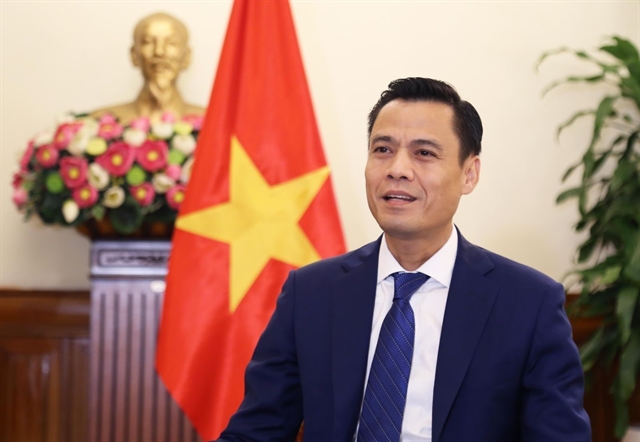
Đào Ngọc Nghiêm, vice chairman of the Vietnam Urban Planning and Development Association
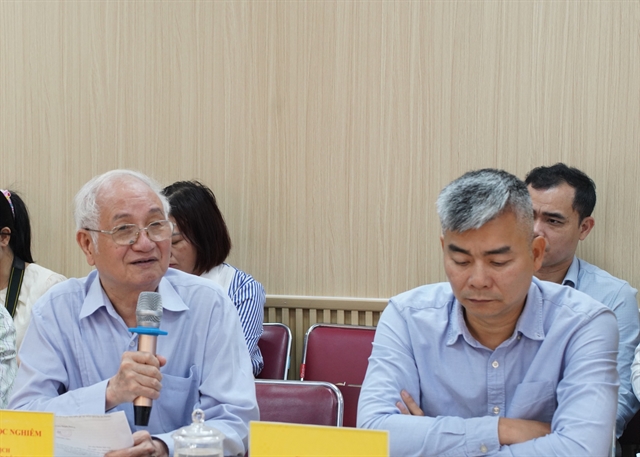 |
| Đào Ngọc Nghiêm (left), vice chairman of the Vietnam Urban Planning and Development Association. |
A significant step forward in the current master plan is the recognition of the Red River as the central landscape axis and a symbol of Hà Nội’s development, alongside growing attention to underground space planning.
However, non-traditional security issues, including climate change, water security, cybersecurity and underground safety, have not been fully integrated into planning frameworks.
Planning still focuses largely on traditional security, while non-traditional risks remain insufficiently defined. These concepts need to be translated into concrete urban design solutions.
Communication is also essential, as public understanding of new models such as multi-centre development and non-traditional security will be key to effective implementation.
Hoàng Đình Phi, rector of Hanoi School of Business and Management, Vietnam National University
Hà Nội’s underground infrastructure faces significant risks due to overlapping systems and a lack of coordination. Five critical systems, including flood drainage, wastewater treatment, water supply, electricity and telecommunications, are essential but under increasing pressure.
Without integrated planning and technical solutions, managing these systems will be costly and inefficient, with wastewater treatment alone potentially requiring billions of dollars.
If not properly coordinated, construction, operation and maintenance costs could escalate sharply. Addressing this challenge requires stronger coordination and learning from international experience.
Hà Nội is envisioned as a diverse ecological capital. As such, not all universities should be relocated. Those with long-standing traditions should be retained to sustain the vitality of the urban core.
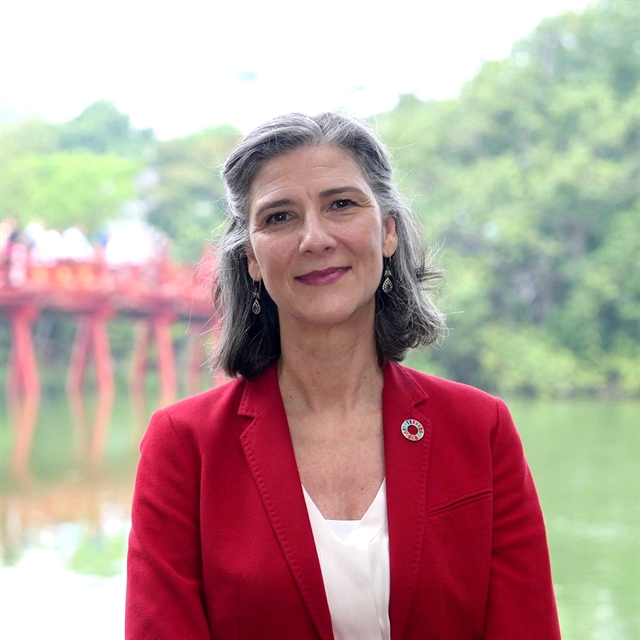
Maksim Kurilov, first secretary of the Russian Embassy in Việt Nam
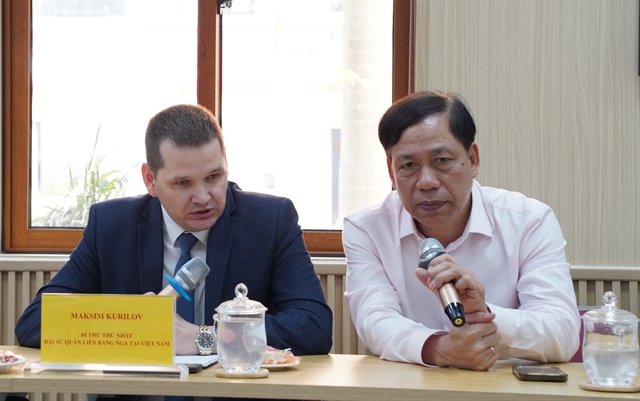 |
| Maksim Kurilov (left), first secretary of the Russian Embassy in Việt Nam |
Moscow provides an example of how a city can modernise while improving quality of life through effective planning.
Public transport, particularly the metro system, plays a central role, with high-frequency services allowing residents to travel efficiently without relying on private vehicles.
Smart city technologies, including monitoring systems and digital platforms, help improve urban management and public services.
These experiences offer valuable lessons for Hà Nội as it seeks to modernise its own infrastructure and governance systems.
Nguyễn Trung Dũng, Vietnam Institute for Urban and Rural Planning
Non-traditional security may be an abstract concept, but it requires concrete, physical solutions in urban planning. It is necessary to develop a dedicated system of infrastructure for safety and security, including emergency spaces, evacuation zones and facilities designed for both daily use and crisis response.
Urban planning must go beyond social and technical infrastructure to include security infrastructure as a core component.
In disaster scenarios, cities must have designated spaces for rescue operations, emergency gatherings and supply delivery, all of which need to be clearly integrated into spatial planning.
Early warning systems and response mechanisms must also be incorporated into urban design, rather than treated as separate or secondary considerations. — VNS
Opinion
 Opinion
 Opinion
 Opinion
 Opinion
 Opinion
 Opinion
 Opinion
 Opinion
 Opinion
 Opinion
 Opinion
 Opinion
 Opinion
 Opinion