 Life & Style

HKUST President Prof. Nancy IP Receives UNESCO–Equatorial Guinea International Prize for Research in Life Sciences
1.
|
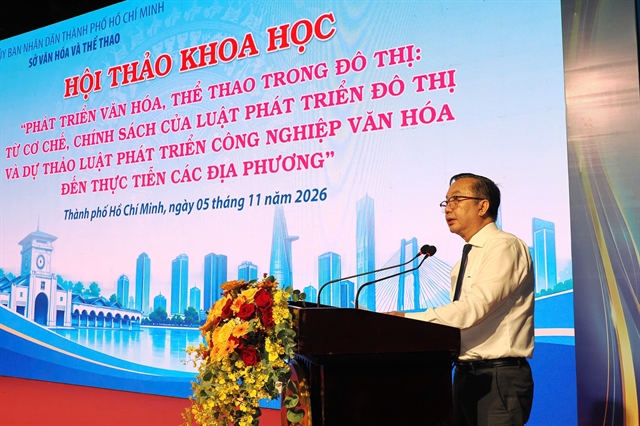
| Trần Thế Thuận, director of the HCM City Department of Culture and Sports, speaks at the workshop. —Photo sggp.org.vn |
HCM CITY — HCM City needs to further refine its institutional framework and make better use of urban space and resources to support the development of culture and sports, experts and policymakers have said.
Despite the city's strong economic and cultural growth, infrastructure for cultural and sporting activities has yet to keep pace with its rapid urban expansion.
Lê Văn Thái, deputy director of the municipal Department of Culture and Sports, said the shortage of grassroots cultural and sporting facilities remained a major challenge, particularly as public land had become increasingly scarce.
The proportion of wards and communes with standard cultural and sporting facilities remains below national targets, highlighting the need for new mechanisms to integrate cultural and sporting development into urban planning, according to Thái.
The issue is not simply a matter of capital, but also reflects the lack of sufficiently strong and coherent legal foundations linking urban infrastructure planning with the development of cultural and sporting ecosystems.
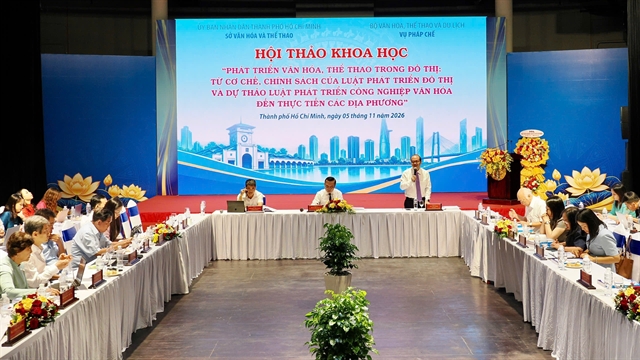
The issue was discussed at a scientific workshop held in HCM City on November 5 by the municipal Department of Culture and Sports and the Ministry of Culture, Sports and Tourism's Department of Legal Affairs.
The event, entitled “Developing culture and sports in urban areas: From mechanisms and policies under the Law on Urban Development and the draft Law on Cultural Industries Development to local practice”, was part of activities marking Việt Nam Culture Day on November 24.
Thái said the recently enacted Law on Urban Development would provide greater authority to municipal People's Councils and People's Committees in areas including land-use planning, underground and elevated spaces, transit-oriented development, public asset management, the night-time economy and cultural and sporting complexes.
Meanwhile, the draft Law on Cultural Industries Development was expected to provide a more comprehensive framework for creative infrastructure, finance, taxation, investment incentives and intellectual property protection.
The two legal frameworks would offer significant opportunities but also require authorities to identify overlaps, gaps and differences in jurisdiction to ensure consistency and feasibility at the local level, he said.
Participants at the workshop called for closer coordination in applying relevant laws and for the draft law on cultural industries to be made compatible with the Law on Urban Development.
|
| Participants attend a scientific workshop on developing culture and sports in urban areas in HCM City on November 5. —Photo sggp.org.vn |
They also proposed policies for multi-purpose sports infrastructure and the night-time economy, as well as new approaches to land-use planning for cultural and sporting spaces in densely populated urban areas.
Dr Nguyễn Thị Hiền Thanh of Hoa Sen University said the sports economy and cultural industries increasingly intersected in urban spaces.
While major sporting events could generate considerable economic benefits and promote tourism, their long-term impact on local culture had not always been adequately assessed, she said.
Thanh suggested that the city digitalise input data and improve its legal framework to make better use of resources generated by sporting facilities and events.
Other experts proposed integrating heritage, sports and the circular economy into digital experience ecosystems, using technology and gamification to turn conservation and environmental values into new economic resources.
Noise pollution was also identified as a key policy challenge, with participants calling for a clearer legal framework to balance the development of the night-time economy with residents' quality of life.
Dr and Meritorious Artist Lê Nguyên Đạt, vice rector of the HCM City University of Theatre and Cinema, proposed measures to remove bottlenecks facing traditional performing arts and help bring them closer to younger audiences, particularly in schools.
He said stronger cooperation among the State, businesses and communities would be essential to mobilising and using urban cultural resources effectively.
Phạm Cao Thái, director of the Ministry of Culture, Sports and Tourism's Department of Legal Affairs, said the workshop's recommendations were practical and addressed pressing socio-economic issues.
Authorities would continue reviewing relevant regulations to ensure consistency and avoid overlaps among legal documents, he said.
Closing the workshop, Trần Thế Thuận, director of the HCM City Department of Culture and Sports, said discussions had highlighted the potential of cultural spaces as resources for the creative economy, while also addressing emerging urban management challenges.
The organisers identified seven major areas for further consideration, including the night-time economy, traditional arts, sports and the application of virtual reality technology.
Based on the recommendations, the department would focus on four priorities: improving legal mechanisms, restructuring cultural institutions, building a cultural industry ecosystem, and developing policies to train and attract talent in culture and sports.
The proposals would also be submitted to the Ministry of Culture, Sports and Tourism to support the completion of the draft Law on Cultural Industries Development. — VNS
Life & Style
 Life & Style
 Life & Style
 Life & Style
 Life & Style
 Life & Style
 Life & Style
 Life & Style
 Life & Style
 Life & Style
 Life & Style
 Life & Style
 Life & Style
 Life & Style
 Life & Style