 Life & Style

Malaysia Secures 20 Recognitions, Including Eight Category Wins, At ASEAN Energy Awards 2026
1.
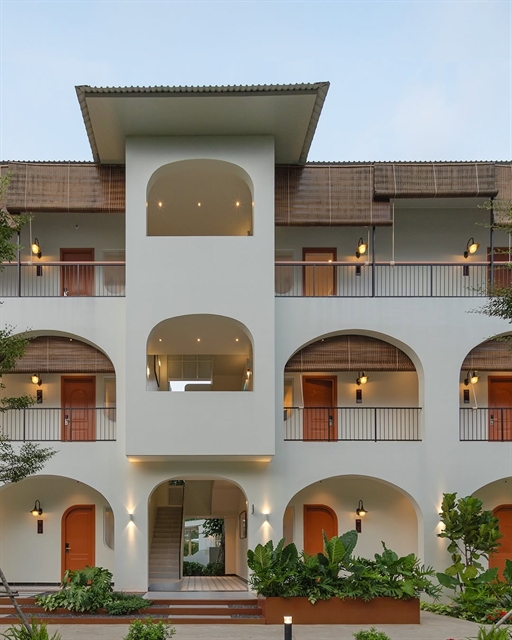 |
| Sadec Garden Boutique Hotel blends contemporary tropical design with the timeless elegance of Indochine architecture. — Photo courtesy of the hotel |
Mia Hoang
In my mind, Sa Đéc had always been inseparable from the French film L'Amant (1992), the story of a forbidden romance between a Chinese businessman and a young French girl.
Adapted from Marguerite Duras’s 1984 autobiographical novel, it was also the first international film shot in Việt Nam after reunification, helping to introduce the country's tourism potential to the world.
Beyond that, I can't say I knew much about Sa Đéc, or that it had ever made it onto my travel list. Still, I've learned that saying yes to an invitation, especially one that leads somewhere off the beaten path, rarely disappoints.
Three hours, one bánh mì and a cà phê sữa đá (iced coffee with milk) later, we arrived in Sa Đéc. On a sunny July weekend, the town wasn't crowded, but it was fully awake. We walked through a small wet market, exchanging greetings with the aunties, before eventually arriving at Sadec Garden Boutique Hotel, tucked away in this historic town.
Described as a peaceful retreat “where time slows”, Sadec Garden draws its inspiration from the romance and elegance of L'Amant. Yet the story reaches beyond the film itself. There's another invisible thread linking the French romance to the hotel: its founder, a Hanoian, has a love story of her own, having met her Vietnamese-French husband while studying in France.
That cross-continental journey perhaps explains both the hotel's aesthetic sensibility and its thoughtful approach to hospitality.
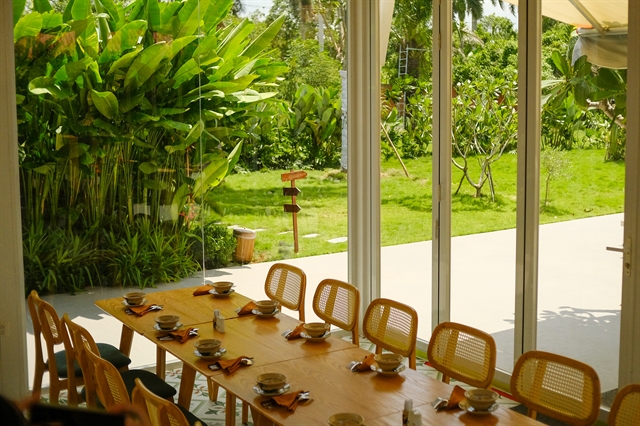 |
| A veranda framed by floor-to-ceiling windows offers generous views of the pool garden, blurring the line between indoors and the lush landscape beyond. — Photo courtesy of the hotel |
For its scale and location, I wasn't expecting five-star treatment, but that's exactly what we got. We were welcomed with house-made butterfly pea tea and a cold towel before stepping into a garden oasis, where contemporary tropical architecture meets Indochine-inspired design. White walls, graceful arches, warm timber details and abundant greenery made the space feel airy and quietly elegant.
First impressions
L'Amant, the hotel's restaurant, feels like the signature expression of this vision. White and sage green soften the space, while a veranda framed by floor-to-ceiling windows offers generous views of the pool garden, blurring the line between indoors and the lush landscape beyond.
Our room was compact but thoughtfully equipped with everything we needed. In fact, I had been told before arrival that I wouldn't need to bring anything besides my clothes. Comfortable bedding, sunlit windows, bathrobes and amenities, a hairdryer and even a nón lá (traditional palm-leaf conical hat) were all there, like an invitation to experience the textures of the Mekong Delta countryside.
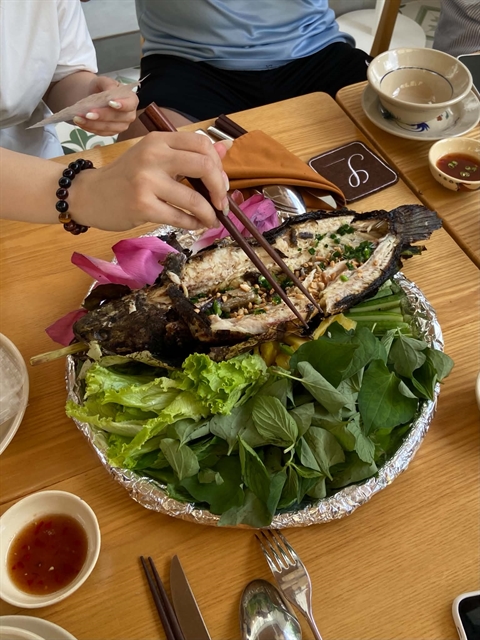 |
| Grilled snakehead fish with aromatic herbs wrapped in rice paper is a signature dish of the Mekong Delta. — VNS Photo Mia Hoang |
Huỳnh Thủy Lê Ancient House is a fitting place to begin, as it is one of the remaining homes of the Chinese businessman who inspired the real-life story behind L'Amant.
The residence is a conversation between cultures: a Chinese façade, a traditional Vietnamese three-bay structure and French interior elements all exist under one roof. Gold-carved details, dark wooden cabinets, intricate mother-of-pearl inlays and patterned Indochine tiles all reward a slower gaze.
The same could be said for the roads outside. We spent the afternoon cycling through the town's flower villages, where endless rows of marigolds, bougainvillea, bonsai and other ornamental plants stretched as far as the eye could see. I found myself mumbling "wow" every few minutes.
After spending most of my days looking at a screen, my eyes felt almost overstimulated — in the best possible way — by the abundance of textures around me: the breeze, sunlight dusting the river with specks of gold and tree canopies meeting overhead like natural archways. At one point, I remember thinking it felt like cycling through a scene from Call Me by Your Name. Only this wasn't northern Italy; it was the Mekong Delta.
Then came a sound I hadn't heard in years.
Somewhere between the nurseries and the narrow village roads, the public address loudspeaker stirred a wave of nostalgia. Growing up, it was the soundtrack to my mornings before gradually fading from modern life. The sound was never particularly pleasant. Yet hearing it again, in a town where life still follows its own unhurried rhythm, felt strangely comforting.
Where time slows
Light, too, becomes part of the texture: sunlight dusting the river surface, beams filtering through the branches. By the time we returned to the hotel, the sky had softened into a spectrum of purple and orange and the heat had subsided. Staff had moved the dining tables to the poolside, dressing them with candles and fresh flowers before dinner unfolded beneath an open sky.
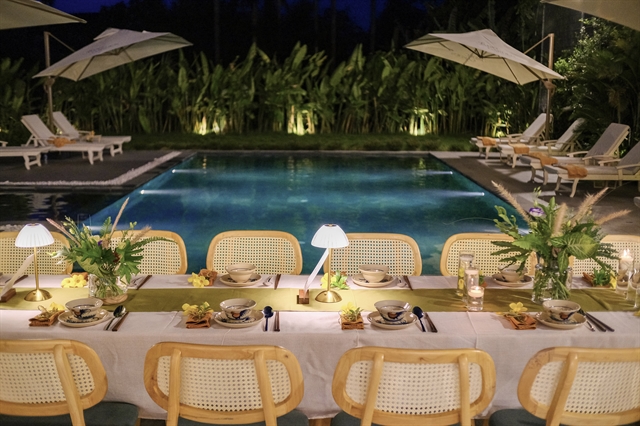 |
| By the time the sky had softened into a spectrum of purple and orange and the heat had subsided, the dining tables had been moved to the poolside and dressed with candles and fresh flowers for dinner beneath the open sky. — VNS Photo Mia Hoang |
Somewhere between giggles, sticky BBQ wings and a fiercely competitive round of Ludo, I happily lost to a nine-year-old.
By the time I headed back to my room, another surprise was waiting. The curtains had been drawn, the night lamps were on, and on my bed rested a handwritten note alongside a small portion of lotus seeds. It was a local bedtime ritual I hadn't known about until that evening.
Sometimes, luxury comes in details you would never think to ask for.
We left Sa Đéc the next day carrying little more than a few photos, a bag of local rambutan and a newfound appreciation for a town that rarely makes it onto travel itineraries.
And perhaps that's what "where time slows" really means: a place where everything in this Mekong Delta town asks to be noticed. — VNS
Life & Style
 Life & Style
 Life & Style
 Life & Style
 Life & Style
 Life & Style
 Life & Style
 Life & Style
 Life & Style
 Life & Style
 Life & Style
 Life & Style
 Life & Style
 Life & Style
 Life & Style