 Life & Style

Việt Nam seeks to modernise state audit amid emerging challenges
1.

|
| A stilt walking performance combined with a dragon dance in Hải Xuân Commune, Ninh Bình Province. — VNA/VNS Photos Công Luật |
NINH BÌNH — Along Ninh Bình's long coastline, generations of coastal communities have developed ingenious ways of working in harmony with nature, among them the art of stilt walking.
Originally a practical tool that enabled fishermen to move easily across tidal mudflats while harvesting aquatic resources, stilts gradually evolved into a distinctive cultural tradition, reflecting the creativity, diligence and resilience of the region's coastal people.
Working tool
The origins of stilt walking are closely tied to the need for coastal communities to adapt to the unique landscape of tidal flats.
According to Nguyễn Quang Hải, a member of the Hải Tiến Commune Stilt Walking Team, its use first appeared in the 1960s, when fishing equipment and tools were still rudimentary.
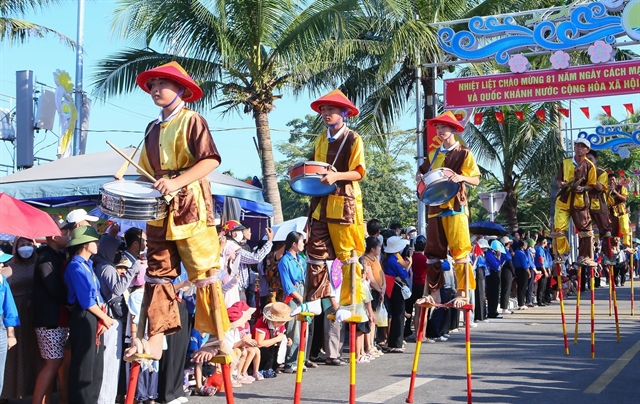
|
| Villagers walk on stilts while playing drums. |
Though simple in design, each pair of stilts is carefully crafted. They are typically made from mature bamboo or sturdy timber, measuring two to three metres in length, with footrests fixed about 1.5-2 metres above the ground to suit different tidal levels and allow ease of movement across the mudflats.
On the stilts, locals could move more quickly and steadily across the tidal flats, helping them haul nets, cast nets and catch fish.
Today, despite the widespread use of modern fishing equipment and tools, stilts remain part of the livelihoods of many coastal fishermen.
For coastal communities, stilts were once an important means of reaching deeper into tidal flats and expanding the areas where they could harvest aquatic and marine resources.
However, mastering these unusual tools requires considerable practice. Users first have to become accustomed to walking on stilts on dry land, before learning to keep their balance in moving water, on soft, sinking mud and amid waves.
After learning to master the stilts step by step, residents are able to move around while carrying out their work more effectively.
Stilts are not just a working tool. They have increasingly evolved into a distinctive form of performing art. In Hải Xuân Commune, a stilt-walking team of around 30 members maintains regular training and mobilises social resources to invest in costumes and props, gradually improving the quality of its performances.
Standing on their wooden stilts, team members perform a variety of acts, including fan, flag and lion dances, dragon dances and martial arts. The performances require considerable skill, physical strength and close coordination, helping highlight the distinctive cultural identity of the region’s coastal communities.
Team captain Nguyễn Văn Đoán, 50, said he remains passionate about stilt walking after around 30 years of practising it.
Đoán said around 70 per cent of people in the commune in his generation knew how to walk on stilts. The image of fishermen carrying their fishing gear and striding across the tidal flats on wooden stilts is closely associated with their livelihoods, and also reflects the creativity and perseverance of coastal communities in adapting to nature.

|
| Stilt walking has become part of the cultural life of coastal communities in Ninh Bình Province. |
Coastal culture
Local stilt-walking artisans have also actively taught the skills to younger generations while leading teams in performances at various events and festivals, helping to preserve the art as part of community cultural life.
Đoán said the enduring appeal of stilt walking has been reinforced by growing public interest. In recent years, the team has received a steady stream of invitations to perform at various cultural events in Ninh Bình and even as far as Huế City.
Most recently, at the traditional cultural festival in the Hải Hậu area marking National Day on September 2, the team’s stilt-walking performances made a strong impression and drew an enthusiastic response from large crowds.
Meanwhile, a growing number of students in the commune have been introduced to the art form. After more than a year of training, they are able to walk confidently on stilts and incorporate the skill into performances.
“I have been practising stilt walking for more than a year,” said Nguyễn Hoàng Hơn, a seventh-grade student at Hải Xuân Commune Secondary School. “Now I can use the stilts confidently, moving around while performing flag dances or lion, lioness and dragon dances.”
According to Hơn, maintaining balance is the most difficult part of learning to walk on stilts. Beginners usually need nearly a month of practice, with quite a few falls, before they can stand steadily and walk proficiently. Once Hơn mastered the stilts, he found the activity increasingly enjoyable and exciting.
Efforts to preserve the unique art are no longer limited to localities with a longstanding tradition, but are expanding among coastal communities in Ninh Bình Province.
In Giao Phúc Commune, a stilt-walking club was established in August with 20 members, all of whom are current or former fishermen. The club provides a gathering place for people who share a passion for the art while helping preserve and pass on the skill to future generations.
Training sessions are held regularly at weekends for members to improve their skills and prepare for performances at local cultural and sports events and on major holidays.
According to Trần Văn Ngọc, vice chairman of the Giao Phúc Commune People’s Committee, stilt walking has become a cultural tradition closely intertwined with the lives of coastal residents.
“The local authorities are committed to maintaining the stilt-walking team’s activities and facilitating training and performances, thus helping preserve traditional values and create a lively atmosphere at community events,” he said. — VNS
Life & Style
 Life & Style
 Life & Style
 Life & Style
 Life & Style
 Life & Style
 Life & Style
 Life & Style
 Life & Style
 Life & Style
 Life & Style
 Life & Style
 Life & Style
 Life & Style
 Life & Style

.jpg)




