 Life & Style

Vietnamese Prime Minister meets Cambodian National Assembly President
1.
|
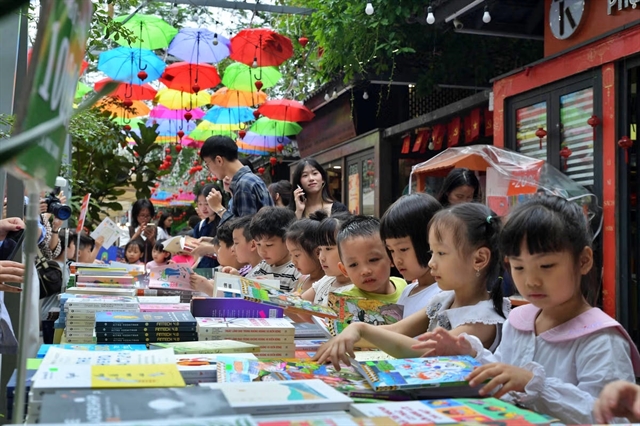
| Children browse books at a reading event in Hà Nội. As digital entertainment becomes increasingly accessible, initiatives that encourage reading continue to play an important role in fostering imagination, curiosity and a lifelong love of books among young readers. — Photo daidoanket.vn |
HÀ NỘI — As smartphones, games and online content increasingly compete for children's attention, writers are exploring new ways to ensure books remain meaningful companions.
They beleive children's literature still holds a unique power to spark imagination, nurture empathy and inspire dreams that no screen can fully replace.
In today's digital world, children have more entertainment choices than ever before. With just a few taps on a smartphone, they can access videos, games and an endless stream of online content.
The shift has inevitably created new challenges for children's literature. Yet many writers believe technology itself is not the reason children are turning away from books. Instead, the question is whether authors and adults truly understand the interests and emotional needs of a new generation of readers.
Poet Lữ Mai believes children's literature must evolve alongside changing reading habits. Rather than competing directly with technology, books should offer experiences that remain difficult to replace.
According to her, contemporary children's books need to be more visually engaging, more interactive and more closely connected to issues that matter to young readers today, from friendship and family to nature, compassion and the challenges of growing up in a digital environment.
She also encourages writers to embrace new storytelling formats, including picture books, audiobooks and animated adaptations, allowing literature to reach children in different ways while preserving its core values.
Author Phụng Thiên shares a similar perspective. While attractive illustrations, interactive elements and digital editions can help books appeal to modern readers, he believes the true strength of literature lies elsewhere.
"Children's literature should become a companion that helps young readers balance the digital world with the world of dreams and imagination," Phụng says.
|
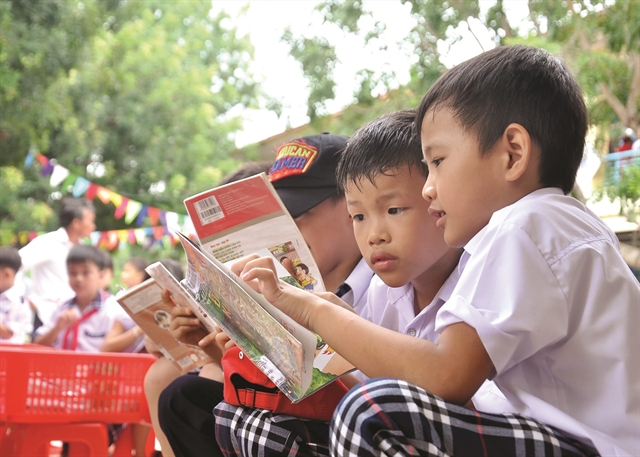
| Schools in Quảng Nam Province are promoting reading culture through daily activities integrated into teaching and learning. Such programmes help cultivate reading habits and strengthen children's connection with books from an early age. — Photo baodanang.vn |
Planting dreams through stories
Despite the growing influence of technology, writers remain committed to creating stories that do more than entertain. Children's literature, they say, should help young readers develop emotionally, cultivate empathy and discover the joy of imagination.
For Phụng Thiên, imagination is one of the greatest gifts literature can offer. Through stories, children can explore new worlds, expand their understanding and believe in possibilities beyond their everyday experiences.
Every book, he says, has the potential to become a gateway to discovery, encouraging children to dream and shape their own futures.
Lữ Mai, meanwhile, hopes her writing can help children develop kindness and an appreciation for the beauty of ordinary life.
"I want children to understand that the world is shaped not only by great achievements but also by small, familiar and ordinary things," she said.
"In many of my works, I try to plant seeds of love for one's homeland, nature and gratitude. Children who learn to appreciate people and life will grow up with a stronger sense of responsibility and compassion."
A lasting role in a changing world
As technology continues to transform childhood, children's literature is adapting to new realities. Yet its fundamental purpose remains unchanged: to inspire curiosity, nurture empathy and enrich young minds.
The conversation also reflects broader efforts to strengthen Việt Nam's cultural and creative sectors. Under the orientation of the Politburo’s Resolution No 80-NQ/TW, culture is increasingly recognised as a source of national soft power and sustainable development. Encouraging reading among young people and supporting quality literary works are important steps in nurturing future generations of readers, thinkers and creators.
In a fast-changing world, books continue to offer something timeless - a place where imagination can flourish, dreams can take shape and children can learn not only how to understand the world around them, but also how to imagine a better one. — VNS
Life & Style
 Life & Style
 Life & Style
 Life & Style
 Life & Style
 Life & Style
 Life & Style
 Life & Style
 Life & Style
 Life & Style
 Life & Style
 Life & Style
 Life & Style
 Life & Style
 Life & Style