 Life & Style
Hà Nội adorned in red ahead of Liberation Day
1.
|
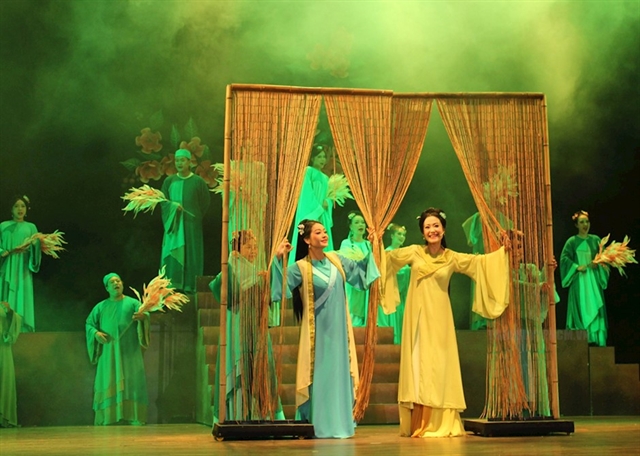
| They play “Dưới bóng giai nhân” tells a different story about the life of Kiều. – Photo hcmcpv.org.vn |
HCM CITY – As artificial intelligence (AI) increasingly finds its way into artistic production, Vietnamese theatre practitioners are questioning whether technology can match the emotional depth and lived experience at the heart of performance.
AI is demonstrating an almost comprehensive level of involvement across the entire production chain of artistic work.
The Authors’ Branch of the HCM City Theatre Association recently discussed the issue of “AI participating in the creative process”.
At present, AI is no longer confined to the digital environment; AI-generated products have begun appearing in literary and artistic competitions.
A “misalignment”
AI can write a complete script in a matter of minutes, but can it create a “theatrical life”?
Addressing this question, Associate Professor Dr Phan Bích Liên at Văn Lang University emphasised that while AI can provide structure and even build fairly logical character arcs, theatre does not operate on pure logic.
It requires lived conflict and real-life experience, something technology has yet to reach.
From another perspective, People’s Artist Trần Minh Ngọc noted that theatre has undergone many technological transformations, from lighting and sound to staging techniques, yet its core remains human. If a script loses the breath of real life, theatre becomes merely a form of simulation.
“AI cannot express emotionally rich language born from the vibrations of the human heart. In traditional forms such as tuồng, chèo, cải lương, and opera, AI cannot compose in accordance with the structural nuances of each line and lyric,” he said.
In practice, many current literary and artistic competitions have refused entries involving AI. Some platforms are more open, allowing its use but requiring clear disclosure of the level of technological involvement.
Author Trần Văn Hưng, head of the Authors’ Branch, noted that works overly dependent on AI often reveal weaknesses, including a lack of depth, repetitive structures, and impersonal language.
Particularly in Vietnamese, a language rich in tone and nuance, this “misalignment” becomes even more apparent.
Author Vương Huyền Cơ shared: “A good script always has its own identity. Readers can recognise the author through the way situations are constructed, through dialogue rhythms, and through the handling of conflict. AI can imitate, but it cannot yet create a personal imprint.”
Author Lê Thu Hạnh added: “If AI is overused, writers will gradually lose their own voice. Creativity then becomes an act of borrowing.”
Musician Lê Văn Lộc, a member of the Arts Council under the HCM City Department of Culture and Sports, added that in several recent music competitions, AI-assisted works were accepted but failed to leave a mark. In some cases, they were even judged as “off-topic” and lacking emotion.
|
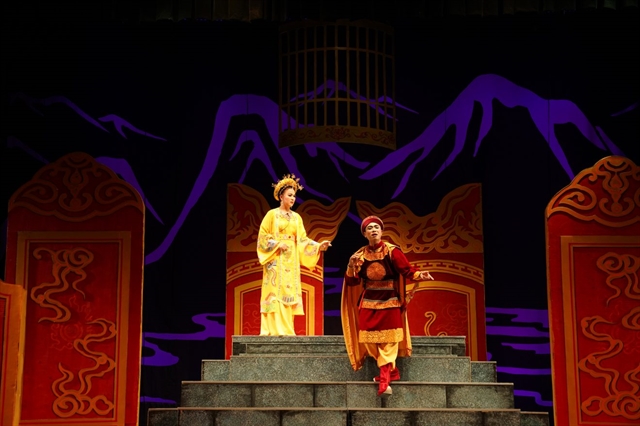
| A scene from the play “Làm vua” by the Việt Nam Tuồng Theatre, which won the A Prize in the Stage Performance category in 2021. – VNA/VNS Photo |
What cannot be programmed
In music, many experts point out that AI often struggles with Vietnamese, easily falling into the trap of “forcing words into melody”, resulting in unnatural lyrics.
When applied to theatre, where dialogue is highly conversational, this limitation becomes even more pronounced.
Director Tôn Thất Cần analysed that Vietnamese theatre has its own distinct characteristics. From cải lương to spoken drama, each genre possesses its own rhythm, tempo, and expressive style.
AI can construct a script framework, but to create a performance layer with true rhythm and flow requires lived experience.
This explains why, despite being permitted for experimentation, AI-assisted works have yet to win over judging panels or audiences. It is not because the technology is weak, but because it lacks the human element in the creative process.
Theatre is a unique art form. It brings together script, performance, lighting, and music into a vivid, live moment before an audience. A line may be written by AI, but for it to resonate, it needs actors, emotion, and the synergy of stage space.
Many artists believe AI cannot replace humans in this field.
It may support, suggest, and even open new directions. But to create a work with lasting vitality still requires experience, memory, and emotion, things that cannot be programmed.
The emergence of AI is not merely a technological phenomenon.
It is compelling creators to reflect on themselves: What is the core value of an artistic work? Where does the role of the artist lie in the digital age? And more importantly, how can creative identity be preserved?
AI may produce a “structurally correct” script or a “formulaically correct” piece of music, but as practitioners affirm, art has never been about correctness alone. It needs surprises, moments even the creator cannot foresee.
AI has stepped onto the stage, whatever its role may be. Its presence will undoubtedly continue, even deepen.
Yet ultimately, theatre remains a place where humans tell their own stories through their own emotions. – VNS
Life & Style
 Life & Style
 Life & Style
 Life & Style
 Life & Style
 Life & Style
 Life & Style
 Life & Style
 Life & Style
 Life & Style
 Life & Style
 Life & Style
 Life & Style
.jpg) Life & Style
Life & Style
 Life & Style



