 Life & Style
SBV to curb property price inflation, enforce lending rate rules
1.
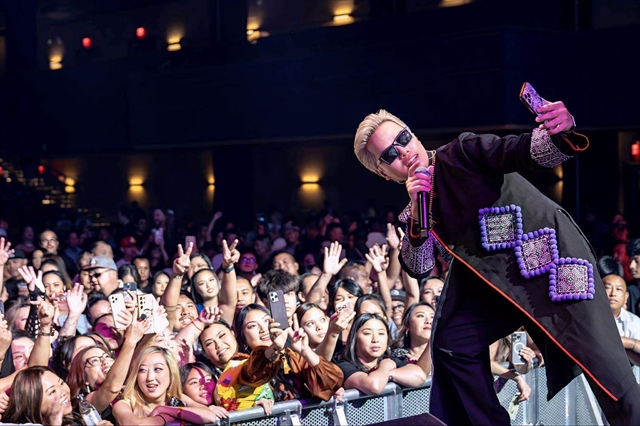 |
| NT One performs at Sabaidee Fest – the largest Southeast Asian music and cultural festival in the U.S. – Photo courtesy of Sabaidee Fest |
By Trần Khánh An
a small studio tucked inside an apartment block in Hà Nội, an unusual scene unfolds as the sound of a traditional Hmong flute and khèn drifts through the room, merging with the pulse of digital beats and the rapid flow of rap verses in Hmong.
Here, three young independent Hmong artists – NT One, THEENG VANG and Ly Mí Cường – usually gather to create new music.
Yet behind the sound lies a quiet paradox: they are writing and performing in a language that many in their generation, including themselves, no longer speak daily or fully understand.
Still, that gap has not dulled their drive to be proudly Vietnamese Hmong through music.
A name, a pride in roots
For some artists, a stage name reveals the reason their journey began.
Cường was originally named Ly Minh Cường, a name that sounds more typical among the Kinh majority in Việt Nam. Like many Hmong families, his parents chose a name that would make it easier for their child to fit into the majority.
However, when he began making music, the young instrumentalist chose to perform as Ly Mí Cường, adopting a familiar Hmong middle name. The name instantly signals his Hmong roots, marking a quiet but deliberate return to his heritage.
NT One chose to carry his homeland in his stage name. The letters NT stand for nhất, one in Vietnamese, and together with ‘One' they form the number 11, the licence plate code of Cao Bằng Province, where he was born.
These choices, though personal, reflect a shared sense of pride in roots among these Hmong artists.
With THEENG VANG, a Hmong artist from Cao Bằng Province, that pride also became the starting point of his musical journey.
"The Hmong people don't live only in Việt Nam," THEENG VANG said. "We're part of a global community, with many living in the U.S., Laos and Thailand. For us, Vietnamese Hmong culture is incredibly diverse."
Việt Nam is home to more than one million Hmong people, making it the world's second-largest Hmong population. Over centuries of migration, the community has evolved into multiple subgroups spreading across provinces, each with its own dialects, clothing and customs.
"Among the Hmong, each clan, province or region, even each subgroup, has its own distinct features," Cường said. "It's the subtle differences that make our heritage so diverse."
These subtle differences form a rich cultural mosaic, yet they rarely find their way into mainstream narratives.
"In other countries, the Hmong music scene is thriving, while in Việt Nam, only a few artists have been active – to the point that some Hmong abroad didn't even know Hmong people live here," THEENG VANG said. "That's what drives me to carry local stories into my music and share them with young audiences in Việt Nam and abroad."
From forgotten words to living music
What began as simply making the music they loved soon exposed a harsh reality: they did not fully understand their mother tongue.
"My biggest challenge, and ours probably, is the language itself," THEENG VANG said. "Since I studied at boarding school from grade 6 to grade 12, I did not get to speak Hmong often. Over time, my connection to the language became limited."
His experience reflects a broader reality among some young Hmong today.
Traditionally, Hmong communities live high in the mountains, shaping a way of life deeply connected to the forests. Growing up in these remote areas, many Hmong children leave their villages to attend boarding schools far from home – one of several shifts shaping how they engage with their native tongue. While studying in Vietnamese opens up educational opportunities, it also means children speak Hmong less in daily life.
Cường pointed to a deeper loss than just everyday speech: "Many no longer understand the meanings behind the old Hmong riddles and proverbs."
"We call it figurative language, a poetic way of speaking, even when the story itself is simple. Now, many of those words have faded and only the elders know them."
Refusing to let language barriers dull his passion, THEENG VANG and his peers turn to traditional sources, Hmong-speaking films and village elders, gradually rebuilding their language. They also rediscover Hmong customs to weave into their music videos.
"Making music drove me to explore more about my own people and identity on a deeper level," he said.
These artists blend Hmong cultural elements and narratives with contemporary musical styles, including rap, creating music that resonates with and is shared by younger audiences.
The influence is immediate, as a wave of standout releases has brought wider attention. Among them, Baby Xav Ntsib Koj (Baby I Wanna Meet You) has amassed more than 7.5 million views on YouTube three years after its release.
"It's becoming one of the most well-known love songs among Hmong audiences worldwide," THEENG VANG said.
Txhob Xaiv Xaiv (Don't Be So Picky), a collaboration between Hmong-American artist NewSONG and THEENG VANG, became a TikTok sensation with more than 170,000 videos created using the track.
Beyond the numbers, these songs not only spark a renewed sense of pride among young Hmong but also bring the language back into everyday listening.
"Through the songs, young Hmong start discovering words they never knew before," THEENG VANG said. "Some tell us, 'I only understand half of the lyrics, but I love listening to your songs.'"
"Even young listeners from Tày, Dao or Kinh communities enjoy our songs, sparking curiosity about Hmong people. I have come to realise that music has become a medium to preserve, celebrate and reimagine our heritage in a more meaningful way," he concluded.
Carrying the homeland onto global stages
NT One said his stage name also reflects his personal journey, as he has often felt like "the first and only one" – the only child in his family, the first in his village to attend college and among the first Vietnamese Hmong to pursue rap in his own language.
"Back then, I felt like I was the loneliest," he said with a chuckle.
After a decade pursuing music, he may have been one of the first, but he is no longer alone.
Alongside a growing circle of peers, he has taken his music beyond Việt Nam, performing for Hmong audiences in the US, China, France, Thailand and Laos.
He appeared at major music events, from Sabaidee Fest, the largest Southeast Asian music and cultural festival in the US, to the Hmong New Year Festival in southern France.
The reception, especially in the US, surprised him.
"The organisers abroad deeply cared about me, knowing that I was an independent artist from an ethnic minority community in Asia. Audiences are just as welcoming, eager for a chance to meet me."
One moment that remains vivid in his memory is when US fans noticed that he had placed the Vietnamese flag in the title of his music video.
"They told me they would feel proud if they were in my position," he said.
In the global Hmong diaspora, where identity is shaped across borders and national belonging is less emphasised, such a gesture stood out. Seeing a Vietnamese Hmong artist openly represent his homeland felt different and meaningful.
"For many Hmong artists abroad, music is often rooted in personal emotion rather than a sense of belonging in a nation or pride in their homeland," he added. "That's why they said they respected that spirit."
Yet that recognition has not been matched at home, where opportunities remain limited.
"As independent artists, we do more than just create music – we manage the finances ourselves, produce our own music videos and handle promotion on our own," THEENG VANG said, adding that they even take charge in shooting, editing and directing videos for their peers.
"The Hmong music scene in Việt Nam remains very limited, with almost no professional platforms or performance spaces," NT One said, adding that he has in fact performed more often abroad than in Việt Nam.
The future of the Hmong culture in Việt Nam may not rest in textbooks or museums alone. It may lie in music videos, in streaming playlists and in concerts yet to be organised.
None of the artists claims they are saving a language or culture. They are simply making the music they love. But by doing so, their songs are quietly carrying forward the narratives of an ethnicity that refuses to fade. — VNS
Life & Style
 Life & Style
 Life & Style
 Life & Style
 Life & Style
 Life & Style
 Life & Style
 Life & Style
 Life & Style
 Life & Style
 Life & Style
 Life & Style
 Life & Style
 Life & Style
 Life & Style