 Life & Style

ASEAN's COSTI-90 holds first meetings of five technical sub-committees
1.
|
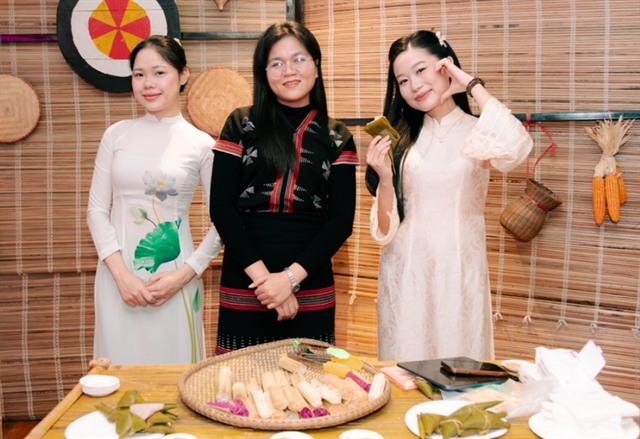
| Cơ Tu ethnic girls introduce their local cuisine at a festival. Photos dantocmiennui.baotintuc.vn |
HÀ NỘI — With simple dishes that are easy to make from local ingredients, the cuisine of Cơ Tu, an ethnic group living mostly in central Việt Nam, showcases the natural fragrance of mountains and forests, rustic yet refined and deeply imbued with tradition and culture.
Cơ Tu culinary culture has recently been identified as a key factor in the development of the community's tourism sector. Visitors to areas where Cơ Tu people live can experience a unique cuisine with distinctive dishes.
The ethnic group has long lived in the Trường Son-Central Highlands region, including in the former Thừa Thiên Huế Province (now Huế City), and Quảng Nam Province, now part of Đà Nẵng City.
Their cuisine carries stories passed down through generations that tell of an ancient and cherished way of life and a people who dwell in harmony with the region's forests and streams to create an unmistakable identity.
|
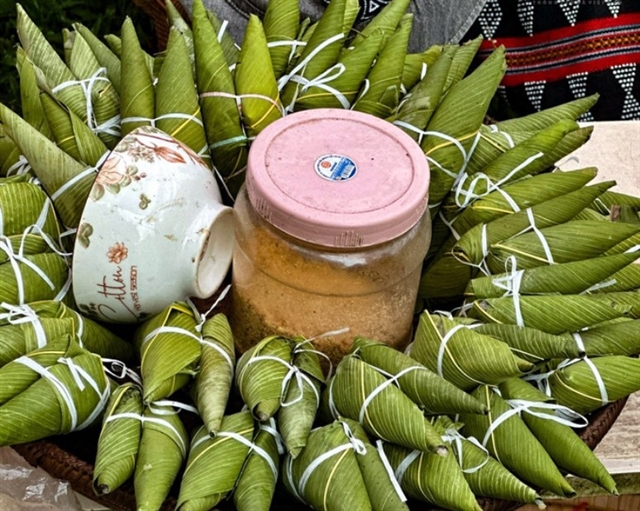
| Avị cuốt (buffalo horn-shaped cakes) require the meticulous care and skilful hands of Cơ Tu women to make. |
Some notable specialities include sticky rice steamed in bamboo tubes, buffalo horn-shaped cakes, roasted black pork skewers, smoked pork, grilled fish, frog cooked with lemongrass, stir-fried vegetables, cassava soup with dried meat and black glutinous rice wine.
These are not just simple, rustic dishes but also a cultural language, which spreads through the flavours of meals to subtly reflect the majestic Trường Sơn mountain range and how local people live in harmony with nature.
Each dish is a slice of life, a reflection of labour, indigenous knowledge and unpretentious human connection. These flavours have been preserved through the modern age, becoming a bridge for visitors to better understand the diverse local culture.
Trần Thị Một, a local official in Hòa Vang Commune, Đà Nẵng, said: "Every year, when Cơ Tu villagers hold their cultural festivals, they always enthusiastically showcase their culinary skills. All the ingredients are sourced from nature.
"To ensure each dish is prepared to the highest standards and is delicious, from early morning, everyone lends a hand – some catch snails and fish, others light fires to cook rice."
A feast with a variety of ingredients and vibrant colours can help introduce local culture to tourists, and at the same time help preserve the beauty of tradition, so that younger generations will strive to develop it and not let it fade away in the future," Một added.
Đỗ Thanh Tân, former head of the Division of Culture and Sports of Hòa Vang Commune, said that thanks to the efforts of the local authority and people, Cơ Tu cuisine and culture is no longer the private property of each household but has become a rich resource for tourism development.
"Within this cultural stream, cuisine is like an enduring current, preserved and passed down through many generations," he said.
The following are a few popular dishes of the Cơ Tu people that have earned praise from both domestic and international tourists.
|
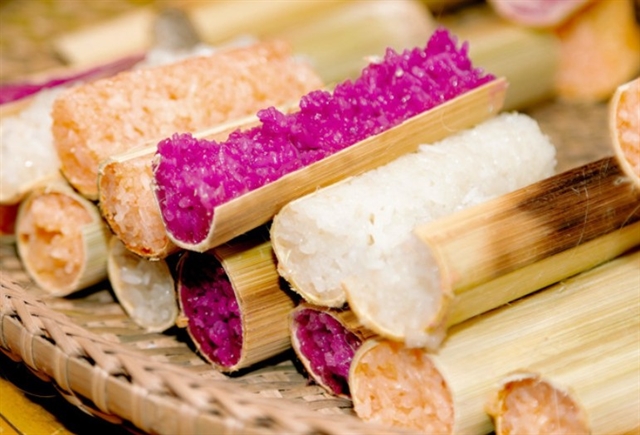
| Cơ Tu sticky rice steamed in bamboo tubes, locally known as cơm lam, embodies the unique flavours of the area in its preparation. |
Buffalo horn cakes
Broom grass leaf, locally known as đót, is used to make avị cuốt (buffalo horn-shaped cakes) in the Cơ Tu tradition. Although they are not very complicated to make, they require the meticulous care and skilful hands of Cơ Tu women.
Before making the cakes, đót leaves are selected from the forest. The leaves must be large, undamaged, washed clean, dried and then quickly pressed to maintain their softness, as they will be used to wrap the cakes.
The rice for the cakes should be fragrant. Sticky upland glutinous rice is most commonly used. Grown in the high mountain region, the rice grains are small, but rich in flavour and nutrition.
No soaking is required for the rice before making the horn-shaped cakes, which do not have a filling. Cooks simply bend a đót leaf into the shape of a buffalo horn, pour in the rice, then bend the other end into a pointed shape before tying it with a string.
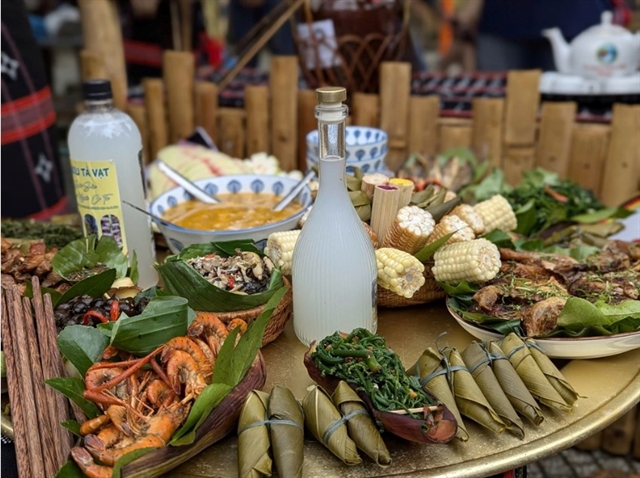
|
| A typical meal for Cơ Tu people showcasing popular traditional dishes. |
Two cakes are tied together and then soaked in cold, clear spring water for about two hours so the glutinous rice absorbs it, becoming softer and more pliable.
After soaking, the cakes are boiled for two to three hours. When cooked, the đót leaf still retains its light green colour, emitting a gentle aroma mixed with the rich fragrance of the glutinous rice.
Buffalo horn-shaped rice cakes have a chewy, rich and refreshing taste – a unique and unforgettable flavour.
Sticky rice in bamboo
Cơ Tu sticky rice steamed in bamboo tubes, or cơm lam, may sound simple, but its preparation requires skill. For the Cơ Tu people, the dish also holds a sacred significance and is often used as a worship offering to ancestors and the heavens during important festivals.
Unlike a normal rice dish, cơm lam is made of rice steamed in fresh bamboo stalks. Cơ Tu women select bamboo stalks that are neither too young nor too old, with a diameter about the size of an arm. They cut the middle section of the bamboo stalk, levelling one end to hold the rice and water, while leaving the other end intact.
Fragrant glutinous rice is also used for cơm lam. After soaking in water for three to four hours, the rice is drained and placed inside the bamboo tube.
Water is then poured in until it reaches about a finger's width higher than the level of the rice. The tube is sealed and placed around a wood-fired stove for cooking.
As it cooks, the tube must be rotated regularly to ensure even contact with the fire. When the rice emits an aroma, the fire should be reduced and the tubes left for a few more minutes until the rice is completely cooked.
Cơm lam has a fragrant and delicious taste, a harmonious blend of sticky rice, the smoky aroma of bamboo and a naturally refreshing flavour. It is often enjoyed with grilled chicken or wild boar, creating a rich and unforgettable taste.
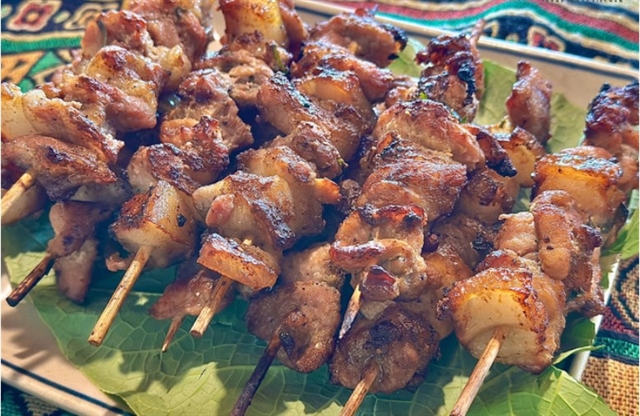
|
| Grilled pork skewers made of black pork are a simple yet distinctive dish of the Cơ Tu people. |
Authentic grilled pork
Grilled pork skewers made of black pork are a simple yet distinctive dish of the Cơ Tu people. The pork is washed, cut into small, bite-sized pieces and marinated with a little salt for about 30 minutes. The meat is then skewered onto smooth bamboo or rattan sticks and grilled over charcoal.
When grilling, the cook must turn the meat evenly to ensure it cooks perfectly, without burning, while retaining its tenderness and natural sweetness. The grilled meat has a deep golden colour and emits a fragrant aroma, a blend of charcoal smoke and the distinctive scent of wild game.
Skewers are usually served with local chilli salt, called ariêu or Rằn Ray, or ariêu chilli sauce with the savoury flavours of the mountains and forests.
Grilled pork is often served for Cơ Tu community meals and festivals. VNS
Life & Style
 Life & Style
 Life & Style
 Life & Style
 Life & Style
 Life & Style
 Life & Style
 Life & Style
 Life & Style
 Life & Style
 Life & Style
 Life & Style
 Life & Style
 Life & Style
 Life & Style