 Talking Shop

Direct flights boost tourism links across central Việt Nam
1.
 |
| Đỗ Thị Thúy Hương, vice president and general secretary of the Vietnam Electronic Industries Association. — VNS Photo |
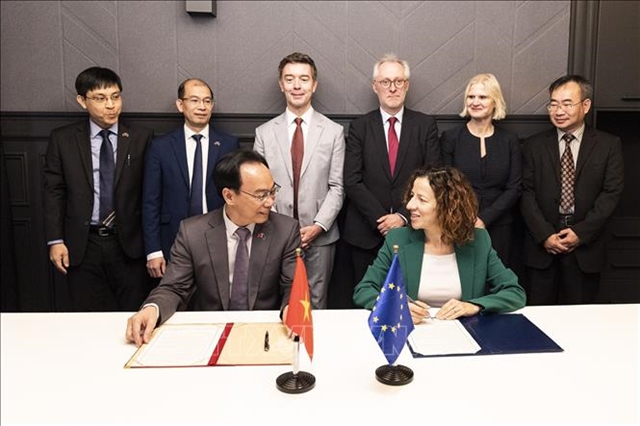
Việt Nam and the European Free Trade Association (EFTA) have officially signed a free trade agreement (FTA) in Hà Nội after 14 years of negotiations. The deal is expected to create new opportunities for Vietnamese electronics firms to access technology, improve production standards and increase domestic value added, helping them move further up regional and global supply chains. Đỗ Thị Thúy Hương, vice president and general secretary of the Vietnam Electronic Industries Association (VEIA), speaks to Việt Nam News about the agreement.
What is the significance of Việt Nam and EFTA signing the deal, particularly as global supply chains undergo major restructuring?
The signing of the agreement is important to Việt Nam’s strategy of international economic integration, market diversification and improvement of the quality of investment inflows.
Its significance lies not only in expanding market access and promoting imports and exports, but also in creating opportunities for deeper cooperation in technology, investment, production management and sustainable development.
As global supply chains undergo major restructuring, expanding ties with partners that have strengths in technology and high standards could help Việt Nam strengthen its links with higher-value production and trade networks.
From the perspective of the electronics industry, what opportunities do you expect the agreement to create for investment and the development of Vietnamese companies?
I expect it to provide additional impetus for attracting high-quality investment projects, particularly in electronic components, industrial equipment, automation, advanced manufacturing technologies, medical devices and solutions supporting digital and green transitions.
The agreement will also give Vietnamese companies opportunities to access advanced standards, technologies and production methods, thereby improving productivity, quality and their ability to meet international customers’ requirements.
However, what the association and the industry care about is not simply how much additional investment Việt Nam attracts or how much export turnover increases, but the tangible value that the domestic economy and local companies can retain from this cooperation.
Việt Nam’s electronics industry has achieved substantial export scale and an increasingly important position in global production chains. What constraints must be addressed for domestic companies to participate more deeply in the value chain?
Although Việt Nam’s electronics industry has achieved substantial export scale and an increasingly important position in global production chains, domestic companies’ participation in higher-value-added stages remains limited.
Against this backdrop, opportunities from the pact need to be translated into concrete cooperation programmes to develop supporting industries, strengthen component design and manufacturing capabilities, promote technology transfer and build a network of Vietnamese suppliers capable of participating more deeply in the value chains of international corporations.
What are the main positive effects that the deal could have on Việt Nam’s electronics industry?
In my view, the agreement’s positive effects can be seen in three areas.
First, it could expand export markets and diversify trading partners, reducing excessive dependence on a limited number of traditional markets.
Second, it could improve investment quality and promote technological cooperation, helping Vietnamese companies gradually move from contract manufacturing and assembly towards producing components with higher technical content and participating in design, research and development activities.
Third, it could provide further impetus for building a competitive supporting-industry ecosystem, strengthening links between foreign-invested enterprises and domestic companies, and improving Vietnamese suppliers’ ability to participate in regional and global supply chains.
Beyond the opportunities created by the agreement, what challenges will electronics companies face in accessing markets with stringent requirements?
Markets with stringent requirements on quality, traceability, the environment, social responsibility and corporate governance are placing new demands on manufacturers.
Companies can no longer compete solely on labour costs or tariff advantages. They must invest more systematically in technology, production standards, human resources and management capabilities.
For small and medium-sized electronics enterprises in particular, meeting these requirements simultaneously can be a major challenge if they lack financial resources, market information and appropriate technical support.
From the association’s perspective, what support measures should be implemented to help businesses make effective use of the agreement’s opportunities?
We expect the implementation of the agreement to be accompanied by business-matching activities, investment promotion and the provision of information on rules of origin, technical standards and market-access requirements.
At the same time, practical support programmes are needed to help small and medium-sized enterprises upgrade technology, train workers, improve quality management systems and meet sustainable development standards.
The association also hopes that regulatory agencies, industry associations, business support organisations and EFTA partners will coordinate their efforts to turn commitments under the agreement into genuine business opportunities for the business community.
What will be the most important measure of the agreement’s long-term success for Việt Nam’s electronics industry?
I believe it's greatest success would not simply be an increase in bilateral trade turnover, but its ability to foster a new generation of Vietnamese companies with stronger technological capabilities, higher positions in supply chains and more sustainable competitiveness.
If Việt Nam can seize the opportunity in this way, the agreement will make a tangible contribution to transforming the electronics industry’s growth model — from one driven primarily by expanding production scale to one based on productivity, technology, innovation and greater domestic value added. — VNS
Talking Shop
 Talking Shop
 Talking Shop
 Talking Shop
 Talking Shop
 Talking Shop
 Talking Shop
 Talking Shop
 Talking Shop
 Talking Shop
 Talking Shop
 Talking Shop
 Talking Shop
 Talking Shop
 Talking Shop