 Talking Shop



TPBank secures $50 million in long-term funding from DEG
1.
 |
| Deputy Director of the State Bank of Vietnam's Information Technology Department, Hoàng Minh Tiến. — VNS Photo |
After five years of digital transformation that has helped increase the total value of cashless payments to 28 times GDP, the banking sector is entering a new phase driven by AI and data. However, as digitalisation intensifies, fraud control has become a key factor in the process.
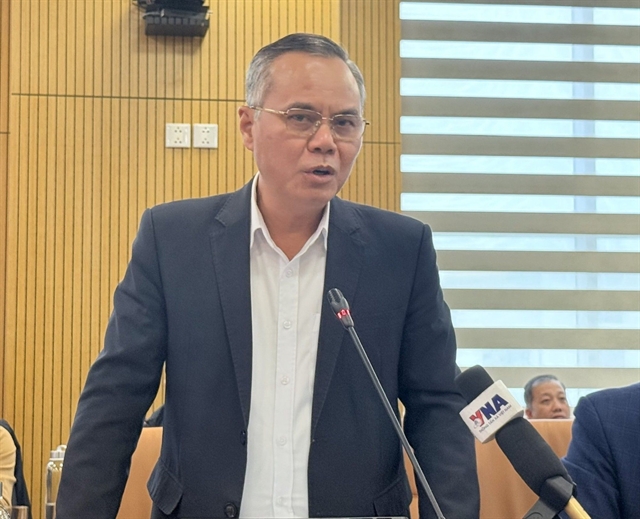
On the sidelines of the press conference announcing the ‘Banking Sector Digital Transformation 2026’ this week, Deputy Director of the State Bank of Vietnam's (SBV) Information Technology Department, Hoàng Minh Tiến, discusses the SBV’s measures to control risks, ensure safety and protect customer data during the AI application in banking operations.
How is the banking sector accelerating the adoption of AI?
Many Vietnamese banks have implemented AI applications in specific areas in recent times. Notably, AI is used to analyse customer consumption and payment behaviours, enabling banks to better understand customer needs, offer tailored products and services, and enhance the overall customer experience.
Another area of focus for banks is the application of AI in credit analysis, assessment, and scoring. By analysing data, AI can assist in recommending appropriate credit limits for different customer segments, thereby supporting operational departments in their decision-making processes.
Beyond direct customer-facing activities, AI is also being applied to internal operations to boost automation and improve processing efficiency. Many banks have deployed AI-powered chatbots to help customers look up information more quickly and conveniently.
Overall, AI is becoming a valuable tool for banks in data analysis and operational decision-making. This technology not only helps specialised departments improve operational efficiency but also makes it easier for customers to access and use banking services.
What measures is the SBV taking to streamline the legal framework with an aim to ensure the safe and effective application of AI in banking operations?
Alongside promoting AI adoption, the SBV is developing and finalising regulations and policies to establish a comprehensive legal framework for the technology's implementation.
The SBV’s Information Technology Department is expected to submit a draft circular regarding AI application in banking operations to the SBV Governor by the third quarter of 2026, which will outline safety standards, risk management protocols, and requirements for deploying AI applications in banking operations.
As data plays a pivotal role in AI applications, ensuring the security of customer data is a top priority for the SBV. This priority is clearly reflected in the draft circular.
Under the draft circular, data input into AI systems must originate from clear sources and be subject to strict access controls and authorisation protocols. Furthermore, data usage must fully comply with legal regulations concerning personal data protection and general data security.
A significant concern today is that criminals are also utilising AI to commit fraud. For instance, criminals can employ deepfake technology to impersonate individuals and attempt to bypass banking security measures, such as biometric authentication.
In response to this situation, the SBV has advised on the issuance of regulations requiring credit institutions to implement standards and solutions to combat AI-driven impersonation.
AI is also being deployed to analyse authentication data and accurately identify customers, thereby helping to thwart fraud and biometric impersonation attempts.
In addition, AI is used to analyse transaction information and behavioural patterns to verify whether a transaction was indeed initiated by the actual customer. The system is capable of identifying anomalies based on factors such as time, location, transaction frequency, and other relevant data, thereby enabling the early detection of and issuance of warnings regarding potential fraud.
In addition to leveraging technology to enhance risk detection capabilities, the SBV has recently implemented the System for Intelligent Monitoring and Oversight (SIMO), which helps identify and flag accounts showing signs of suspected fraud or scams. When a customer initiates a transaction involving such an account, a warning can be issued, allowing the customer to recognise the risk early and halt the transaction if they perceive a threat of fraud or a scam.
Thanks to the SIMO, by July 2026, over 4.6 million customers had received alerts, with more than 1.5 million of them suspending or cancelling transactions worth nearly VNĐ5.2 trillion following such notifications.
The Prime Minister has issued directives to strengthen measures aimed at promptly preventing fraud and the misappropriation of funds from bank accounts. What measures is the banking sector implementing to enhance coordination with other agencies in issuing early warnings to customers and proactively intercept fund flows showing signs of frauds or scams?
To address the early interception of suspicious fund flows, the Vietnam Banks Association and its members have developed a handbook to improve coordination and facilitate the exchange of information regarding questionable transactions. Upon receiving a warning, banks can implement temporary account freezes in accordance with regulations. This represents an initial collaborative step within the banking system, facilitated by the Vietnam Banks Association.
In addition, the SBV and the Ministry of Public Security have recently also signed a coordination plan to strengthen the prevention and combatting of high-tech crime in the banking sector. Moving forward, the two bodies will continue to draft specific guidelines, establishing a cohesive legal framework to put this coordination mechanism into practice.
When individuals detect signs of fraud and notify their bank or the police, the information is promptly shared among the relevant parties through an inter-agency coordination mechanism. This enables the involved entities to quickly verify the situation and implement preventive measures against fraudulent fund flows.
Accelerating information sharing and coordinated responses not only enhances the effectiveness of combatting high-tech crime but also helps intercept fraudulent funds early, thereby minimising financial losses for individuals and businesses. — BIZHUB/VNS
Talking Shop
 Talking Shop
 Talking Shop
 Talking Shop
 Talking Shop
 Talking Shop
 Talking Shop
 Talking Shop
 Talking Shop
 Talking Shop
 Talking Shop
 Talking Shop
 Talking Shop
 Talking Shop
 Talking Shop