 Economy


Vietnamese community in Macao strengthens solidarity, contributes to homeland
1.
|
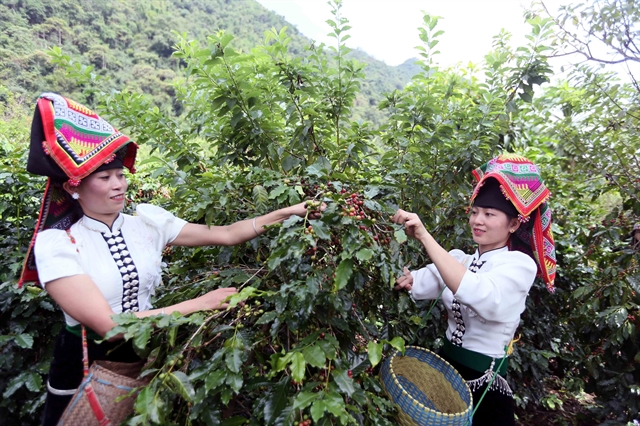
| Farmers harvest coffee cherries in Muổi Nọi Commune, Sơn La Province. Favourable climate and soil conditions have helped make the north-west province an important Arabica-growing area in Việt Nam. VNA/VNS Photo Quang Quyết |
Mai Hương
SƠN LA — As Arabica coffee cultivation spreads across the hills of Sơn La, the province is looking for ways to increase production while protecting the land that supports it.
Favourable climate, altitude and soil conditions have helped make the north-west province an important Arabica-growing area in Việt Nam. But rapid expansion has also raised concerns about soil health, ageing trees and farming practices.
Regenerative farming, which aims to restore soil health, protect biodiversity and use natural resources more carefully, could offer a way forward.
Sơn La’s elevations, ranging from 600 to 1,200 metres and exceeding 1,700m in some areas, together with its seasonal climate and suitable soils, provide favourable conditions for Arabica coffee.
Introduced in 1945, the crop covered just 278 hectares in 1990 but has grown to 44,000ha this year, according to Nguyễn Thành Công, vice chairman of the Sơn La People’s Committee.
The province is reviewing the figures, which are expected to exceed 50,000ha. Annual production is forecast to reach 100,000 tonnes of processed coffee beans.
As the area under cultivation expands, improving farming methods is becoming more important. Nguyễn Quý Dương, deputy director of the Department of Crop Production and Plant Protection under the Ministry of Agriculture and Environment, said planting densities of more than 6,000 trees per hectare, especially without enough shade trees, could make sustainable production more difficult.
He said many Catimor coffee trees in the north-west region were ageing, making replanting and the use of improved varieties necessary.
New varieties offer better quality and resistance to leaf rust, according to Dương. The disease can damage coffee plants and increase farmers’ reliance on chemical pesticides.
He said the Western Highlands Agriculture and Forestry Science Institute had completed the self-declaration procedure for the THA1 variety, allowing it to be considered for local replanting programmes.
Dương also called for more appropriate planting densities, more shade trees, greater use of organic fertilisers and biological plant protection products, and improved plant health management. However, these measures need to be adapted to local terrain and farming practices.
|
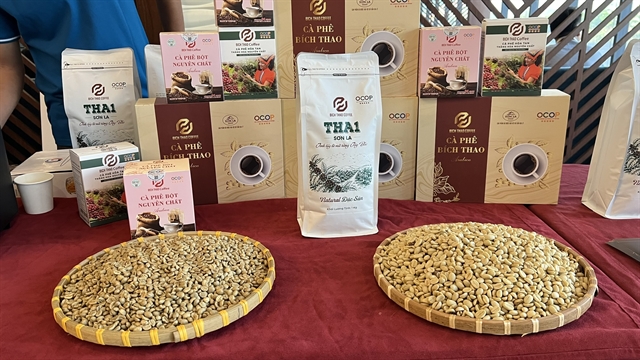
| THA1 Arabica coffee, a new variety promoted in Sơn La, is displayed alongside raw coffee beans and speciality coffee products. — VNS Photo Mai Hương |
Nguyễn Văn Thiết, country director of the Rainforest Alliance in Việt Nam, said the coffee sector needed to move beyond conventional farming towards regenerative agriculture in response to climate change and changing market demands.
He identified five main areas: soil health, crop recovery, biodiversity, water protection and farmers’ incomes. One key practice is agroforestry, which combines coffee cultivation with shade trees. Maintaining vegetation cover instead of leaving the soil bare can also help protect the land.
“The land is not just a resource to exploit, but a partner to restore,” Thiết said.
Thiết encouraged farmers to use coffee-processing by-products and other organic materials to make fertiliser, reducing their reliance on chemical inputs. The aim is to improve soil conditions so that coffee farms can remain productive over the long term, rather than focusing only on short-term yields.
Adding market value
Environmental standards are also becoming more important for coffee exporters. International buyers increasingly want to know not only how good the coffee beans are but also where they come from and how they are produced.
The EU's Deforestation Regulation has increased the need for reliable location data and traceability in coffee supply chains serving the EU market.
Sơn La has been reviewing its coffee-growing areas to verify their origins and prepare for international requirements. According to Công, about 35,000ha were covered by certification schemes or sustainability standards, including Rainforest Alliance, UTZ, 4C and Fairtrade.
Bạch Thanh Tuấn, vice chairman of the Việt Nam Coffee and Cocoa Association, said the country needed to change how it approached international markets.
“Rather than simply selling high-quality coffee, it should present a wider ecosystem behind the product, bringing together national policies, farmers, businesses and other stakeholders to create value,” he said.
This approach would help show international buyers not only the quality of Vietnamese coffee but also the efforts and cooperation behind its production, from policy and farming practices to processing and market development.
For Sơn La, this means combining the quality of its Arabica beans with evidence of responsible production and a stronger value chain, Tuấn said.
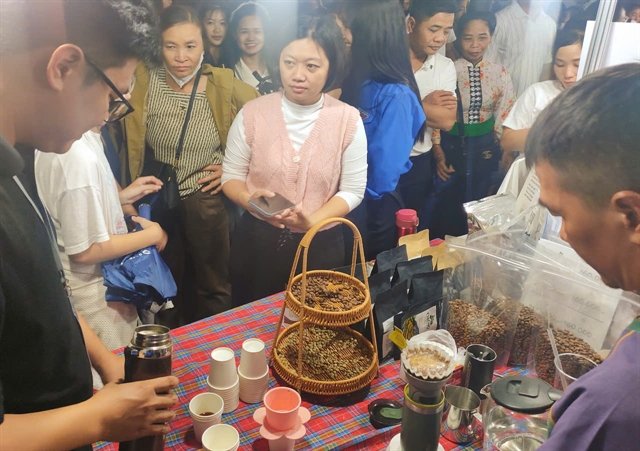
|
| Visitors sample Sơn La’s Arabica coffee at a display showcasing local coffee beans and brewing methods. — VNS Photo Đoàn Tùng |
Vũ Ngọc Huy, representing Phúc Sinh Sơn La Coffee JSC, said the province benefited from favourable growing conditions and the hard work of local farmers, many of whom grew coffee on steep hillsides.
“However, farmers needed to move from traditional methods towards more technical and sustainable practices,” he said.
Businesses also needed to improve productivity, develop new products and processing methods and gain access to more high-value markets.
Sơn La is seeking investment in more advanced coffee processing to increase the value of its products. Dương said only about 15 per cent of Việt Nam’s coffee underwent further processing, suggesting there was room to create more value beyond exports of unprocessed beans.
The province is also developing speciality coffee products to diversify its offerings and increase their market value.
Making the transition work
The success of regenerative farming will depend partly on whether farmers benefit from the change.
Farmers may need to invest in new varieties, shade trees, organic fertilisers and improved cultivation methods. Meeting certification and traceability requirements can also involve additional costs.
If these expenses are not offset by lower input costs, better yields or higher prices, smallholders may find it difficult to make the transition.
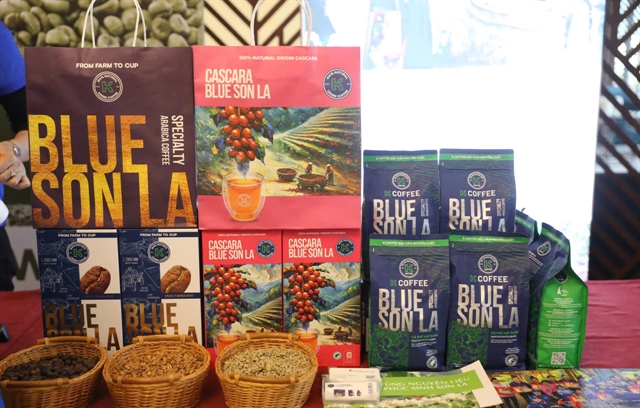
|
| Speciality Arabica coffee and cascara products from Sơn La are displayed at the Sơn La Coffee Festival 2026, showcasing efforts to diversify products and increase the value of the province’s coffee industry. — VNS Photo Đoàn Tùng |
Thiết said products certified under the Rainforest Alliance’s regenerative agriculture programme had reached the market, with reported premiums of US$70–100 per tonne associated with the certification.
Climate change also presents risks and possible opportunities. Nguyễn Hữu Ninh, chairman of the board of the Centre for Environment Research, Education and Development, said climate information could help businesses anticipate weather risks and make better decisions.
He also pointed to the potential of carbon finance to create additional value, provided that suitable technology, measurement methods and policies were in place. However, this remains a potential opportunity rather than an established source of income for local farmers.
At the policy level, Dương said Việt Nam had a range of measures supporting agricultural production, technology, post-harvest processing and trade. The challenge was to put them into practice through coordination among local authorities, businesses, farmers and investors.
Given the distinctive quality of Arabica coffee grown in the north-western region, Dương called for a dedicated development scheme for the crop to unlock its potential and raise its value.
Sơn La is also looking beyond its own borders. Together with neighbouring Điện Biên and Lai Châu, it hopes to develop a larger Arabica-growing region in the north-west, combining local production strengths with research, processing and market development. — VNS
Economy
 Economy
 Economy
.jpg) Economy
 Economy
 Economy
 Economy
.jpg) Economy
 Economy
 Economy
 Economy
 Economy
 Economy
 Economy
 Economy