 Economy


Enterprises should promote development of Vietnamese brands in overseas markets
1.
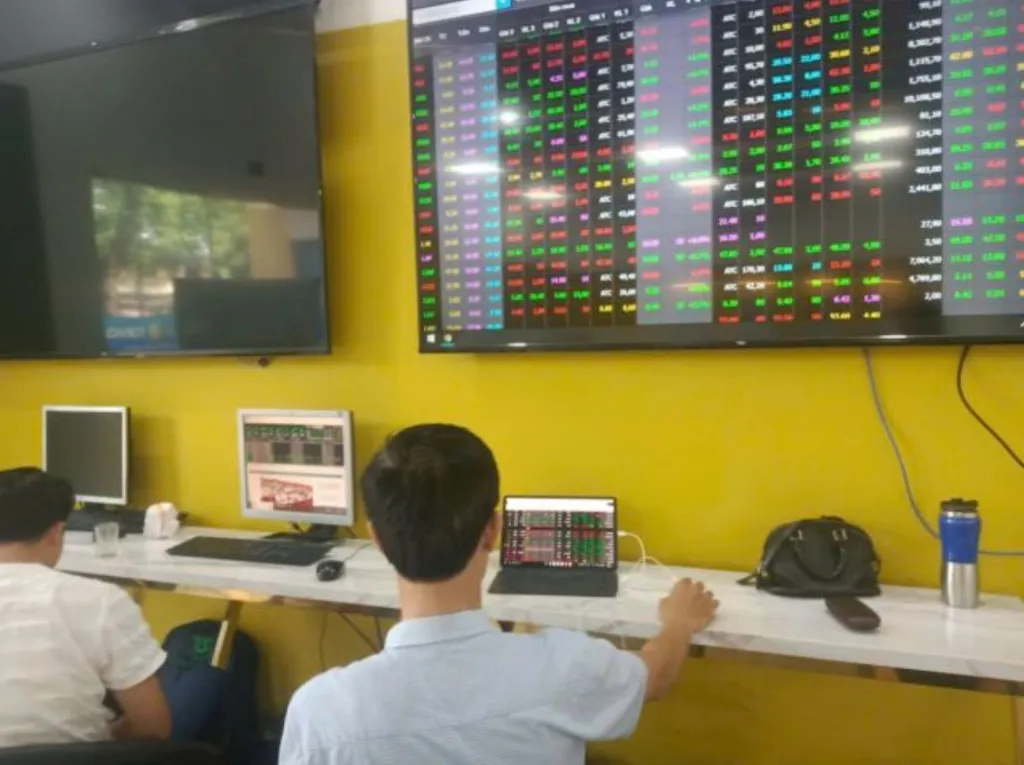 |
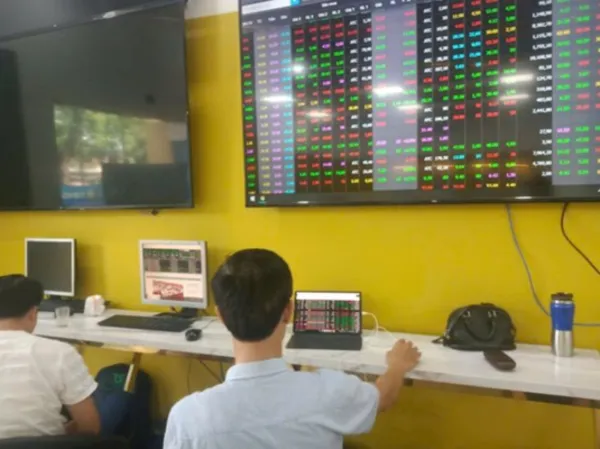
| Investors tracking stocks movements in the trading room of a security firm. VNA/VNS Photo |
HÀ NỘI — The stock market extended its correction last week, with the VN-Index slipping slightly as persistent foreign net selling weighed on sentiment, despite an improvement in trading liquidity.
The VN-Index on the Hochiminh Stock Exchange (HoSE) closed the week at 1,735.09 points, down 0.15 per cent from the previous session.
This decline was significantly smaller than the 47.4-point loss recorded in the previous week, from September 28 to October 2, but the market showed no clear signs of a sustained recovery.
In the first two sessions of the week the benchmark advanced, before reversing course and declining over the following three sessions.
From the end of September through October 9, the VN-Index had lost a further 33.53 points, or approximately 1.9 per cent, indicating that the correction remained in place.
Trading activity improved compared with the previous week. Total trading value exceeded VNĐ91.7 trillion (US$3.5 billion), up 18.8 per cent, while trading volume increased 7.6 per cent.
However, foreign investors recorded their largest weekly net selling since the beginning of the year, with a value approaching VNĐ14 trillion, 8.5 times the previous week’s level.
On the HoSE, foreign investors were net sellers for five consecutive sessions.
Cumulative net selling by foreign investors across the market exceeded VNĐ115 trillion from the beginning of 2026 through October 9.
In the first nine months of the year, net selling on HoSE approached the record of VNĐ125 trillion recorded for the whole of 2025.
Nguyễn Duy Phương, senior director of the financial advisory division at DG Capital, said the market had recently seen sharp fluctuations in the benchmark index, while domestic capital flows had offset the funds withdrawn by foreign investors.
He said this trend was not confined to 2026, but was seen through 2024 and 2025.
Domestic investors, including both institutional and individual investors, are now playing the main role in absorbing the supply coming from foreign investors, according to Phương.
By the end of September, the number of domestic individual securities accounts had exceeded 14 million, an increase of more than 2.2 million from the beginning of the year.
Phương said the domestic investor base was now substantially larger than in previous market cycles, marking an important structural change.
Pinetree Securities analyst Nguyễn Tấn Phong said that the VN-Index would likely continue to fluctuate with a slight downward bias within a range of 1,700–1,760 points.
He said capital flows were expected to remain highly selective, as shares in the Vin-related stocks group lose momentum and banking stocks face selling pressure from foreign investors.
According to Phong, the foreign net-selling streak is unlikely to end soon amid elevated US Treasury yields. The yield on 10-year US Treasury bonds has reached its highest level since 2002, adding to pressure on capital outflows from emerging markets such as Việt Nam.
On the domestic front, however, Phong said Việt Nam’s macroeconomic fundamentals remained solid, with third-quarter gross domestic product growth reaching 9.95 per cent.
The third-quarter earnings season, expected to gather momentum in the coming weeks, could also act as a catalyst for capital flows into companies with their own growth prospects.
Nevertheless, Phong said earnings announcements could lead to greater differentiation among individual stocks rather than providing uniform support for the broader market. This would be consistent with a pattern in which investment flows concentrate on individual companies while major stocks have yet to regain strength.
He also highlighted risks from elevated domestic interest rates and inflationary pressure as fuel costs rose sharply, saying these factors could affect the market’s overall direction despite support from economic growth and corporate earnings.
"Investors should take advantage of short-lived market rallies to optimise returns rather than expect a sustainable uptrend, while proactively reducing the proportion of equities in their portfolios to defensive levels," Phong said. — BIZHUB/VNS
Economy
 Economy
 Rikkeisoft ký kết MOU với LAC.Co, LTD - thúc đẩy hợp tác kinh doanh toàn diện trong lĩnh vực an ninh mạng.jpg) Economy
Economy
 Economy
 Economy
 Economy
 Economy
 Economy
 Economy
 Economy
 Economy
 Economy
 Economy
 Economy
 Economy