 Economy


Power transmission to be separated from EVN to develop a competitive electricity market
1.
|
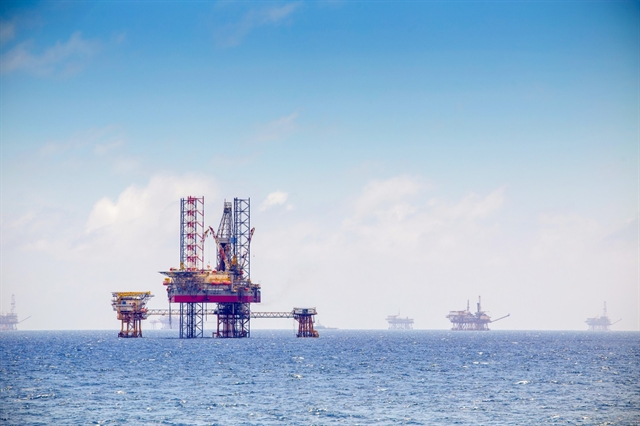
| Jack-up oil rigs of Petrovietnam. — Photo pvdrilling.com.vn |
HÀ NỘI — Petrovietnam plans to invest roughly US$14.23 billion in oil and gas exploration and production during 2026–2030, about 2.3 times the investment made in the previous five-year period, as it seeks to support double-digit growth and maintain domestic energy supplies.
The group will prioritise its core exploration and production (E&P) activities, including reserve replacement, production from existing fields, development of new projects and opportunities to acquire producing assets, according to Petrovietnam.
During the first nine months of 2026, the group's domestic crude oil output reached 6.66 million tonnes, up 10.4 per cent year-on-year, while gas delivered ashore totalled 4.82 billion cubic metres. Reserve additions reached 13 million tonnes of oil equivalent, exceeding production during the period and contributing to efforts to sustain output and safeguard energy security.
Petrovietnam's upstream subsidiary, PetroVietnam Exploration Production Corporation (PVEP), produced approximately 3.3 million tonnes of oil equivalent in the first nine months, exceeding its plan by 10 per cent and rising 27 per cent from a year earlier.
Petrovietnam Chairman Lê Ngọc Sơn said the group's upstream operations continued to face challenges despite the recent production gains. Reserve replacement remained below expectations, while natural declines at major fields put pressure on output. New discoveries in the Cửu Long and Nam Côn Sơn basins were largely small, while significant undiscovered potential was concentrated in deepwater and offshore areas with higher risks and greater difficulties in attracting foreign investors. The energy transition has also made oil and gas financing more challenging.
He noted, however, that changes to the legal framework, including the 2025 Investment Law and amended Petroleum Law, had increased the group’s autonomy and provided more flexible arrangements for investment, small and marginal fields, and enhanced oil recovery (EOR).
Petrovietnam targets annual domestic reserve additions of 13–17 million tonnes of oil equivalent and aims to maintain production during 2026–2030. Sơn emphasised that exploration activities undertaken today would determine production over the following 5-10 years.
The group plans to connect smaller fields to existing infrastructure, apply incentives for marginal fields, improve recovery rates and closely manage the Block B gas project chain while moving to restart the Cá Voi Xanh gas project chain.
Its technical priorities include advanced seismic technology to identify unconventional traps, improved well-location selection, drilling technologies to reduce time and costs, and an integrated exploration and production database.
Petrovietnam also plans to apply artificial intelligence and machine learning while expanding research into carbon capture and storage (CCS), seabed minerals, geothermal energy, natural hydrogen and gas hydrates.
General Director Lê Mạnh Cường said E&P remained a core activity and a leading driver across the group’s value chain, contributing to profits and the State budget, although investment required time to translate into production growth.
He called on subsidiaries to pursue mergers and acquisitions, particularly overseas, to supplement production and support the double-digit growth target.
Investment plans are to specify priorities, objectives, implementation schedules and accountable managers, with investment performance linked to key performance indicators for representatives of Petrovietnam's capital.
During 2021–2025, Petrovietnam acquired 9,623 square kilometres of 3D seismic data, drilled 46 wells and recorded eight new oil and gas discoveries, including Hải Sư Vàng, Bunga Aster, Rồng Đôi Mới and Lạc Đà Hồng.
The group added 75.79 million tonnes of oil equivalent in reserves, brought 16 new fields and facilities into operation, produced 51.98 million tonnes of oil and delivered 35.21 billion cubic metres of gas ashore, meeting the five-year plan assigned by the government. — BIZHUB/VNS
Economy
 Economy
 Economy
 Economy
 Economy
 Economy
 Economy
 Economy
 Economy
 Economy
 Economy
 Economy
 Economy
 Economy
 Economy