 Economy


Sơn La launches $24 million industrial cluster project
1.
|
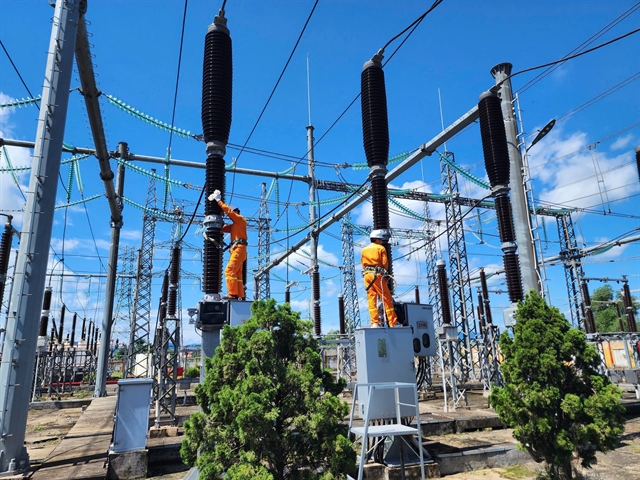
| EVN workers perform maintenance, equipment repair and industrial cleaning at transformer stations. — Photo npt.com.vn |
HÀ NỘI — The Ministry of Finance (MoF) has proposed restructuring Vietnam Electricity (EVN) to align the state-owned power group with the development of a competitive electricity market.
This includes changes to its ownership stakes in power generation companies and a phased separation of electricity distribution and retail operations.
In Submission No. 812/TTr-BTC dated October 2, the ministry sent the proposal to the Government Party Committee for approval.
The plan outlines the restructuring of capital in EVN's subsidiaries and the organisation of electricity generation, transmission, distribution and retail activities.
The proposal was developed based on directions from Government leaders, opinions from the Ministry of Industry and Trade, and reports from EVN, with the aim of establishing an adequate political and legal basis for restructuring in line with the development of a competitive power market.
Under the proposed plan, EVN would remain a single-member limited liability company wholly owned by the State during 2026–2030.
It would retain 100 per cent ownership of the five regional power corporations, EVNGENCO1 and Thu Duc Thermal Power Company. Meanwhile, EVN would reduce its stakes in EVNGENCO2 and EVNGENCO3 while maintaining controlling interests in both companies.
Restructuring power generation
For power generation, the MoF proposed not establishing a National Strategic Power Generation Corporation. Instead, it recommended restructuring EVN's existing generation units to better suit a competitive market.
The proposal also seeks to avoid affecting the financing arrangements for the Ninh Thuan 1 nuclear power project.
For transmission, the ministry proposed retaining the National Power Transmission Corporation (EVNNPT) as a single-member limited liability company wholly owned by EVN in the immediate term.
EVN would consider separating EVNNPT into an independent enterprise once existing obstacles have been resolved and the corporation is able to fulfil its responsibilities under the revised Power Development Plan VIII, following directions from Government leaders.
The proposed restructuring of electricity distribution and retail would be implemented in three phases.
By the end of 2027, EVN would complete the separation of distribution costs from retail electricity costs. During 2028–2030, the group would continue separating costs across all voltage levels while studying and piloting organisational separation between the two activities.
After 2030, electricity retail units currently operating under dependent accounting arrangements would gradually be converted into independently accounting companies when conditions permit.
The potential equitisation of electricity retail companies would be studied after 2035.
The Ministry of Industry and Trade, however, has not agreed with several elements of the proposal, particularly the continued placement of EVNNPT under EVN and the proposed timetable for restructuring distribution and retail operations.
The ministry has also called for a more thorough assessment of the financial implications, the mechanism for pooling depreciation funds and the impact of dependent accounting arrangements on transparency in the electricity market.
The MoF said retaining certain strategic multipurpose hydropower plants within EVN was important for power-system operation, electricity purchasing-cost management, retail price stability and the fulfilment of public-service obligations.
These assets also provide financial resources and collateral to support EVN's mobilisation of capital for major power generation projects in the coming years.
The proposed restructuring aims to establish a roadmap suited to the development of a competitive electricity market while maintaining national energy security and improving the operational efficiency of the state-owned group. — BIZHUB/VNS
Economy
 Economy
 Economy
 Economy
 Economy
 Economy
 Economy
 Economy
 Economy
 Economy
 Economy
 Economy
 Economy
 Economy
 Economy