 Economy


Data centre market faces energy challenges
1.
|
|
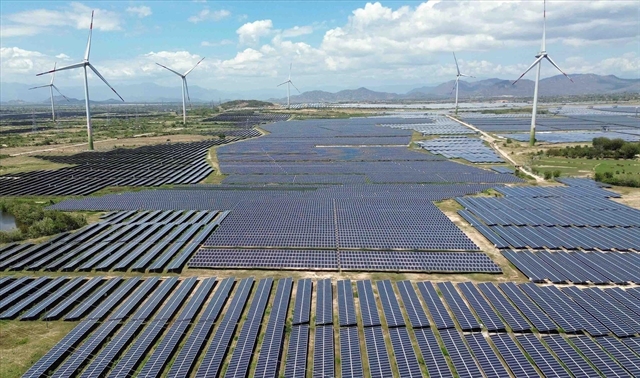
| Việt Nam is expanding its power systems to meet the needs of the fast-growing data centre and artificial intelligence market. — VNA/VNS Photo Trần Việt |
HCM CITY — Việt Nam’s data centre market faces energy and infrastructure challenges as the industry experiences massive growth.
As Việt Nam targets an artificial intelligence (AI) economy to reach 6 per cent of its gross domestic product (GDP) by 2030, demand for data centre development is very high.
Total data centre power capacity is projected to increase from approximately 580 MW in 2025 to nearly 980 MW by 2030.
According to ABB Vietnam, which provides smart technology solutions for major enterprises in the industry such as CMC Corporation and Viettel Group, the high power demand of data centres puts pressure not only on the electricity supply but also on the entire transmission and distribution system.
The decisive factor for the industry’s sustainable development is whether power infrastructure and other foundational infrastructure can expand fast enough to meet demand.
The country also needs to boost investment in core platforms such as electricity, power grids, land funds, and connectivity infrastructure, which will be the factors that determine the ability to attract large-scale projects in the future.
Việt Nam aims to invest about US$136.3 billion in developing the power system in the 2026-2030 period, including $118.2 billion for power generation and $18.1 billion for the transmission grid, in order to meet the needs of the fast-growing economy and emerging sectors such as data centres.
However, the country’s power supply relies not only on domestic sources but also on imports.
“This is a complex challenge,” said Jessica Nguyễn, General Director, Country Holding Officer and Board Chairwoman of ABB Vietnam, adding that the long-term path was to diversify supply sources, such as renewable energy, imported electricity, and new power sources, to enhance stability and reduce reliance on any single source.
She added that the energy challenge facing AI and data centres was a global issue, not one unique to Việt Nam. Administrative agencies and businesses needed to coordinate to accelerate infrastructure development that laid the foundation for the industry's sustainable growth.
She believed that Việt Nam was on the right track. The country clearly defined a strategy for developing the digital economy, AI, and data centres and built appropriate policies, regulations, and mechanisms to support the industry’s sustainable development.
“With its current growth momentum and strong commitments from the government, Việt Nam has many favourable conditions to become an important destination for the data centre industry in the region,” Nguyễn said. — VNS
Economy
 Economy
 Economy
 Economy
 Economy
 Economy
 Economy
 Economy
 Economy
 Economy
 Economy
 Economy
 Economy
 Economy
 Economy