 Economy

Businesses need to expand share of online export market
1.
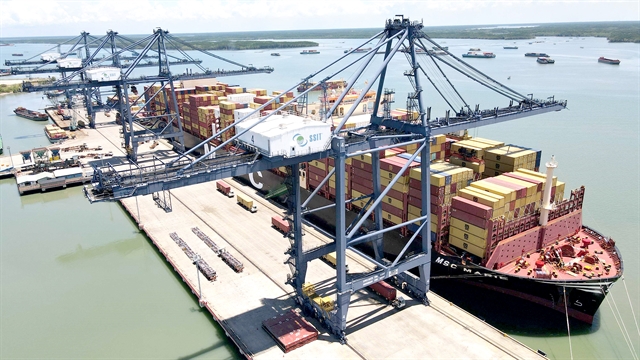 |
| BIG TRADE: A view of SSIT Port in HCM City. Technology can create a driving force and provide the foundation for Việt Nam to become a strong maritime nation. VNA/VNS Photo Mạnh Dương |
Nguyễn Hằng
Việt Nam is on the path to acquiring the knowledge, technology and capacity needed to become a strong maritime nation.
Experts believe that science and technology are among the pillars underpinning the ambition set out in the Party's Resolution 20, adopted on July 28, 2026, which focuses on building Việt Nam into a strong maritime nation as a long-term goal.
Science and technology could determine whether Việt Nam remains largely dependent on conventional, small-scale exploitation of marine resources or moves towards a modern maritime economy based on technology, productivity and knowledge.
Nguyễn Chu Hồi, a National Assembly deputy and permanent vice president of the Việt Nam Fisheries Society, said technology would be the foundation for building national maritime capacity, while international scientific cooperation could help Việt Nam acquire knowledge, train its workforce and gain access to advanced models of marine governance.
“It can create a driving force and provide the foundation for Việt Nam to become a strong maritime nation,” he said.
At the same time, international cooperation in science and technology would further promote domestic technological development.
“We must go to sea on the legs of technology and the legs of institutions," Hồi said.
The scale of the challenge becomes apparent as soon as Việt Nam moves beyond its familiar coastal waters.
Nguyễn Như Trung from the Institute of Earth Sciences under the Việt Nam Academy of Science and Technology said Việt Nam urgently needed stronger scientific and technological capacity to explore deep and offshore waters. The country did not yet possess sufficiently powerful vessels for large-scale surveys and exploration at great depths.
“If surveys in coastal waters at depths of 100–200m are already difficult, working in waters 1,000–4,000m deep presents a far greater challenge,” Trung said.
The problem is not a lack of ambition but a lack of equipment. Despite its coastline of more than 3,200km, Việt Nam does not yet have a fully equipped research vessel dedicated to comprehensive marine research. That technological gap limits the country’s ability to understand what lies beneath its waters and, consequently, its ability to manage and develop those resources effectively.
The same challenge appears in marine aquaculture. Việt Nam has around 1,000 sq.km of water surface suitable for marine fish farming, according to Nguyễn Hữu Dũng, chairman of the Việt Nam Marine Aquaculture Association.
Yet much of that potential remains untapped. More than 99 per cent of marine farms are small-scale household operations, often fragmented and reliant on outdated technology.
Việt Nam currently has fewer than five industrial marine aquaculture clusters. Industrial-scale marine farming could increase output and value, reshape the structure of the fisheries sector and transform how production is managed.
But to do this, the role of science and technology is indispensable.
A maritime industry
Technology is equally critical to another pillar of the maritime economy: shipbuilding and maritime services.
Nguyễn Hồng Thu, deputy general director of Engineering at VARD Vũng Tàu Co Ltd, a member of Norwegian shipbuilding group VARD, said Việt Nam was facing a major opportunity to develop its maritime industry.
Its geographical position is highly favourable, while the country has shipyards, a large workforce and experience in carrying out international projects, according to Thu.
But the shipbuilding industry still faces a substantial technological and industrial gap compared with more developed maritime economies. Weak value chains, an incomplete supplier ecosystem, limited investment in research and development and a shortage of specialised experts remain major constraints.
Bridging that gap requires the creation of an entire maritime ecosystem, from engineering and design to high-tech equipment, logistics and specialised human resources.
Thu proposed that Việt Nam focus on specialised vessels, offshore energy development technologies, engineering and design and high-tech maritime equipment.
He also identified three strategic maritime regions: Hải Phòng–Quảng Ninh, Đà Nẵng–Quảng Ngãi-Khánh Hòa and HCM City–Vũng Tàu–Đồng Nai.
By 2030, he said, Việt Nam should have laid the foundations for a clear development roadmap involving the Government, businesses, research institutes, universities and international partners.
Another fundamental gap is marine data.
According to Sylvain Ouillon, head of the representative office of the French Research Institute for Development (IRD) in Việt Nam, Việt Nam currently has 21 hydro-meteorological stations, including nine along the coast, 11 on small islands and one offshore platform.
But these stations mainly measure physical parameters at the surface, such as temperature, salinity, wind and waves. “None of them measure chemistry, biology or ecology,” Ouillon said.
Environmental observations are also largely carried out through individual programmes rather than continuous monitoring. The result is a fragmented picture of the marine environment.
“We lack continuous measurements of biological and chemical information. We also lack offshore data and real-time integration of data for forecasting and operational purposes, particularly to prevent extreme events,” he said.
For a country increasingly exposed to climate change, coastal hazards and pressure on marine ecosystems, such gaps are not merely scientific inconveniences. They affect the ability to make timely decisions and manage marine space and resources.
Ouillon believes international cooperation can help fill some of these gaps. The IRD and French scientific organisations would be ready to provide technical advice on monitoring station design and equipment, connect Vietnamese infrastructure with French institutions, support training and help Việt Nam access international research networks, he said.
He proposed beginning with two pilot marine stations, one at Đồ Sơn in the northern city of Hải Phòng, where the Việt Nam Academy of Science and Technology has a site close to the sea, and another in Quy Nhơn Ward.
An agreement has recently been signed involving the IRD, ICES and Gia Lai Province to advance plans for a pilot marine station in Quy Nhơn.
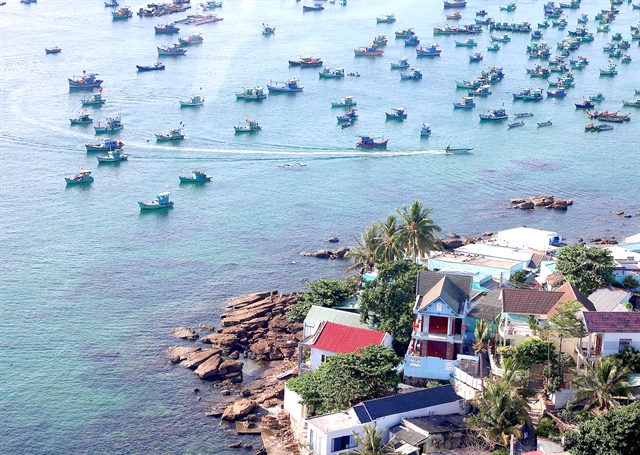 |
| Boats at Hòn Thơm fishing village, Phú Quốc Island, in the Mekong Delta province of An Giang. Việt Nam has around 1,000 sq.km of water surface suitable for marine fish farming. VNA/VNS Photo Dương Giang |
From cooperation to capacity
For Việt Nam, the challenge is ultimately to develop the capacity to master, adapt and innovate with technology.
Hồi said this required a national marine science and technology strategy, a clear coordination mechanism and a more enabling policy environment.
“Without an open policy framework, science and technology may set out very ambitious goals, but the necessary resources cannot be mobilised,” he explained.
He also called for a national marine database with clear standards and decentralised access, a stronger network of marine monitoring stations and mechanisms for controlled testing and commercialisation of marine technologies.
Research institutes, universities and businesses must be connected to form an ecosystem capable of developing and commercialising technology, while the country’s human resources must be upgraded to ensure that imported or newly developed technologies can actually be mastered.
Dũng similarly called for industrial marine farming clusters supported by modern equipment, specialised human resources, appropriate infrastructure, a better business environment and stronger international cooperation.
For advanced marine aquaculture technologies, he suggested prioritising partnerships with Norway, Denmark, South Korea and Australia.
Deputy Minister of Science and Technology Trần Trung Tính proposed four priorities of strengthening marine research organisations, mastering advanced technologies, connecting ocean data infrastructure and attracting leading international experts.
The first priority involves raising the capacity of Việt Nam’s marine research organisations with the aim of placing them among the leading institutions in ASEAN.
The ministry will develop a legal framework and encourage links between Vietnamese institutes and universities and leading ocean research centres worldwide.
The second is to strengthen research cooperation, technology transfer and mastery in areas including autonomous underwater vehicles, ocean remote sensing, high-speed submarine cables, subsea data centres, offshore renewable energy and marine biotechnology.
Priority partners include countries with strong marine technology capabilities such as Japan, Germany, Italy, the US, Australia and Russia.
The third is to connect Việt Nam’s ocean-data infrastructure with regional and global systems, including through the UN Decade of Ocean Science for Sustainable Development and multilateral mechanisms such as the Intergovernmental Oceanographic Commission.
The fourth is to establish mechanisms to attract leading international scientists and experts to participate directly in major marine science and technology programmes.
For Tính, this is where science diplomacy meets maritime development. “Science helps us understand the sea. Technology helps us master the sea. Innovation helps us generate wealth from the sea. Digital transformation helps us govern the sea more effectively,” he said.
Technological self-reliance, he added, would also contribute to protecting national sovereignty and interests at sea. VNS
Economy
 Economy
 Economy
 Economy
 Economy
 Economy
 Economy
 Economy
 Economy
 Economy
 Economy
 Economy
 Economy
 Economy
 Economy