 Economy



Learning Việt Nam through food
1.
|
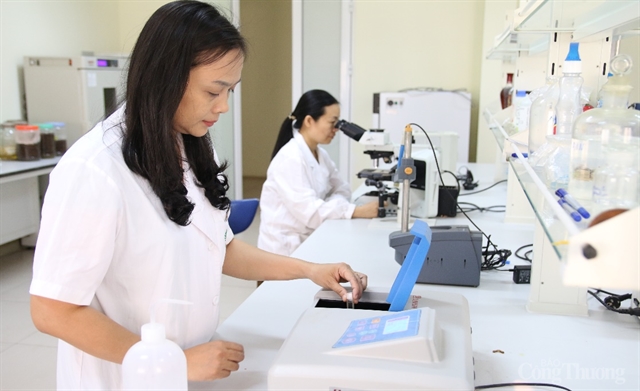
| Staff at the ministry's Institute of Food Industry conducting scientific and technological research. Photo congthuong.vn |
HÀ NỘI — The industry and trade sector is working to streamline institutional frameworks and strengthen the technology absorption capacity of enterprises to bridge the gap between research and production, with an aim of generating tangible products and value.
In carrying out the Politburo’s Resolution 57-NQ/TW on breakthrough developments in science, technology, innovation and national digital transformation, the Ministry of Industry and Trade is shifting from a broad outlook to one that prioritises depth, effectiveness and concrete outputs.
Hoàng Ninh, deputy director of the ministry’s Department of Science, Technology and Digital Transformation, said that a significant shift in the implementation of Resolution 57 is the move from breadth to depth, and from general policy guidelines to specific and actionable tasks.
Since the beginning of the year, the ministry has received 287 tasks related to carrying out Resolution 57, of which 187 have been completed, 10 are currently underway within their deadlines and 90 are regular tasks.
At the same time, institutional development has been prioritised, with 17 legal documents either promulgated or submitted for promulgation. Authorities have also simplified and reformed over 55 per cent of the ministry’s administrative procedures.
These figures demonstrate that the process of carrying out the resolution has been translated into a concrete workload.
However, for science and technology to truly be integrated into production, it remains necessary to remove bottlenecks regarding institutions, resources and human capital, as well as to bridge the gap between research and application.
Drawing on his management experience, Ninh identified three major bottlenecks affecting the implementation of science, technology, innovation and digital transformation within the industry and trade sector.
The first is institutional. As technology evolves rapidly, the regulations and procedures governing research, testing, transfer and application often fail to keep pace.
Next, without sufficiently concentrated resources, initiatives in science, technology, innovation and digital transformation struggle to generate significant impact.
The last issue is the gap between research and application that is difficult to bridge when research outputs from institutes and universities do not fully align with production needs, while enterprises may lack the necessary personnel, capital or infrastructure to adopt them.
Dương Đức Anh, deputy director of the ministry’s Institute of Electronics, Informatics and Automation, agreed.
Đức Anh said that many research products currently remain at the laboratory prototype stage. Transitioning them to factory-scale production requires extensive testing to evaluate durability, efficiency and operational stability. Meanwhile, a gap persists between research-based technologies and the actual needs of enterprises.
Financial resources also pose a challenge, as businesses must provide matching funds for testing, evaluation and technology refinement, yet not all are capable of sharing the risks involved in this process.
The journey from the laboratory to the production line thus remains a long one, and bridging this gap requires effort from all parties involved, rather than relying on just one side, Đức Anh said.
Ninh said that to continue implementing Resolution 57 in the future, the ministry will focus on tangible outputs, such as products, technologies and data generated during task execution, that are applicable in practice. These are the results that hold true significance.
"In the near future, the ministry's priority is for science, technology, innovation and digital transformation to yield measurable results for both individual enterprises and the industry as a whole," Ninh noted.
Tasks must be closely aligned with the industry's development needs, focusing on strategic technologies and products, as well as technological upgrades that enable enterprises to adopt and apply research findings.
Digital transformation must be data-driven. It involves not merely migrating processes to a digital environment, but also sharing and leveraging data to support production management and business operations.
Ultimately, effectiveness must be demonstrated through concrete outcomes for each enterprise, such as increasing labour productivity, reducing costs and creating new products, to enhance competitiveness.
"The key question for the next phase is not just how many tasks have been implemented, but rather what products, technologies and value those tasks have generated for enterprises and the industry. That is a crucial benchmark for ensuring Resolution 57 translates into real-world impact," Ninh said. — BIZHUB/VNS
Economy
 Economy
 Economy
 Economy
 Economy
 Economy
 Economy
 Economy
 Economy
 Economy
 Economy
 Economy
 Economy
 Economy
 Economy