 Economy

Việt Nam’s trade surpasses $1 trillion in 10 months
1.
|
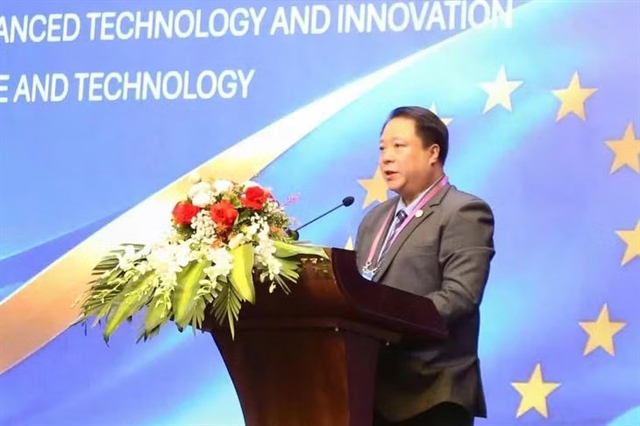
| Nguyễn Đắc Bình Minh, deputy director of the National Institute of Innovation under the Ministry of Science and Technology, speaks at the forum on Việt Nam-EU on science and technology cooperation in advanced materials. — VNA/VNS Photo |
QUẢNG NINH — A Việt Nam-European Union (EU) forum on science and technology cooperation in advanced materials was held in Quảng Ninh Province on Thursday as part of Vietnam International Digital Week 2026.
The event focused on opportunities and challenges in applied research and the development of an industrial and technological innovation ecosystem.
Nguyễn Đắc Bình Minh, deputy director of the National Institute of Innovation under the Ministry of Science and Technology, said Việt Nam needs to shift from a growth model based on resource extraction and low-cost manufacturing to one driven by knowledge, technology and added value.
This requires stronger scientific and technological capabilities, closer links between research and market needs, and more effective commercialisation of research results, he said, adding that international cooperation would help Việt Nam participate more deeply in global research, manufacturing and innovation value chains.
The EU is an important partner with extensive experience in advanced materials, industry-linked research and the circular economy, Minh said, noting that combining its research and technological strengths with Việt Nam’s industrial capacity, workforce and demand for innovation could create significant cooperation opportunities.
Gonzalo Serrano, deputy head of partnerships at the EU Delegation to Việt Nam, said the forum offered a platform to exchange experience, discuss policy approaches and identify initiatives tailored to both sides’ needs.
Cooperation in advanced materials could strengthen strategic autonomy, diversify supply sources and mitigate geopolitical risks. The EU hopes to work with Việt Nam to increase added value in global supply chains and support the country’s ambition to become a high-income nation by 2045, he said.
Discussions at the forum focused on research cooperation in semiconductor materials, new energy, energy storage, smart manufacturing and the circular economy; stronger links among research institutes, universities and businesses; and technology transfer, testing and commercialisation to bring scientific advances into practical applications.
Mangala Srinivas, deputy chair of the European Commission’s Group of Chief Scientific Advisors, said advanced materials are designed to deliver improved properties and performance while meeting specific technical requirements.
They are crucial to industrial competitiveness, strategic autonomy, supply chain security and the green transition. Amid increasingly widespread export restrictions on raw materials, the EU is seeking to strengthen supply capacity and reduce reliance on external sources, she said.
Srinivas highlighted the links between science, policy and industry, stressing the need to accelerate the commercialisation of research outcomes, strengthen supply chains and promote sustainability throughout product life cycles. These strategies could help Việt Nam develop appropriate policies and enhance science and technology partnerships with the EU.
Leonie Nagarajan, a EURAXESS ASEAN representative, introduced Horizon Europe, the EU’s research and innovation programme with a budget of 95.5 billion euros (US$106.3 billion) for 2021-27. Its priorities include the green and digital transitions, industrial competitiveness and solutions to global challenges.
Vietnamese scientists, universities, research institutes and businesses can participate in various funding schemes. As a non-associated third country, Việt Nam’s eligibility for funding depends on the conditions of individual calls for proposals.
Materials science can contribute to fields ranging from industry and digital technologies to healthcare, energy, agriculture, environmental protection and heritage conservation, she noted.
Nagarajan encouraged Vietnamese researchers to seek international partners, understand funding requirements and prepare proposals suited to specific calls.
The forum highlighted the strategic role of advanced materials in industrial competitiveness, technological autonomy and sustainable development, while opening up cooperation opportunities for research organisations, universities, scientists and businesses in Việt Nam and the EU. — VNA/VNS
Economy
 Economy
 Economy
 Economy
 Economy
 Economy
 Economy
 Economy
 Economy
 Economy
 Economy
 Economy
 Economy
 Economy
 Economy




