 Economy

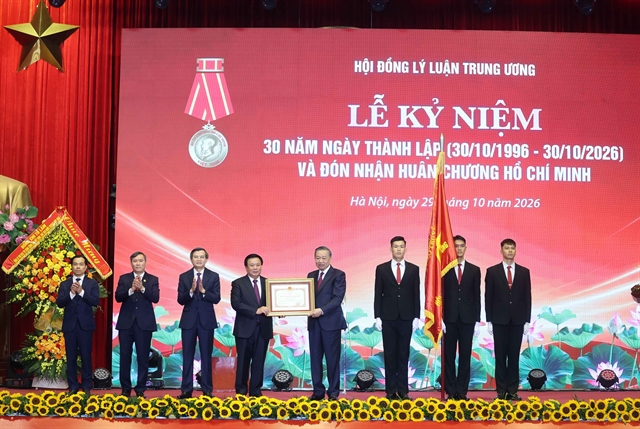
Central Council Theoretical Studies requested to strengthen core role in strategic advisory work
1.
|
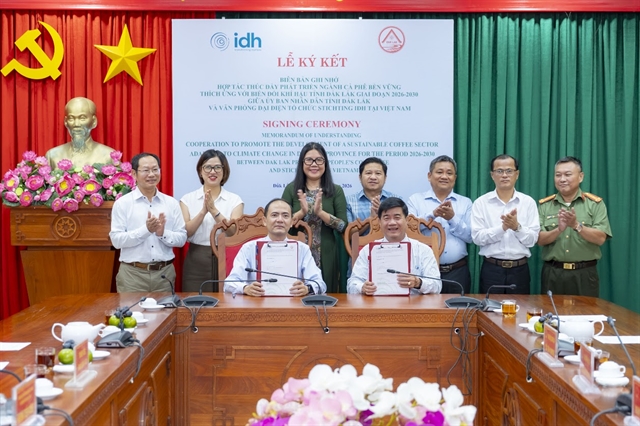
| The signing ceremony of the MoU on developing a 75,00ha of of sustainable, climate-resilient coffee area for the 2026-2030 period in Đắk Lắk Province. — VNS Photo Hồ Ngọc |
ĐẮK LẮK — The People’s Committee of Đắk Lắk Province on Thursday signed a Memorandum of Understanding (MoU) with the Netherland’s Office of Stichting IDH in Việt Nam (IDH Việt Nam) on growing 75,000ha of sustainable, climate-resilient coffee area for the 2026–30 period.
The agreement scales up the sustainable landscape model the two partners have successfully implemented since 2016 to the entire province.
Speaking at the signing ceremony, Nguyễn Thiên Văn, vice chairman of the provincial People’s Committee, said that Đắk Lắk has more than 217,000 hectares of coffee that is key product creating livelihood for hundreds of thousands of households and generates nearly US$ 900 million in export value each year – more than half of the province’s total export turnover.
“However, the sector faces mounting challenges from climate change, soil degradation and water scarcity, as well as new requirements from major export markets such as the European Union Deforestation Regulation (EUDR),” Văn said.
Since 2016, IDH has worked with the province to implement the Sustainable Landscape Programme (ISLA) under a public-private partnership model, co-funded by JDE Peet’s (the Netherlands), one of the world’s largest coffee buyers.
In 2021–25, the programme operated in the specialised coffee-growing districts of Krông Năng and Cu M’gar, expanding to the former Ea H’leo district in 2023. It covered more than 91,500ha of coffee, over 14,400ha of pepper and 11,200ha of fruit trees, benefiting more than 75,000 households.
These positive results have led Đắk Lắk and IDH to scale up their cooperation from district to provincial level, in line with Việt Nam’s two-tier local government model following the reorganisation of administrative units.
Through this partnership, the parties will continue to work together towards four main objectives.
First, conserving and efficiently using soil and water resources and applying sustainable, climate-adaptive production practices.
Second, strengthening production capacity and fostering linkages among farmers, cooperatives and businesses, thereby improving the quality, value and market access of Đắk Lắk coffee.
Third, developing a database of growing areas and an EUDR-compliant traceability system, together with a Measurement, Reporting and Verification (MRV) and monitoring and evaluation system.
Fourth, mobilising resources, expertise and the participation of businesses, organisations and other stakeholders.
The provincial Department of Agriculture and Environment is assigned as the focal agency to advise on and coordinate implementation.
IDH Việt Nam will share expertise, provide technical assistance, propose models and solutions, and connect financing from businesses, investors and development partners.
Over five years, the programme delivered sustainable production training to more than 120,000 farmers. More than 1.3 million coffee seedlings for replanting and nearly 505,000 intercrop seedlings were provided, along with 84 demonstration models for water-saving irrigation and ground-cover management.
The programme helped establish and strengthen the capacity of 20 cooperatives with more than 7,300 member households farming 9,556 hectares of coffee.
In the 2024–25 crop year alone, companies purchased over 23,000 tonnes of green coffee from these cooperatives, including 1,903 tonnes of high-quality coffee sold at VNĐ10,000-20,000 per kilogramme above the market price.
By the end of 2025, nearly 28,000 hectares – 31 per cent of the programme area – were farmed under sustainability standards such as 4C, Rainforest Alliance and Fairtrade.
IDH will continue to support Đắk Lắk Province, connecting businesses, investors and partners to turn the province’s goal of 150,000ha of sustainable, EUDR-compliant coffee into reality, said Huỳnh Tiến Dũng, chief representative of IDH in Việt Nam.
“We believe Đắk Lắk can become one of the leading models for sustainable coffee regions around the world,” Dũng said.
“The agreement will also further strengthen the public-private partnership model, in which government, businesses, development organisations and farmers share responsibility for the province’s green growth and the sustainable development of its coffee sector,” he added. — VNS
Economy
 Economy
 Economy
 Economy
 Economy
 Economy
 Economy
 Economy
 Economy
 Economy
 Economy
 Economy
 Economy
 Economy
 Economy