 Economy


Hội An to host international lantern festival, year-end cultural events
1.
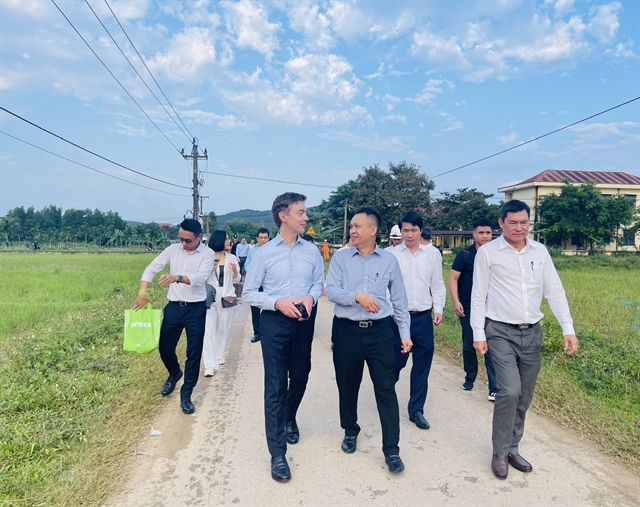 |
| The Ambassador of the European Union to Việt Nam, Julien Guerier, and Deputy Minister of Industry and Trade Nguyễn Việt Sơn (centred) during a working visit to an energy project in Quảng Trị Province on July 26-27. VNS Photo Khánh Chi |
QUẢNG TRỊ - Quảng Trị is seeking appropriate mechanisms and policies to attract strategic investors to renewable and clean energy projects, with a view to gradually developing the province into an energy hub of Central Việt Nam.
Vice Chairman of the Provincial People’s Committee Lê Đức Tiến underscored this recommendation at a working session with a joint delegation from the European Union and the Ministry of Industry and Trade (MoIT) during their visit to energy projects under the EU–Việt Nam Sustainable Energy Transition Programme (SETP) in Quảng Trị Province and Huế City on October 26-27.
Tiến noted that Quảng Trị benefits from a coastline of approximately 200km. The local topography features the Trường Sơn Mountain range and natural wind convergence corridors. Beyond offshore and nearshore wind assets, the province boasts substantial inland wind energy potential along the Trường Sơn range—most notably in the western area of the former Hướng Hóa District. Wind speeds here are exceptionally favorable, yielding plant operational run-times of 3,500 to 3,600 equivalent hours annually, representing significant untapped potential.
"Based on international case studies, we see tremendous room for growth. Major industrial groups from Germany, Belgium, and across the EU have decades of operational experience manufacturing wind turbines, transmission towers, and related auxiliary equipment," Tiến said.
 |
| Vice Chairman of the Provincial People’s Committee Lê Đức Tiến higlights tremendous room for growth of renewable and clean energy in Quảng Trị. Photo Kiều Chi |
"Quảng Trị expects to secure support to develop a renewable energy logistics and supply-chain hub. We possess a deep-water seaport network and ample industrial land to support this sector. The province is keen to facilitate joint ventures between domestic enterprises and European partners with advanced technological capabilities to build this hub, covering heavy mechanical engineering, turbine manufacturing, and allied services."
On the occasion, the Vice Chairman also proposed that the MoIT and the EU continue providing technical and financial assistance through EU-supported programmes to further upgrade the rural and mountainous power distribution grids across the locality.
In his remarks at the working session, the Ambassador of the European Union to Việt Nam, Julien Guerier, emphasised that 2026 is a historic year for the development of EU – Việt Nam given a number of high-level visit exchanges.
“We have agreed to further invest in Việt Nam through Global Gateway, in particular in renewable energy and sustainable transport, and to reinforce further our cooperation under the Just Energy Transition Partnership,” said Julien.
“In the JETP, together with the UK, we are co-chairing the group of international donors to invest into decarbonising the Vietnamese economy and developing a clean energy transition process for the country.
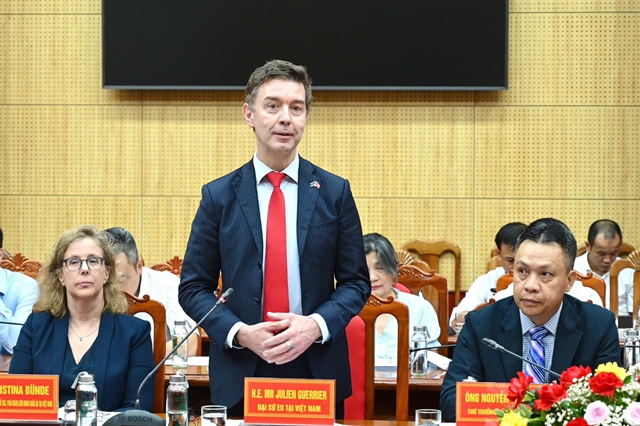 |
| Tthe Ambassador of the European Union to Việt Nam, Julien Guerier, addresses the working session with Quảng Trị Provincial People's Committee on July 26. Photo Kiều Chi |
“As a long-term partner of the country, we have been investing in Việt Nam's sustainable development for several decades, and we will continue to do so. Already in 2018 – 2020, we invested in the Energy Sector Policy Support Programme 108 million euro (approximately US$120 million) in order to provide sustainable energy in rural Việt Nam.”
According to the Ambassador, beyond energy transition, the EU currently engages in Quảng Trị Province on climate change adaption, more specifically in coastal urban development.
Under the EU’s Global Gateway Strategy, in collaboration with Team Europe, the EU has committed significant financial resources to support Việt Nam, primarily focusing on green energy transition and sustainable infrastructure. The EU and its member states have taken a 2.8 billion euros commitment to Việt Nam’s Just Energy Transition Partnership (JETP), supporting a just and sustainable energy transition.
The EU allocated 250 million euros in grants to support Việt Nam's sustainable energy development during the 2018-2027 period, which was channelled through two programmes including SETP. With 142 million euros, the programme support improving energy efficiency, increasing a larger share of renewable energy in the energy mix, and enhancing of Việt Nam Energy Information System.
Addressing the session, Deputy Minister of Industry and Trade Nguyễn Việt Sơn affirmed that Quảng Trị possesses immense resource potential and is rapidly evolving into a major energy hub for both Central Việt Nam and the nation at large. In recent years, local energy infrastructure has achieved substantial progress, making critical contributions to national energy security and provincial socioeconomic development.
Sơn noted that the SETP plays an instrumental role in assisting Việt Nam in fulfilling its international carbon emission commitments and driving sustainable energy growth. He also expressed gratitude to the EU for supporting rural electrification initiatives in Quảng Trị, which have upgraded local power networks and significantly expanded electricity access for local communities.
Under the National Power Development Plan VIII (PDP8) and the revised PDP8, the total planned power generation capacity in the province stands at 12,963 MW for the 2025–2030 period, with an additional 3,822 MW planned for 2031–2035.
The provincial Department of Industry and Trade reported that Quảng Trị currently has 40 completed projects operating commercially with an aggregate capacity of 1,164.9 MW, alongside 166 MW currently under active construction. Furthermore, 31 projects with a combined capacity of 6,400 MW have selected investors and are finalising statutory procedures ahead of groundbreaking.
Under the Resolution of the Provincial Party Congress for the 2025–2030 term, Quảng Trị identified four key socioeconomic pillars: energy, logistics, green agriculture, and tourism. Among these, energy is viewed as a vital catalyst to transform the locality into a growth pole and an emerging energy hub for Central Việt Nam. VNS
Economy
 Economy
 Economy
 Economy
 Economy
 Economy
 Economy
 Economy
 Economy
 Economy
 Economy
 Economy
 Economy
 Economy
 Economy