 Economy



Hà Nội Liberation Day: From historical memory to a modern “City for Peace”
1.
 |
| Lạng Sơn authorities and agencies organise livestream sessions on TikTok Shop to promote the province's speciality custard apples and help connect local agricultural products with consumers. — VNA/VNS Photo |
HÀ NỘI — Cross-border e-commerce is opening up new opportunities for Vietnamese goods to reach international consumers directly, but businesses are still tapping only a small share of the market.
To expand online exports, enterprises need to strengthen their sales, operations and logistics capabilities rather than treating e-commerce as merely a supplementary channel.
The global cross-border e-commerce market has surpassed US$800 billion, while Vietnamese businesses have tapped only about $5.5 billion, including around $2 billion in exports, according to an updated e-commerce industry report released by SHS Securities in late September 2026.
The proportion of businesses using e-commerce websites and applications for exports ranged from 14 per cent to 19 per cent during 2021–25, according to SHS, indicating that investment in the channel has yet to establish a sustainable trend.
China is currently the leading market targeted for online exports, accounting for 43 per cent, followed by Japan at 30 per cent, South Korea at 28 per cent, the European Union at 17 per cent and the US at 12 per cent.
SHS said e-commerce continued to play more of a supporting role than a core one in Vietnamese businesses' export activities. About 35 per cent of businesses said exports through the channel accounted for less than 10 per cent of their total export value, while only 14 per cent said the share exceeded 30 per cent.
The gap between the size of the global market and the level of Vietnamese businesses' participation points to significant room for growth. But turning this opportunity into a substantive export channel will require long-term investment in brands, data, sales and operations.
Building for scale
Võ Thanh Tòng, senior account manager at Amazon Global Selling Vietnam, said the scale of online sales depended not only on products but also on the resources businesses could commit to a market over a sufficiently long period.
The number of Vietnamese businesses generating millions of dollars in revenue on Amazon was increasing, but reaching that scale would require operational capacity, brand management and sustained resources, he said.
This meant online exports could not be treated as a short-term experiment. Businesses would need time to understand customers, improve products, build up reviews and optimise sales operations.
Content platforms are also creating new ways to reach consumers. Trần Thị Tân, director of CSR and strategic partnerships at TikTok Shop Vietnam, said videos, storytelling and livestreams could generate consumer interest before a purchasing need had fully emerged.
For Vietnamese goods, this approach could broaden access to international consumers, particularly for products that can be effectively presented through images and storytelling.
However, when selling internationally, businesses would still need to localise content to turn consumer attention into orders. "Discovery e-commerce", in which content creates demand before consumers actively search for a product, would provide another way to reach buyers.
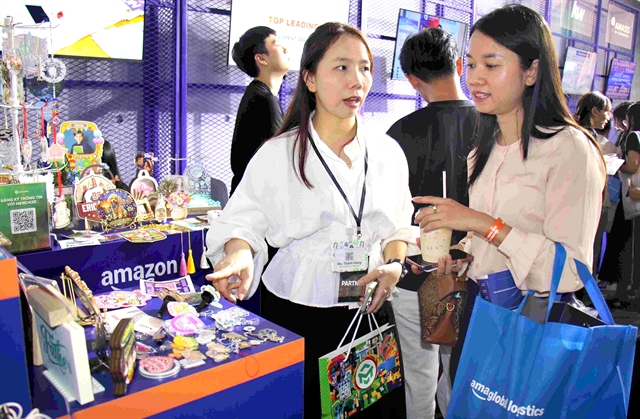 |
| Cross-border e-commerce platforms such as Amazon are creating new opportunities for Vietnamese goods to expand their global reach and strengthen their brands internationally. — VNA/VNS Photo |
Logistics key to scaling up
According to SHS, platforms such as Amazon Global Selling, Alibaba and TikTok Shop, along with bonded warehouse models, are creating additional routes for companies to reach international consumers directly.
But direct sales also require businesses to take greater control of products, brands, orders and logistics.
Winning orders is only the first step. Logistics costs, delivery times and order fulfilment capacity can determine whether a business can sell a product profitably.
SHS said high logistics costs, long international delivery times and limitations in bonded warehouses and border-area sorting centres were hindering businesses from expanding online exports.
Tân said products could be discovered by consumers through content, but turning attention into sales required businesses to ensure competitive products and prices as well as reliable services and fulfilment operations.
Tòng added that as order volumes increased, requirements for inventory, delivery and customer service also grew. If operational capacity failed to keep pace, higher revenue would not necessarily translate into greater efficiency.
Logistics needed to be considered when businesses select a market, rather than only after orders have been received.
Businesses could ship directly from Việt Nam while testing a market. As order volumes grew, they could consider using bonded warehouses or sorting centres in destination markets to shorten delivery times and control costs.
Beyond delivery
The Vietnam E-commerce and Digital Economy Agency under the Ministry of Industry and Trade recently organised field programmes in Henan Province, China, helping businesses study distribution systems, international rail routes and bonded warehouses in Zhengzhou.
The initiative is expected to expand to the EU, the US, Japan and South Korea, creating more options for businesses to organise supply chains suited to individual markets.
However, efficient delivery addresses only part of the challenge.
Trần Quốc Hùng, an international economics and finance expert, said the restructuring of global supply chains was creating opportunities but did not mean the benefits would automatically flow to Vietnamese businesses.
He said advantages in geo-economic position, free trade agreements (FTAs) and production capacity could generate long-term value only if businesses improved productivity, technology, adaptability and their ability to participate more deeply in global value chains.
From an e-commerce perspective, a cross-border order would also be only a starting point. If businesses remained heavily dependent on platforms, intermediaries or external service providers, higher revenue might not necessarily translate into greater value for the businesses themselves.
Greater control over brands, customer data, product positioning and distribution systems could help businesses turn each transaction into a foundation for subsequent orders.
Việt Nam's 17 FTAs have opened markets, while its production capacity provides the goods. To expand online exports, businesses also need to strengthen their ability to reach customers and manage sales, logistics and after-sales operations. VNS
Economy
 Economy
 Economy
 Economy
 Economy
 Economy
 Economy
 Economy
 Economy
 Economy
 Economy
 Economy
 Economy
 Economy
 Economy