Rikkeisoft ký kết MOU với LAC.Co, LTD - thúc đẩy hợp tác kinh doanh toàn diện trong lĩnh vực an ninh mạng.jpg) Economy
Economy



World Health Summit 2026: Berlin Becomes Global Meeting Point for the Future of Health
1.
|
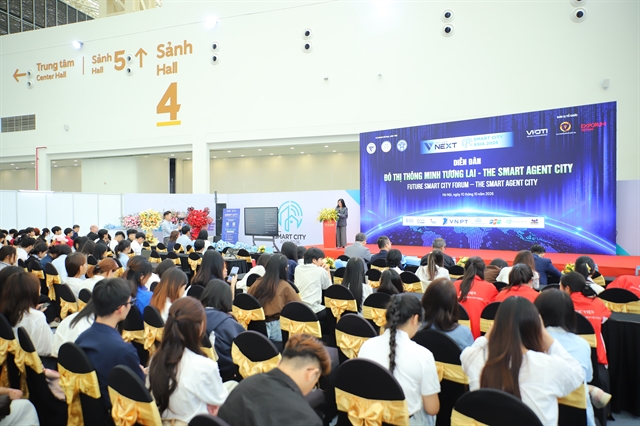
| The Future Smart City Forum 2026 held in Hà Nội on October 10. —Photo courtesy of the organiser |
HÀ NỘI — Artificial intelligence (AI) agents could help transform smart cities by enabling systems to coordinate responses to urban challenges, connect public services and support businesses, experts said at the Future Smart City Forum 2026 on October 10.
The event was organised by the National Digital Transformation Agency, the Institute of Innovation and Digital Transformation (VIDTI) and the Stamford Global Leadership Centre (SGLC), under the direction and auspices of the Ministry of Science and Technology, the Việt Nam Union of Science and Technology Associations and the Hà Nội People’s Committee.
A key question raised at the forum was how cities would operate when AI agents could act on behalf of people, carry out tasks, connect public services and interact with urban systems.
Speaking at the forum, Professor Trương Xuân Lam, vice president of the Việt Nam Union of Science and Technology Associations, said concepts such as AI City, AI-Native City, Agent City and Smart Agent City were increasingly featuring in discussions about the future of urban development.
While digital cities focus on data, infrastructure connectivity and technology-based services, the next generation of smart cities would need to go further by developing an integrated urban ecosystem capable of operating intelligently, he said.
AI could connect data, coordinate resources, forecast changes and potential risks, and interact directly with urban systems, helping improve quality of life. However, smart city models and solutions needed to reflect Việt Nam’s socio-economic conditions, with human needs at the centre of development and technology serving as a driver of progress, Lam said.
Dr Bangdao Chen, co-founder of Tyr and the Blockchain Research Centre at the University of Oxford, and a member of the SGLC Advisory Council, outlined a vision of cities in which AI agents move beyond isolated applications to work together across daily life, business and urban governance.
Just as cities connect people, organisations and services through shared rules, AI agents need a common operating environment as they increasingly act on behalf of individuals, assist businesses and interact with other organisations’ systems.
This approach would take smart cities beyond using AI to analyse data and support decision-making, enabling agents to perform tasks and coordinate across systems securely, transparently and accountably.
The challenge was not simply what AI could do, but how people granted authority to AI agents and maintained control over their actions in real-world settings, Chen said.
The Agent City initiative identifies three core priorities: data sovereignty and autonomy, security in AI agent operations, and narrowing the digital divide. Its guiding principle is that AI should not govern people; people should manage and control AI.
Individuals and organisations would retain control over their data, internal rules and the AI agents acting on their behalf. Agents could be stopped before carrying out actions beyond their authorised scope.
When accessing another organisation’s systems, agents would have to pass through control gateways to verify their identities, establish whom they represented and obtain only the permissions required for specific tasks. Rules would be enforced before actions were executed.
From vision to pilot programmes
A panel discussion, “Agent City – Capabilities, Institutions and Sandbox”, examined the technological, governance and cooperation requirements for turning the concept into practical trials in Việt Nam.
Discussions covered the transition from digital and smart cities to AI-native cities, where AI agents could coordinate specific tasks in public services, business operations and everyday life.
Participants highlighted the need for technological infrastructure and security, data management, identity verification, access permissions and controls over AI agents’ actions. They also discussed the role of institutional frameworks and regulatory sandboxes in testing new applications while ensuring safety and accountability.
Potential pilot areas included finance, tourism, retail, food services, healthcare and urban public services. Implementing these applications would require investment, skilled personnel and coordination among government agencies, technology companies, research institutions and communities.
Timothy Ngo, co-founder and chief executive of Iozera.ai Inc said that alongside investment in data centres and computing infrastructure, attention should be given to transparent communication, workforce training and building public consensus.
From a business perspective, Ashish Arvind Thukral, co-founder and chief executive of NeuGenM.ai, stressed the need to standardise product and service information so AI agents could identify them, as well as establish safety rules for transactions between agents.
Kaylene Wong, chief executive of John Ethans International, advised businesses to start with specific problems, select suitable tasks for automation and clearly define human responsibilities in operating AI systems.
Chen called for greater use of simulation and testing to identify risks, verify safeguards and refine AI governance policies. Sandbox programmes should maintain human oversight and accountability while allowing members of the public to experience the applications directly and provide feedback, he said.
The discussions identified issues requiring further research, conditions for implementation and potential areas of cooperation during the pilot phase.
The forum also saw the official launch of the Agent City initiative, which aims to develop one of the world’s first large-scale environments where AI agents can operate across real-world public and commercial services under a shared set of rules.
The initiative is intended to help Việt Nam engage with international developments in AI and Agent City. Its founding partners called on government agencies, businesses, research organisations and communities to help refine the model, strengthen cooperation and gradually develop pilot programmes in Việt Nam. — VNS
Economy
 Economy
 Economy
 Economy
 Economy
 Economy
 Economy
 Economy
 Economy
 Economy
 Economy
 Economy
 Economy
 Economy
 Economy