 Economy



Jazz evolves through national academy’s 70-year journey
1.
|
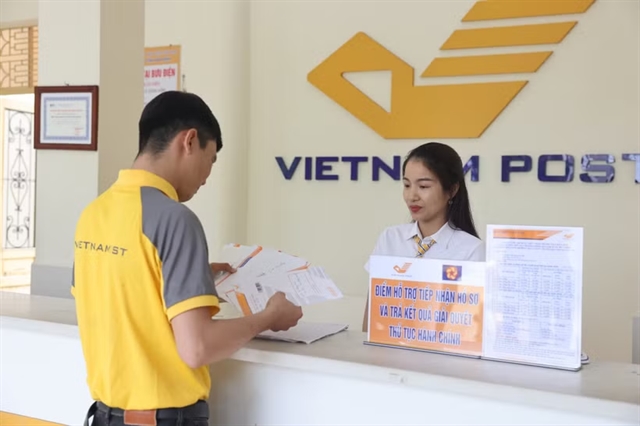
| At an office of Vietnam Post. — Photo vietnampost.vn |
HÀ NỘI — The postal sector is facing growing pressure for a regulatory overhaul as booming e-commerce reshapes traditional delivery services and blurs the boundaries between postal operations and modern logistics.
Postal volumes have expanded more than twelvefold over the past 15 years, from about 360 million items in 2010 to approximately 4.1 billion in 2025, while postal service revenue reached around VNĐ87 trillion (US$3.3 billion). Traditional letters now account for less than 10 per cent of total volume, compared with more than 90 per cent for parcels and goods.
The structural shift means postal companies are no longer simply delivering parcels. Their operations increasingly extend across e-commerce supply chains, from order acceptance and sorting to transportation, delivery and returns.
At the same time, new business models have emerged since the Postal Law was adopted in 2010, including automated sorting centres, order-processing warehouses, fulfilment services, automated collection points, return management and digital platforms connecting sellers with delivery networks.
This has created a regulatory challenge: defining which activities constitute postal services, which are independent logistics operations and which overlap and therefore require a consistent and transparent management mechanism.
Modern logistics can encompass warehousing, inventory management, packaging, order processing, cargo consolidation, transportation and distribution, while postal activities traditionally focus on accepting, sorting, transporting and delivering postal items.
Without clear boundaries, companies can face uncertainty over applicable business conditions, legal responsibilities and regulatory requirements. Excessively broad regulation could increase compliance costs, while insufficient oversight could create gaps in parcel safety, information protection, traceability and controls against prohibited goods.
The draft revised Postal Law in 2026 is seeking to address this regulatory "grey area".
According to the Ministry of Science and Technology, the draft defines postal services according to the nature of the activity, covering acceptance, sorting, transportation and delivery as well as operations directly associated with individual postal items, including storage, order processing, packaging and returns. Independent transportation, warehousing and logistics services would be excluded.
The growing convergence of postal services, logistics and e-commerce is also evident internationally.
In Japan, Japan Post has expanded from conventional mail and parcel services into logistics solutions covering the design, development and operation of logistics chains. It has also worked with Rakuten to develop logistics centres and shared delivery systems serving the e-commerce ecosystem.
Singapore Post, or SingPost, similarly operates across postal and e-commerce logistics services, including warehousing, fulfilment, last-mile delivery and international logistics. Its model allows goods from different warehouses to be consolidated at e-commerce logistics centres, automatically sorted and subsequently distributed to multiple destinations.
The regulatory approach outlined in the draft law would also involve a shift from traditional ex-ante controls towards ex-post supervision and data-driven risk management.
With annual postal volumes reaching 4.1 billion items, comprehensive supervision using conventional methods is becoming increasingly costly and inefficient. The draft therefore envisages identification, traceability and risk-based management, with each postal item assigned a unique identification code within an enterprise's system so that it can be tracked from acceptance and sorting through transportation and final delivery.
The proposed changes come amid broader institutional reforms.
Politburo Resolution No 68-NQ/TW on private-sector development calls for improvements to the business environment, removal of barriers and stronger participation by enterprises in value chains.
Meanwhile, Decision No 2229/QĐ-TTg, issued on October 9, 2025, approved Việt Nam's logistics services development strategy for 2025-35, with a vision to 2050, targeting a sustainable, efficient, high-quality and competitive logistics industry.
As e-commerce expands, the draft law's approach would establish clearer responsibilities while allowing postal companies room to integrate services and invest in technologies such as smart warehouses, automation, data systems and delivery networks.
The proposed framework is intended to balance State management and postal safety and security with efforts to mobilise private resources, reduce logistics costs and improve economic competitiveness. — BIZHUB/VNS
Economy
 Economy
 Economy
 Economy
 Economy
 Economy
 Economy
 Economy
 Economy
 Economy
 Economy
 Economy
 Economy
 Economy
 Economy




