 Economy


HCM City honours fallen soldiers with solemn musical tribute
1.
|
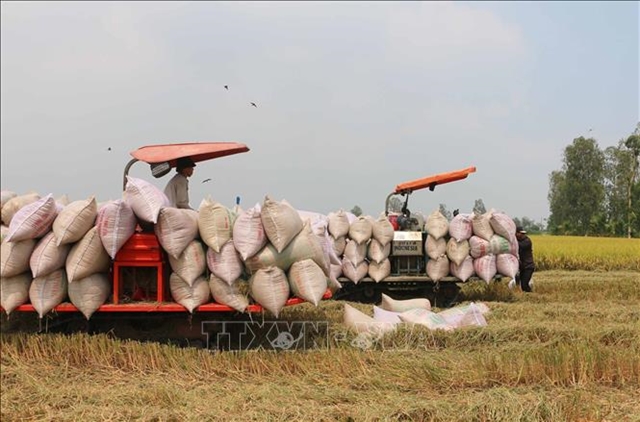
| VCCI said that the drafts grant ‘special privileges’ to incumbent traders. —VNA/VNS Photo |
HÀ NỘI — The Vietnam Chamber of Commerce and Industry (VCCI) has proposed streamlining the regulatory framework in rice exports to ensure transparency and equity, and facilitate enterprises to participate in the sector.
Under a document providing comments on a draft circular and a draft decree on rice export and import business which has been sent to the Ministry of Industry and Trade (MoIT), VCCI said that many regulations governing rice exports in the draft still pose potential market entry barriers, reducing competitiveness and increasing costs for businesses.
Accordingly, the mechanism for designating main rice export traders to ship to centralised transaction markets, which are governed by memoranda of understandings or trade agreements, as stipulated in Article 19 of the draft decree and articles 3, 4, 6, and 8 of the draft circular creates significant market entry barriers for new traders and small- and medium-sized enterprises (SMEs).
In particular, the draft grants ‘special privileges’ to incumbent traders.
Under the draft's framework, the MoIT’s criteria for selecting main traders or allocating export quotas rely primarily on export performance over the preceding two years and credit ratings, which are themselves contingent on past export volumes.
This inadvertently creates a ‘closed loop’ as enterprises seeking large export quotas must demonstrate a track record of performance. However, to achieve the export performance required for the centralised transaction markets, an enterprise must first be designated as a main trader.
Consequently, new traders and SMEs, which fully meet business requirements and proactively establish sustainable production chains, are denied the opportunity to compete on a level playing field. Export rights in key markets will risk being monopolised by a small group of enterprises holding ‘historical market share’, VCCI argues.
In addition to creating competitive barriers, the VCCI argues that the draft lacks clear criteria for the designation of traders, thereby increasing the risk of a rent-seeking mechanism.
To address the shortcomings, the VCCI proposes incorporating a flexible quota mechanism into Article 8 of the draft circular. Specifically, approximately 10-15 per cent of the total volume under export contracts to centralised transaction markets should be reserved for public bidding or allocated to a distinct group of new enterprises and SMEs that have established genuine production-linked and product-offtake supply chains.
The drafting agency needs to specify quantitative criteria for designating key traders, principles for rotational ranking, criteria for selecting replacement enterprises, and the formula for allocating volume among participating enterprises.
The VCCI also recommended to remove the circulation reserve criterion from the credit rating scale to select main exporters. It explains that maintaining large inventories over extended periods increases warehousing and preservation costs for businesses while tying up capital and straining cash flow. Without a corresponding export quota allocation, businesses also face the risk of prolonged inventory holding and heightened business risk.
Besides, the VCCI believes whether rice is stored in farmers' facilities or at business warehouses, it constitutes a reserve for the economy and is already monitored by regulatory agencies through reporting systems.
Consequently, mandating that traders stockpile large quantities of goods in their own warehouses does not enhance management efficiency; instead, it merely incurs additional logistics and preservation costs, thereby undermining the competitiveness of Vietnamese rice in the international market.
Based on this analysis, the VCCI proposes that the drafting agency eliminate the circulation reserve criterion from the trader credit rating system. Instead, priority should be given to evaluating criteria regarding the establishment of production linkage chains and product off-take agreements as stipulated in Clause 1, Article 14 of the draft decree since this represents a sustainable solution for ensuring supply, improving rice quality, and boosting the export sector's competitiveness. — BIZHUB/VNS
Economy
 Economy
 Economy
 Economy
 Economy
 Economy
 Economy
 Economy
 Economy
 Economy
 Economy
 Economy
 Economy
 Economy
 Economy