 Economy


Sales, marketing congress discusses growing influence of AI
1.
|
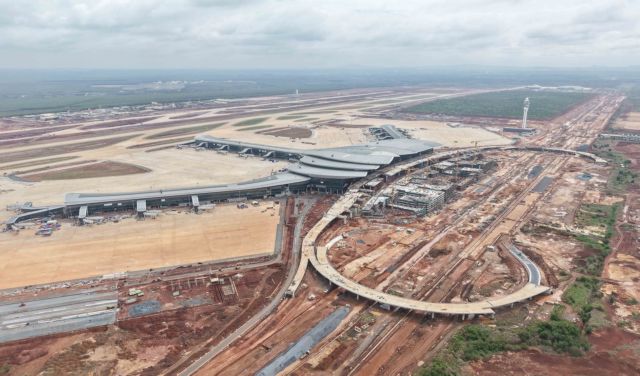
| An aerial view shows construction of Long Thành International Airport in Đồng Nai City. The Politburo has approved a long-term strategy to develop Đồng Nai into a major Asia-Pacific aviation hub centred on the airport. — VNA/VNS Photo |
HCM CITY — The Politburo has approved a long-term development strategy that aims to transform the newly established Đồng Nai City into a major Asia-Pacific aviation hub centred on Long Thành International Airport, while granting it special policy mechanisms to accelerate growth.
The resolution, signed by General Secretary and State President Tô Lâm, sets development targets through 2035 with a vision to 2065, positioning Đồng Nai as a global airport city and a new growth engine for southern Việt Nam.
The Politburo said Đồng Nai's development had yet to match its potential due to institutional constraints and insufficient exploitation of new growth drivers, calling for a strategic shift towards an open development model supported by integrated transport infrastructure and multi-centre urban planning.
Under the resolution, Đồng Nai is expected to become a multi-functional growth pole leading industries including aviation, aerospace, high technology, logistics, cross-border trade, high-tech agriculture and innovation, capitalising on Long Thành’s role as an international airport city with global connectivity.
By 2035, Đồng Nai aims to become a green, smart airport city with high-tech manufacturing, aviation and aerospace industries, and an internationally competitive aviation economy.
By 2045, the city is expected to become a modern aviation centre for the Asia-Pacific region and a knowledge-based economy with high human development indicators and modern urban governance.
By 2065, it aims to rank among the world's leading multi-functional airport cities with a high quality of life.
The Politburo set a target of annual gross regional domestic product (GRDP) growth of at least 10 per cent during 2026-2045, slowing to at least 8 per cent annually during 2046-2065.
Đồng Nai’s GRDP is projected to reach $44 billion by 2030, rising to $70 billion in 2035, $150 billion in 2045 and $600 billion by 2065. Per capita GRDP is targeted to increase from $9,200 by 2030 to $67,500 by 2065.
The digital economy is expected to account for at least 30 per cent of GRDP by 2030 and 40 per cent by 2035, while the urbanisation rate is targeted to reach 65 per cent by 2030.
To support these ambitions, the Politburo outlined eight groups of policy measures, including institutional reforms, strategic planning, infrastructure investment, innovation-driven growth and social development.
The resolution grants Đồng Nai broader decentralisation and decision-making powers across most sectors, except national defence, security, foreign affairs and religious affairs.
It also allows the city to adopt special policy mechanisms similar to those already applied in HCM City in areas such as investment, finance, budgeting, land management, urban planning, construction, science and technology, digital transformation and strategic investor attraction.
The Politburo also endorsed the establishment of special economic zones, free trade zones, concentrated digital technology parks, innovation centres and higher education zones linked to Long Thành International Airport.
The strategy identifies several key development corridors, including the HCM City-Biên Hòa-Long Thành-Phước An Port axis as an aviation, seaport, logistics and services corridor, alongside other industrial, cross-border trade and tourism corridors connecting the Central Highlands, south-central coast and Cambodia.
The Đồng Nai River will be developed as the city’s strategic ecological and urban landscape corridor.
The resolution also calls for the accelerated development of Long Thành International Airport and related transport infrastructure, including the second phase of the airport, the Biên Hòa-Vũng Tàu railway and regional transport links.
Long Thành International Airport is envisioned as Việt Nam’s principal international aviation gateway and a regional transit hub integrated into global supply chains.
The Politburo also directed planners to develop the Long Thành-Nhơn Trạch urban area and surrounding airport region to accommodate an urban population of more than 2.5 million people, laying the foundation for an internationally standardised airport city. — VNS
Economy
 Economy
 Economy
 Economy
 Economy
 Economy
 Economy
 Economy
 Economy
 Economy
 Economy
 Economy
 Economy
 Economy
 Economy