 Economy

Vietnamese scientist wins ASEAN-US Science Prize for Women
1.
|
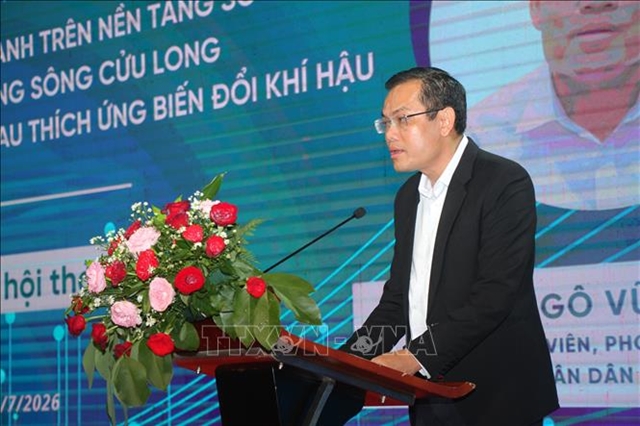
| Vice Chairman of the Cà Mau People's Committee Ngô Vũ Thăng speaks at the event. — VNA/VNS Photo |
HÀ NỘI — The southernmost province of Cà Mau is looking to harness digital technology to accelerate its green transition and strengthen climate resilience, as authorities seek to protect one of the country's most climate-vulnerable regions while boosting growth in its export-driven seafood industry.
This strategy took centre stage at a July 24 conference on the green transition in Cà Mau attended by policymakers, researchers and businesses, where participants discussed how digital tools, scientific innovation and data-driven governance could help the province adapt to rising climate risks while supporting greener, more productive industries.
The conference was held jointly by the Cà Mau People's Committee and the Mekong Institute at Cần Thơ University.
At the event, Vice Chairman of the Cà Mau People's Committee Ngô Vũ Thăng said combining digital transformation with green development has become inevitable for localities and businesses, enabling more efficient use of resources, higher productivity and lower environmental impacts.
For Mekong Delta provinces such as Cà Mau, the transition is particularly urgent as the region faces mounting pressure from sea level rise, saltwater intrusion, coastal and riverbank erosion, environmental degradation and declining natural resources, according to Thăng.
Wider adoption of digital technologies in aquaculture, mangrove forest management, environmental monitoring, seafood traceability and public administration could improve resource management, lower production costs, protect ecosystems and increase the value of the province's key industries, he said.
Researchers at the conference said Cà Mau's extensive mangrove forests, seafood industry, renewable energy resources and coastal ecosystems provide a strong foundation for developing low-carbon and circular economy models that could serve as a blueprint for other parts of the Mekong Delta.
Director of the Mekong Institute at Cần Thơ University Văn Phạm Đăng Trí said the green transition should be seen not just as a shift toward cleaner technologies, but as a broader transformation of development and governance based on science, digital data, innovation and cooperation between the Government, businesses and academia.
He said scientific research should provide the evidence base for policymaking, while technology would enable better monitoring, decision-making and resource management, supported by policies that encourage innovation and long-term investment.
|
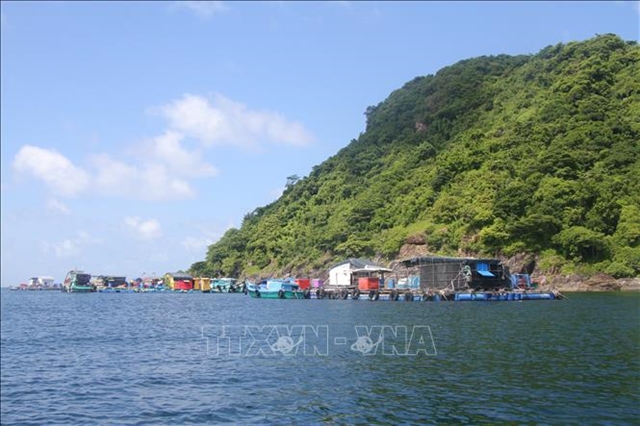
| Officials said digitising the aquaculture sector is central to Cà Mau's long-term strategy for building a green, digital economy and achieving sustainable growth. —VNA/VNS Photo |
Nguyễn Công Quốc from the province's Fisheries Sub-Department said Cà Mau is expanding high-tech shrimp farming, circular production systems and environmentally friendly shrimp-rice and shrimp-mangrove farming models to improve productivity while reducing emissions.
The province is also promoting digital traceability systems and internationally certified farming areas as part of its Cà Mau Shrimp 4.0 initiative, aimed at strengthening export competitiveness and meeting increasingly stringent sustainability requirements in overseas markets.
According to provincial officials, Cà Mau has established 48 production partnerships involving businesses, cooperatives and farming households, covering more than 38,000 hectares certified under international standards including Naturland, EU Organic, ASC and BAP.
Nearly 8,000 households participate in the schemes, reinforcing the position of the Cà Mau shrimp brand on the global market.
Cà Mau is also investing in environmental monitoring systems, disease surveillance, hatchery quality control and digital farm management to improve productivity and reduce climate-related risks.
Thái Trường Giang, deputy head of Cà Mau's Department of Science and Technology, said the province's greatest challenge is not the adoption of technology itself, but identifying practical solutions capable of addressing local climate and development needs.
He said science, technology and digital transformation should help convert natural resources into actionable data, research into commercial applications, industrial by-products into valuable inputs and ecological advantages into long-term market competitiveness. — BIZHUB/VNS
Economy
 Economy
 Economy
 Economy
 Economy
 Economy
 Economy
 Economy
 Economy
 Economy
 Economy
 Economy
.jpg) Economy
Economy
 Economy
 Economy