 Economy

VN-Index extends its losing streak to fourth day
1.
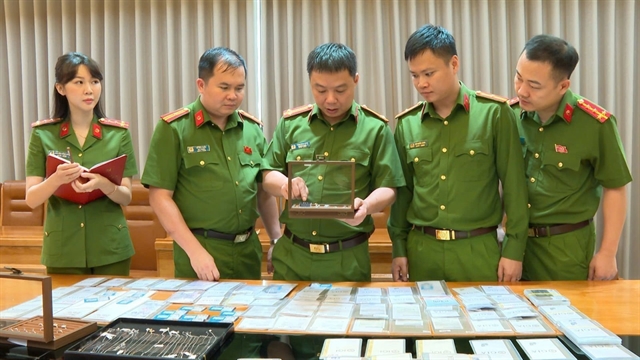 |
| Police in the central province of Thanh Hóa inspect 1,100 diamonds seized in a crackdown on a transnational smuggling ring. — VNA/VNS Photo |
HÀ NỘI — The government has issued a sweeping update to its list of banned imports and exports, adding a first-time prohibition on goods made with forced labour and formalising curbs on e-cigarettes and uncertified rough diamonds.
Decree 292, released this week, sets out detailed schedules of goods barred from crossing Việt Nam's borders in either direction, expanding on existing trade law with more specific categories and criteria.
Among the most notable additions is a ban on importing products mined, produced or manufactured, wholly or partly, through forced labour, whether the goods originate from specific companies, countries or territories.
Officials said the measure brings the country's import rules in line with international treaties it has signed.
The decree also codifies bans on rough diamonds that fail to meet Kimberley Process certification standards for both imports and exports. E-cigarettes and heated-tobacco products are likewise barred in both directions.
On the export side, the prohibited list includes weapons, ammunition and explosives, as well as round logs and sawn timber harvested from Việt Nam's natural forests.
Import restrictions are greater in scope.
Alongside weapons, ammunition and explosives, they cover fireworks of all kinds (except for approved maritime safety flares), banned hazardous chemicals, radioactive waste, and pesticides or veterinary medications blacklisted for use.
Wildlife and plant specimens restricted under the Convention on International Trade in Endangered Species (CITES) also remain off-limits.
The decree also reaffirms an existing ban on a wide range of secondhand goods, including used clothing, footwear, electronics, home appliances, furniture, bicycles, motorbikes, medical equipment and digital technology products.
Separately, it prohibits the import of used automotive parts and components, as well as vehicles or parts with tampered, erased or altered chassis and engine numbers.
Other restricted categories include banned pharmaceuticals and raw drug materials, along with publications and cultural products barred from circulation domestically.
The government said exceptions to any of these bans will only be granted in cases explicitly permitted under the Law on Foreign Trade Management and related regulations. — VNS
Economy
 Economy
 Economy
 Economy
 Economy
 Economy
 Economy
 Economy
 Economy
 Economy
 Economy
 Economy
 Economy
 Economy
 Economy