 Economy



From British-Era Waterway to Eco-Tourism Attraction: Karnival Ban Canal 2026 Returns in November
1.

|
| Deputy Minister of Finance Nguyễn Đức Chi speaks at the briefing. — VNA/VNS Photo |
HÀ NỘI — The Ministry of Finance is stepping up fiscal measures and institutional reforms to support economic growth as the Government pursues a target of at least 10 per cent growth this year amid an increasingly uncertain global environment.
Speaking at the ministry’s second-quarter press briefing on Wednesday, Deputy Minister of Finance Nguyễn Đức Chi said geopolitical tensions, trade uncertainties and volatile energy and commodity prices continued to weigh on the global economy and create challenges for domestic businesses and production activities.
He said the ministry was focusing on improving the legal framework, mobilising resources for development investment and implementing fiscal policies to support growth.
Since the beginning of the year, the ministry has drafted or issued 104 legal documents, including laws, resolutions, decrees and circulars, aimed at removing regulatory bottlenecks and improving the business environment.
State budget revenue in the first five months of 2026 reached 54.3 per cent of the full-year target, up more than 15 per cent from the same period last year.
According to the ministry, the result has helped secure funding for socio-economic development programmes, national defence, social welfare and public investment projects.
The ministry has continued to extend tax payment deadlines and provide tax, fee and land-rent reductions to support businesses and encourage investment and production.
It has also proposed adjustments to taxes and fees related to petroleum products, including environmental protection tax, value-added tax and import duties, while coordinating with other agencies on price management to help stabilise markets and contain inflation.
Despite the positive results, Chi warned that challenges remained in the second half of the year.
“The Ministry of Finance will continue to closely monitor domestic and international developments and proactively prepare policy scenarios to achieve the 2026 fiscal and budget targets,” he said.
|
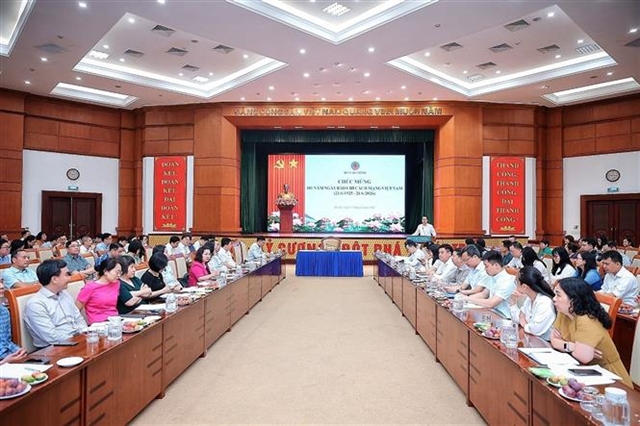
| Participant at the meeting. — VNA/VNS Photo |
At the briefing, officials also addressed concerns over Việt Nam’s trade deficit during the first five months of the year.
Lê Thị Tường Thu, deputy head of the Statistics Office, said around 94 per cent of imports consisted of machinery, equipment and production materials.
She said the strong growth in imports reflected businesses’ efforts to prepare for future production and investment rather than weakening competitiveness.
Meanwhile, Deputy Minister Chi said the trade deficit should be viewed in the context of its underlying drivers.
Of the more than US$13 billion trade deficit recorded so far this year, around $7 billion was attributable to higher petroleum import costs, which he described as an unavoidable expense to ensure the economy continued to operate smoothly.
At the same time, imports of more than $30 billion worth of machinery and components reflected businesses' preparations for the next production cycle, he said.
Chi expressed confidence that exports would strengthen in the second half of the year as new trade agreements with the US and other partners take effect, helping narrow the trade gap and potentially return the trade balance to surplus.
Officials also reaffirmed the Government’s commitment to achieving double-digit growth in 2026, the first year of the 2026-30 socio-economic development plan.
Dương Tiến Dũng, deputy director of the State Budget Department, said the Government had for the first time assigned specific growth targets to localities and State-owned enterprises at the beginning of the year under Resolution No. 01/NQ-CP.
The targets were based on the growth potential and economic structure of each locality and enterprise, he said.
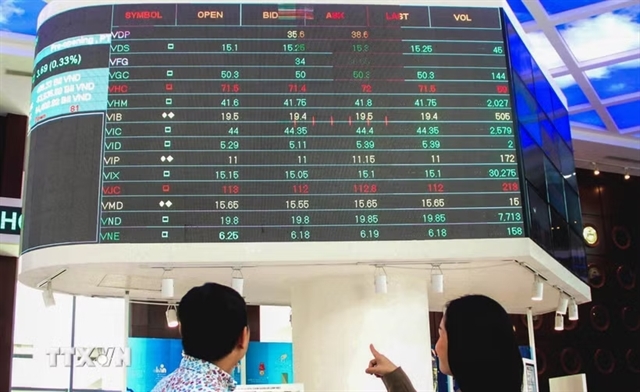
Regarding the stock market, the State Securities Commission said it was reviewing the implementation of the stock market development strategy through 2030 and preparing new measures to support the market’s next phase of development.
Hoàng Văn Thu, vice chairman of the commission, said regulators would continue reforms aimed at meeting higher international standards, including criteria used by MSCI for future market classification upgrades.
The commission is also working on amendments to the Securities Law, expected to be submitted to the National Assembly in October, to simplify administrative procedures, reduce business conditions and improve capital mobilisation channels for enterprises.
Other planned reforms include strengthening regulations on bond underwriting activities and improving electronic trading systems to enhance market safety and efficiency.
Officials said the combination of institutional reforms, investor development programmes and market infrastructure upgrades would help build a more transparent, efficient and sustainable stock market in the years ahead. — VNS
Economy
 Economy
 Economy
.jpg) Economy
Economy
 Economy
 Economy
 Economy
 Economy
 Economy
 Economy
 Economy
 Economy
 Economy
 Economy
 Economy