 Economy


Vietnamese scientist wins ASEAN-US Science Prize for Women
1.
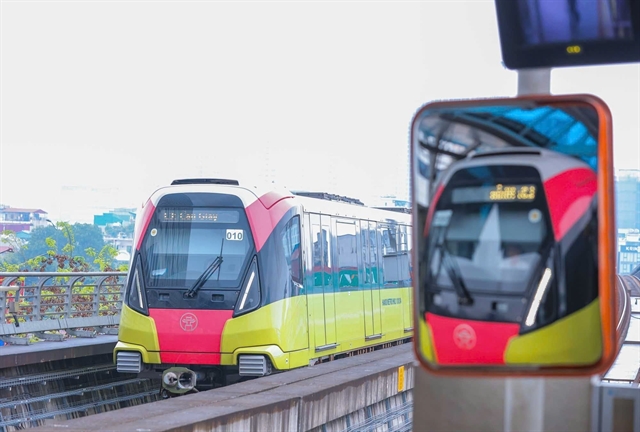 |
| Cát Linh-Hà Đông metro line in Hà Nội. Detailed guidance on a new procurement mechanism intended to support domestic railway suppliers are expected to be issued early. — VNA/VNS Photo Hoàng Hiếu |
HÀ NỘI — Vietnamese railway manufacturers that have invested trillions of đồng in anticipation of a railway construction boom are still waiting for detailed guidance on a new procurement mechanism intended to support domestic suppliers.
Recently, Hòa Phát Dung Quất Rail and Special Steel JSC submitted a proposal to the Ministry of Construction regarding the localisation of railway materials, calling for detailed guidance on the procurement mechanism for major transport infrastructure projects.
The company said that although Decree No 04/2026/NĐ-CP, issued on January 10, allows project investors to place orders for domestically manufactured railway products, no detailed implementation guidelines have been issued.
As the mechanism is new and untested, investors and relevant agencies remain uncertain about its implementation and compliance with regulations on public investment, procurement and State capital management.
The uncertainty has left domestic manufacturers waiting for concrete procurement orders despite having invested heavily in railway production capacity.
Only days after the National Assembly approved the investment policy for the North-South high-speed railway project in late 2024, Hòa Phát Group announced a series of investments manufacture high-speed railway rails and specialised railway materials.
Currently, most railway engineering products used in Việt Nam, including steel rails for railway infrastructure projects, must still be imported.
Among the largest investments is the Hòa Phát Dung Quất Rail and Special Steel plant, a project worth more than VNĐ10 trillion (US$380 million).
Construction of the 700,000-tonne-per-year plant began in December 2025 at Dung Quất Economic Zone in Quảng Ngãi Province. The facility, expected to be the first in Việt Nam and Southeast Asia to produce high-speed railway rails, is set to begin operations in early 2027.
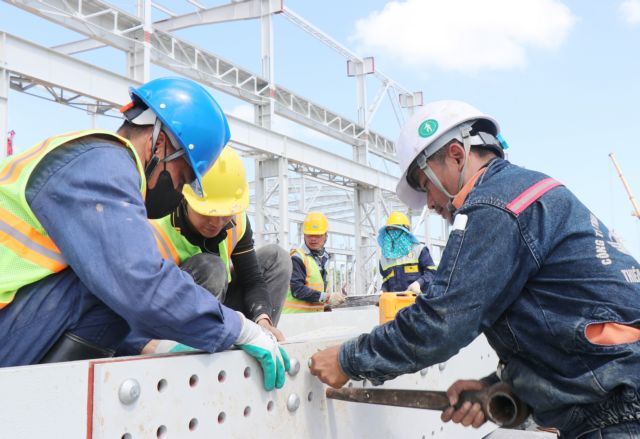 |
| Construction at Hòa Phát Dung Quất Rail and Special Steel plant. — VNA/VNS Photo Phạm Cường |
The plant's product portfolio includes high-speed railway rails, urban railway rails, crane rails and a range of special steel products.
The company is also developing facilities to manufacture railway fastening systems and railway turnouts, with commercial products expected to enter the market in the second quarter of 2027.
The company’s planned product rollout coincided with the expected launch of several major railway projects, including the North-South high-speed railway, the Lào Cai-Hà Nội-Hải Phòng railway, the Hà Nội-Quảng Ninh high-speed railway and multiple urban railway projects in Hà Nội and Hồ Chí Minh City.
The North-South high-speed railway alone is expected to create significant demand for railway materials. With a planned length of approximately 1,541km and a double-track design, total rail demand is estimated at around 6,164km, equivalent to 380,000-400,000 tonnes of steel rails.
However, the manufacturer said they have yet to receive any formal procurement requests from project investors.
Hòa Phát warned that prolonged delays in implementing the procurement mechanism could result in inefficient use of social investment resources and slow efforts to develop domestic railway technology and supply chains.
The company also noted that the decree primarily applies to publicly funded projects, while many future railway developments are expected to be carried out under public-private partnership (PPP) models.
However, the manufacturer says they have yet to receive any formal procurement requests from project investors.
The company warned that delays in implementing the procurement mechanism could hinder the development of domestic railway technology and supply chains.
It also noted that the decree mainly applies to publicly funded projects, while many future railway developments are expected to use PPP models, where the lack of incentives for locally manufactured products could limit the participation of domestic suppliers.
Concerns also emerged in railway workforce development.
Vietnam Railways Corporation said it has not yet received any State-funded training orders for personnel needed to operate and maintain new railway lines and future high-speed rail services.
Hoàng Chính Nam, deputy general director of the corporation, said training programmes should be implemented as early as possible to allow institutions time to cooperate with leading international partners and establish technology transfer centres.
Under Article 5 of Decree No 04/2026/NĐ-CP, companies assigned or contracted to supply railway industrial goods and services must meet requirements related to legal status, financial capacity, facilities, workforce and experience.
Accordingly, companies operating for at least three years must have average annual revenue of at least VNĐ8 trillion (US$306 million) over the previous three years, while newer firms must have charter capital of at least VNĐ3 trillion.
Foreign-invested enterprises must also have at least one domestic shareholder holding more than 35 per cent of charter capital. — VNS
Economy
 Economy
 Economy
 Economy
 Economy
 Economy
 Economy
 Economy
 Economy
 Economy
 Economy
 Economy
 Economy
 Economy
 Economy