 Economy



Understanding skin ageing key to more effective rejuvenation, dermatologist says
1.
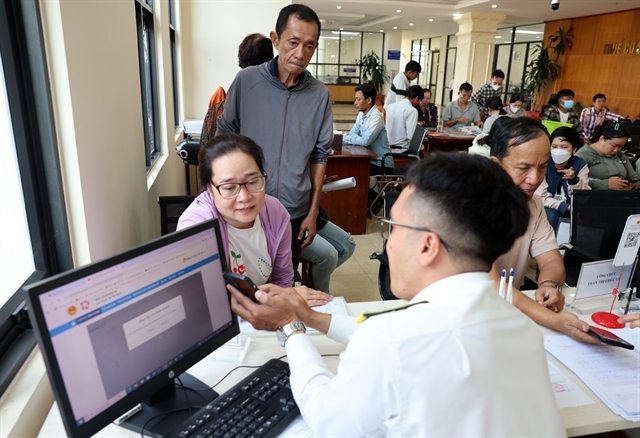 |
| Tax officials of An Giang Province are providing instructions to taxpayers. The Ministry of Finance has proposed classifying taxpayers into three groups based on their levels of compliance and tax risk. — VNA/VNS Photo Phạm Hậu |
HÀ NỘI — The Ministry of Finance has proposed classifying taxpayers into three groups based on their levels of compliance and tax risk as part of efforts to modernise tax management through data-driven risk control.
The proposal is included in a draft circular guiding the implementation of the Law on Tax Management, which is currently open for public comment.
The move comes as tax authorities shift from a uniform management approach to a model that relies on data analysis and risk assessment, at a time when the number of taxpayers continues to rise and business activities are becoming increasingly diverse and complex.
The draft states that taxpayer classification would serve as a basis for setting management priorities, allocating administrative resources and assessing compliance and risk levels.
The ministry said assessments would be updated periodically, or whenever significant changes occur, to ensure accuracy and timeliness.
Taxpayers would be grouped based on four criteria: geographical scope of operations, taxpayer type, business scale and industry characteristics.
Business scale would be assessed through indicators such as revenue, capital, assets, workforce size and organisational structure.
The classification would cover sectors including manufacturing, trade, services, finance, construction, real estate, e-commerce, digital platform-based businesses and cross-border trade.
The ministry said the classification would allow tax authorities to focus resources on taxpayers with higher-risk profiles and provide more favourable conditions for those with strong records of compliance.
It added that the approach is aligned with international trends and recommendations from the Organisation for Economic Co-operation and Development (OECD) on compliance-based tax management.
Under the draft, tax authorities would analyse taxpayers’ records across the entire tax lifecycle, including registration, filing, payment obligations, tax debt status, inspection results and compliance with tax authority decisions.
Risk factors related to the use of electronic invoices, tax refunds, tax exemptions and reductions, as well as tax liability determinations, would also be taken into account.
Based on the analysis, taxpayers would be classified into three categories: high compliance/low risk, medium compliance/risk and low compliance/high risk.
Different management measures would apply to each group.
Low-risk taxpayers could benefit from simplified procedures and priority treatment, while medium-risk taxpayers would receive additional support and guidance.
High-risk taxpayers would be subject to closer monitoring, including direct inspections and enforcement measures where necessary, according to the ministry.
Taxpayer account information rule remains
The Ministry of Finance has also clarified that banks and payment service providers will remain obligated to provide taxpayer account information to tax authorities, rejecting reports that the requirement had been removed from a draft decree detailing the Law on Tax Management.
The Department of Taxation said provisions governing the responsibilities of banks and payment service providers to provide taxpayer account information to tax authorities remain unchanged in the latest draft.
Under the draft decree, currently under review by the Ministry of Justice, credit institutions, foreign bank branches, payment intermediaries and international card service providers would be required to provide tax authorities with information on taxpayers' payment accounts.
The institutions are also required to cooperate with tax authorities when unusual transactions are detected to verify taxpayers' compliance with tax obligations.
Financial institutions would be required to provide account holder identification information, including names, dates of birth, tax identification numbers, addresses, account numbers and account opening and closing dates.
Transaction-related information, including the number and value of transactions, payment details, information on senders and recipients, account balances and income generated through accounts, would also fall within the reporting scope.
In particular, banks would be required to share information on beneficial owners, authorised representatives and suspicious transactions in accordance with anti-money laundering regulations, as well as reports required under international standards for non-resident taxpayers.
The Department of Taxation said clear rules requiring credit institutions to share information with tax authorities would help strengthen tax administration, improve transparency and ensure fairness in the fulfilment of tax obligations.
Previously, the State Bank of Vietnam (SBV) objected the Ministry of Finance's proposal, saying that requiring banks and payment service providers to supply such information could conflict with existing regulations on customer data confidentiality.
Before the Law on Tax Management was passed in 2025, the tax authority had requested access to bank account data under Decree 126/2020 and the 2019 Law on Tax Management. — VNS
Economy
 Economy
 Economy
 Economy
 Economy
 Economy
 Economy
 Economy
 Economy
 Economy
 Economy
 Economy
 Economy
 Economy
 Economy