 Economy



HCM City residents pay tribute to fallen soldiers
1.
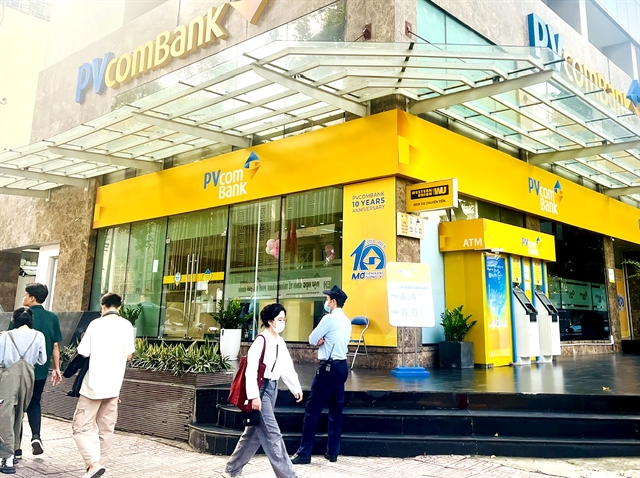 |
| Customers pass by a branch of a private lender in HCM City. — VNS Photo Bồ Xuân Hiệp |
HCM CITY — Interbank interest rates have remained elevated in the first months of 2026, reflecting tightening liquidity conditions as credit growth continues to outpace deposit mobilisation, according to analysts.
Overnight lending rates between banks surged to as high as 17 per cent in early February, the highest level in roughly a decade, before easing. However, rates have stayed volatile, with overnight levels still hovering around 9 per cent in early April.
The interbank market, where credit institutions borrow from one another to meet short-term liquidity needs, has come under increasing strain following a period of strong credit expansion.
Data from the General Statistics Office show that as of the end of March, credit growth reached 2.15 per cent, while deposit growth lagged behind at just 0.44 per cent. This divergence has widened funding gaps across the banking system.
The imbalance is more pronounced in HCM City, where deposit growth stood at only 0.1 per cent in the first quarter, compared to a 1.5 per cent credit expansion, according to the State Bank of Vietnam (SBV).
As a result, loan-to-deposit ratios at several banks have exceeded 100 per cent, increasing reliance on interbank borrowing and pushing up funding costs.
Analysts at Vietcombank Securities noted that liquidity pressures have been building since the second half of 2025, particularly among small and mid-sized joint-stock banks.
“When banks’ capacity to absorb short-term shocks weakens, they become more dependent on interbank funding, contributing to higher interest rates,” the analysts said.
In response, the SBV has actively deployed monetary tools to support liquidity, including injecting funds through open market operations. At times, the central bank has offered up to VNĐ37 trillion (US$1.4 billion) in short-term lending with extended tenors.
However, liquidity management has been complicated by exchange-rate pressures. The SBV has recently conducted forward sales of US dollars with 180-day tenors at a rate of VNĐ26,850 per dollar in an effort to stabilise the domestic currency amid a strong US dollar and global uncertainties.
According to Nguyễn Hoàn Niên, an analyst at Shinhan Securities, while this measure helps ease exchange-rate pressure, it also effectively absorbs a portion of đồng liquidity, contributing to tighter conditions in the banking system.
Market observers also highlight the issue of “localised liquidity shortages”, where funds are not efficiently redistributed from banks with surplus liquidity to those facing deficits, prolonging tight conditions in the interbank market.
Despite rising interbank rates, their transmission to retail deposit rates remains uneven.
Experts note that the relationship between the two markets in Việt Nam does not always follow conventional patterns, partly due to structural characteristics and regulatory measures such as interest rate caps.
Interest income continues to account for a significant share, around 70-80 per cent, of Vietnamese banks’ total revenue, compared to about 30 per cent for many international peers, making the system more sensitive to funding cost fluctuations.
Persistently high interbank rates are expected to put pressure on banks’ net interest margins, prompting lenders to diversify income sources, including expanding consumer lending and fee-based services.
Analysts forecast that interbank rates are unlikely to decline sharply in the near term, with one-month tenors expected to stabilise around 6.8-7 per cent. Deposit rates are projected to range between 7 and 9 per cent per year, depending on the bank.
In the context of ongoing exchange-rate pressures and limited policy room, experts say a return to the low interest-rate environment seen in previous years is unlikely in the short term, signalling continued higher funding costs for businesses and investors. — VNS
Economy
 Economy
 Economy
 Economy
 Economy
 Economy
 Economy
 Economy
 Economy
 Economy
 Economy
 Economy
 Economy
 Economy
 Economy