 Economy


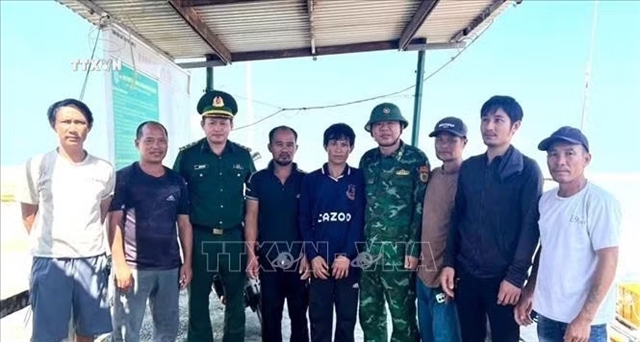
Five fishermen rescued after boat catches fire in Quảng Trị
1.
|
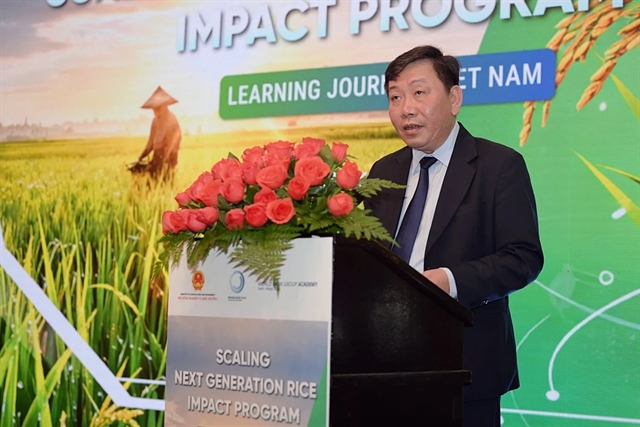
| Nguyễn Đỗ Anh Tuấn, Director General of the International Cooperation Department under Ministry of Agriculture and Environment speaks at a conference on scaling up next-generation rice production on March 2. — Photo mae.gov.vn |
HÀ NỘI — Asia’s rice sector, including Việt Nam, is undergoing a profound shift in strategy, moving away from expanding acreage and maximising output towards raising value per hectare as climate pressures and tighter market standards reshape the industry.
Nguyễn Đỗ Anh Tuấn, Director General of the International Cooperation Department under the Ministry of Agriculture and Environment, highlighted the transition at a conference on scaling up next-generation rice production on March 2.
Global rice production has largely kept pace with demand, Tuấn said. Output for the 2025–2026 crop year is forecast at 556.4 million tonnes, with many countries achieving food self-sufficiency.
Against this backdrop, climate change, emissions reduction requirements and increasingly stringent import standards are emerging as the main forces shaping the sector.
“The growth model based on output expansion is no longer suitable,” Tuấn said, adding that the industry must shift towards a rice economy, where value lies in how rice is grown, not merely in the harvested grain.
Việt Nam has posted strong gains over the past decades through higher yields. Average productivity now stands at about six tonnes per hectare, with total annual output exceeding 43 million tonnes.
However, the scope for further yield growth is narrowing. The next phase will therefore prioritise quality, efficiency and low-emission production.
The Ministry of Agriculture and Environment has launched several initiatives, including a one-million-hectare high-quality, low-emission rice project in the Mekong Delta and a crop-sector emissions reduction programme for 2025–2035. The aim is to enable farmers to earn additional income from carbon markets rather than relying solely on grain sales.
To participate, farmers are required to adopt standardised cultivation practices such as reducing seed, fertiliser and pesticide use, applying alternate wetting and drying irrigation and managing straw responsibly. Pilot models have recorded methane reductions of 20–40 per cent, while profits rose by more than 30 per cent.
A measurement, reporting and verification system is being developed to provide transparent data so eligible rice fields can access carbon finance mechanisms.
Mechanisation and digitalisation are also advancing. Drones are being deployed for seeding and fertilising, while digital records improve traceability across production regions.
Tuấn said the next generation of farmers will not only sell rice but also sell the cultivation process, generating income from premium-quality grain and verified emissions reductions.
Under the new model, cooperatives play a central role in organising production, linking farmers with enterprises and protecting growers’ interests.
Việt Nam has proposed that regional countries share climate-resilient seed technologies, harmonise low-emission standards and work towards mutual recognition of agricultural carbon credits.
Tuấn also called on the World Bank to expand green finance and results-based payment mechanisms tied to emissions reductions.
Dr Sergiy Zorya, Global Lead on Public Policies and Expenditures in Farming and Agribusiness at the World Bank Group, said rice value chain transformation in Việt Nam is centred on four objectives: reducing costs for farmers, improving rice quality and market access, integrating smallholders and lowering the environmental footprint.
Beyond reducing the application of seeds, fertilisers and chemicals, he emphasised the importance of improved seed varieties, stronger vertical integration between farmers and mills, direct-seeded rice and water-saving irrigation.
However, Zorya cautioned that policy frameworks can either accelerate or impede reform. Input subsidies tend to encourage greater use of inputs rather than more efficient use. Public spending on research and extension remains limited, while high expenditure on public stockholding can crowd out the private sector.
Việt Nam has reduced direct production support while increasing spending on research, agricultural extension and post-harvest infrastructure. Budget allocations for rice production fell from 0.5 per cent of GDP in 2013 to 0.2 per cent in 2023.
Zorya proposed reforms to trade and public stockholding policies, including input subsidies, irrigation water tariffs, modernisation of irrigation systems and stronger research and advisory services.
The Mekong Delta, which accounts for 56 per cent of Việt Nam’s rice output and 90 per cent of its exports, has seen significant changes. Research priorities have shifted from maximising yields to enhancing quality and environmental protection.
Breeding programmes now focus on fragrant varieties with high milling rates, tolerance to salinity, drought and heat and lower emissions. Varieties are also being developed to support mechanisation, with growth cycles of 90–110 days, uniform ripening and resistance to lodging for machine harvesting.
This approach reduces seed use, labour demand and post-harvest losses, cutting losses to below 5 per cent from 15–20 per cent previously.
The Cửu Long Delta Rice Research Institute, which has developed more than 160 rice varieties covering 60–65 per cent of the region’s cultivated area, has shifted from maximising yield at any cost to three pillars: economic efficiency, social equity and environmental sustainability.
Mariam J Sherman, Country Director of the World Bank for Việt Nam, Cambodia and Laos, described the one-million-hectare high-quality, low-emission rice initiative as a model for agricultural transformation.
Pilot projects show production costs declining by around 25 per cent, farmer profits rising by about 30 per cent and substantial reductions in carbon emissions.
The World Bank is mobilising concessional finance, providing policy advisory support and strengthening institutional capacity to assist Việt Nam in implementing the programme effectively. The initiative is also seen as a blueprint for scaling up other green agriculture programmes in the future. — VNS
Economy
 Economy
 Economy
 Economy
 Economy
 Economy
 Economy
 Economy
 Economy
 Economy
 Economy
 Economy
 Economy
 Economy
 Economy