 Economy

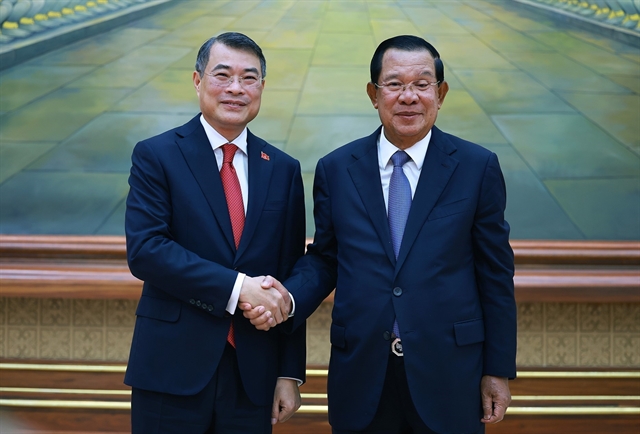
PM Hưng meets with Cambodian People's Party, Senate leader Hun Sen
1.
|
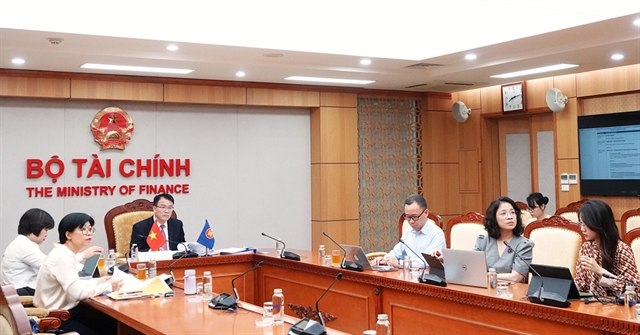
| Representatives from Việt Nam's Ministry of Finance participate in the 13th ASEAN Finance Ministers and Central Bank Governors' Meeting (AFMGM) held virtually on April 7. — Photo mof.gov.vn |
HÀ NỘI — ASEAN countries are focusing on solutions to strengthen regional financial safety and promote cross-sectoral cooperation.
The 13th ASEAN Finance Ministers and Central Bank Governors' Meeting (AFMGM) is being held virtually from April 7 to 10, bringing together financial leaders from member states to discuss these and other issues.
Representing Việt Nam's Ministry of Finance, Deputy Minister Trần Quốc Phương attended the online ASEAN Finance Ministers Meeting (AFMM) on April 7.
The session marked the opening of a series of meetings under the programme, including deputy-level discussions among finance ministries and central banks, as well as strategic dialogues with major partners including the US Department of the Treasury, the Australian Treasury and regional business councils.
In an address, meeting chair and Philippine Deputy Finance Minister Joven Balbosa underscored the urgent need to reinforce financial safety nets amid increasingly unpredictable global economic conditions.
He emphasised the pivotal role of deputy-level officials as a bridge between technical analysis and actionable policy, expressing confidence that the meeting would deliver practical outcomes to enhance resilience and support inclusive growth across the region.
During discussions, participants noted steady progress across several key pillars of financial cooperation, including infrastructure finance, insurance, taxation, customs and climate finance.
In customs integration, one notable highlight is the continued development of the ASEAN Customs Transit System, with Myanmar expected to join later this year. Meanwhile, the ASEAN Express multimodal transport model has been successfully piloted between Malaysia, Thailand and Laos.
The implementation by all 10 member states of the Mutual Recognition Arrangement (MRA) on Authorised Economic Operator (AEO) has also made a significant contribution to strengthening the sustainability of regional supply chains.
At the same time, the ASEAN Single Window is transitioning to its 2.0 phase, focusing on technical and legal standards to better support e-commerce.
Addressing non-traditional challenges, representatives of the ASEAN Cross-Sectoral Working Committee reported on the adoption of an integrated, multi-sectoral approach.
Priority areas include the development of a health finance database, a disaster risk insurance roadmap and enhanced coordination mechanisms for food security.
Collaboration with the Asian Development Bank in advancing the Climate Finance Policy Forum and the ASEAN Infrastructure Fund has also set out a clearer pathway for green finance commitments and sustainable growth.
At the conclusion of the sessions, delegates reviewed preparations for the 30th ASEAN Finance Ministers’ Meeting and took note of Singapore’s plans for its 2027 chairmanship.
In the next few sessions, delegates will continue to refine the ASEAN Economic Community Strategic Plan for 2026-30 and finalise the Joint Statement of Ministers.
Against the backdrop of Việt Nam’s active implementation of Resolution 59-NQ/TW on international integration in the new context and Resolution 69-NQ/TW on socio-economic development policy, the 13th AFMGM series serves as a key strategic lever.
Việt Nam’s deep engagement in multilateral financial cooperation mechanisms not only reinforces its national standing but also translates its commitment to comprehensive and effective international integration into concrete action. — VNS
Economy
 Economy
 Economy
 Economy
 Economy
 Economy
 Economy
 Economy
.jpg) Economy
Economy
 Economy
 Economy
 Economy
 Economy
.png) Economy
Economy
 Economy