 Economy



Vietnamese scientist wins ASEAN-US Science Prize for Women
1.
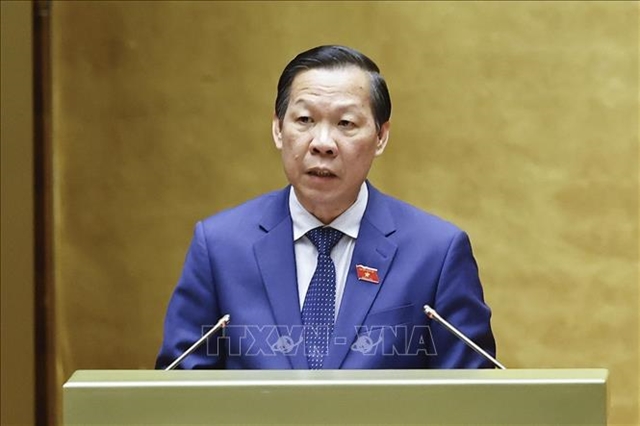 |
| Phan Văn Mãi, Chairman of the NA’s Economic and Financial Committee, presents the appraisal report on the draft Resolution of the NA regarding coordination mechanisms and specific policies to enhance the effectiveness of preventing and resolving international investment disputes. — VNA/VNS Photo |
HÀ NỘI — Continuing the agenda of the first session, the National Assembly on Wednesday afternoon heard submissions and appraisal reports on the draft Resolution of the National Assembly on coordination mechanisms and special policies to enhance the effectiveness of preventing and resolving international investment disputes.
According to the Government’s submission, the development of the Resolution aims to institutionalise the Party’s policies and address practical shortcomings.
Newly arising international investment disputes have continued to increase in both number and value in recent years, posing potential risks of economic losses, reputational damage, and negative impacts on the investment environment if effective coordination is lacking.
The draft Resolution consists of five chapters and 20 articles, focusing on stipulating coordination mechanisms throughout the entire process of dispute prevention and resolution.
A notable feature of the draft is that coordination is not limited to government agencies but is expanded to include other bodies such as the courts, prosecution authorities, and the State Audit.
Regarding specific policies, to ensure adequate resources for this work, the draft proposes exceptional allowances for officials involved.
Accordingly, civil servants at the Legal Representative Agency may receive additional monthly allowances of up to 300 per cent of their current salaries, while those working in this field at ministries, sectors, and localities may receive 100 per cent.
Individuals without formal positions in this area but assigned to lead or participate in inter-agency task forces would also receive civil servant-grade salaries, along with a 100 per cent allowance during their direct involvement in handling cases.
Notably, the draft introduces a protection mechanism for officials that exempts or reduces the liability of heads of agencies and directly involved personnel in cases of full compliance with regulations, even if damages occur.
In the appraisal report on the draft Resolution, Chairman of the National Assembly’s Economic and Financial Committee Phan Văn Mãi stated that the Committee generally agreed on the necessity of issuing the Resolution to address current challenges.
Most members of the Committee support designating the state management agency for foreign investment as the lead agency when the directly involved agency, or the agency proposing contested measures, is a judicial body. This ensures the independence of proceedings and reduces potential conflicts of roles.
However, the Committee emphasised the need for binding mechanisms requiring judicial bodies to provide information and documents, to avoid a situation in which the lead agency becomes merely nominal and dependent on others.
For the Legal Representative Agency, the reviewing body recommended clarifying mechanisms for assignment and coordination with the lead agency to prevent overlap or gaps in responsibilities, while clearly identifying it as the core body responsible for handling legal and technical matters.
Regarding the responsibilities of coordinating agencies, the draft should include binding mechanisms and specific sanctions for cases of non-compliance or incomplete fulfilment of coordination obligations.
Concerning specific regimes and policies, the Committee noted that attracting and retaining high-quality human resources in a highly specialised field with significant legal risks is well-founded.
However, it recommended a careful assessment of the State budget’s capacity and ensuring balance with other specialised sectors in the public system.
In particular, the Committee requested a thorough evaluation and convincing justification for the significant disparity in allowance levels between the Legal Representative Agency and ministries, sectors, and localities, in order to ensure relative fairness and avoid large gaps between these groups. — VNS
Economy
 Economy
 Economy
 Economy
 Economy
 Economy
 Economy
 Economy
.png) Economy
Economy
 Economy
 Economy
 Economy
 Economy
 Economy
 Economy