 Economy



Viên dives again to popularise swimming passion
1.
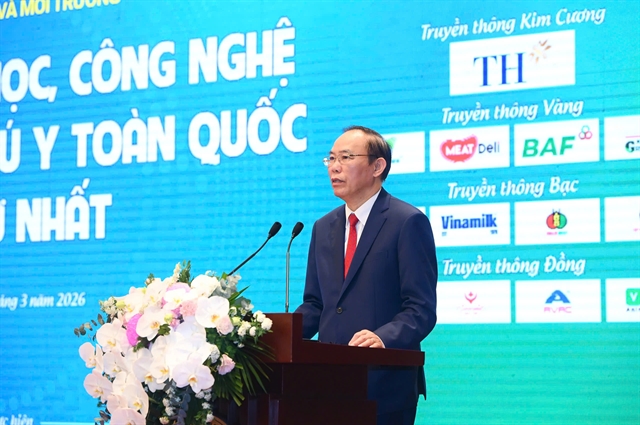 |
| Deputy Minister Phùng Đức Tiến speaking at the conference. — VNS Photo Tố Như |
HÀ NỘI — Việt Nam’s livestock industry is poised for a major overhaul driven by science, technology and innovation, Deputy Minister Phùng Đức Tiến said at the first national conference on livestock and veterinary science and technology held on Saturday at the National Convention Center.
About 750 participants, including policymakers, scientists, industry leaders and international representatives, attended the event, which reviewed the sector’s progress, identified key challenges, and mapped a path toward a modern, sustainable livestock industry.
Tiến said livestock is now one of Viet Nam’s agricultural pillars, valued at roughly US$33 billion and accounting for 26–28 per cent of agricultural output. The sector supplies food for more than 100 million people, supports millions of farming households and contributes to macroeconomic stability and public health.
Over the past decade the sector grew 4.5–6 per cent annually. By 2025 production reached about 8.6–8.7 million tonnes of meat, 21.4 billion eggs and 1.3 million tonnes of fresh milk; exports of livestock products topped about $2.2 billion. Veterinary medicines and vaccines had already been exported to nearly 50 countries.
Yet the industry faces mounting pressures from geopolitical volatility, climate change, natural disasters and complex disease dynamics. Damage from storms and floods in 2025 was estimated at around VNĐ100 trillion ($3.79 billion), underscoring the sector’s rising vulnerability.
Conference speakers highlighted structural constraints, including widespread small-scale production, high input costs, uneven breeding stock quality reliant on imports, slow adoption of advanced technologies, and weak links between research institutes, universities and businesses.
Nguyễn Văn Long, head of the Department of Science and Technology, warned that scientific research and technology transfer remain limited, preventing science from becoming the sector’s main growth engine.
Delegates emphasised digital and biotech solutions such as artificial intelligence, big data, biotechnology and environmental tech to improve farm management, traceability, disease control and value creation across the production–processing–consumption chain. The conference proposed controlled sandbox trials for innovations such as cultured meat and next-generation veterinary drugs to balance innovation with risk management.
Developing circular livestock systems, reducing emissions and pursuing net-zero targets were framed as unavoidable trends. Applying biotech and AI in farm management is seen as essential to boost productivity and climate resilience.
Deputy Minister Tiến described the 2025–2030 period as a “window of opportunity” to restructure the sector toward modernity and sustainability. The government plans to invest about VNĐ100 trillion in science, technology and innovation programmes linked to industry needs.
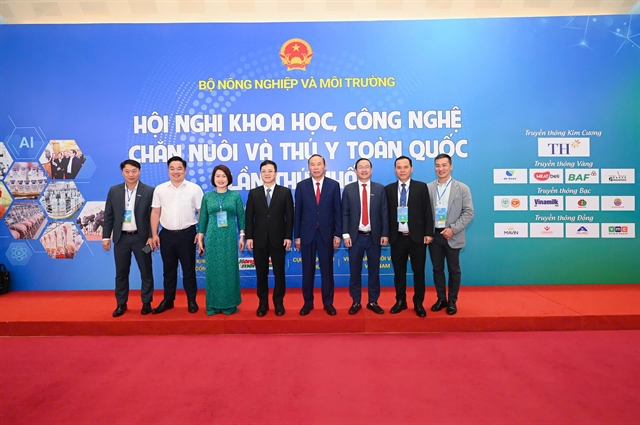 |
| Delegates pose for a group photo at the event. |
Targets for 2030 include more than 10 million tonnes of meat, over 25 billion eggs and roughly 1.6 million tonnes of milk, with higher export shares and greater value-added.
Phạm Kim Đăng, deputy head of the Department of Livestock Production and Veterinary Medicine said future development will focus on a smart livestock ecosystem, including an integrated, tech-driven value chain from breeding and feed to processing and distribution, alongside stronger disease prevention, vaccine development and internationally recognized disease-free zones.
The sector will also accelerate slaughterhouse industrialisation, deep processing and logistics.
Delegates called for stronger value-chain linkages, faster technology transfer and comprehensive digital transformation from traceability to market governance.
With coordinated investment, policy support and closer collaboration among research, industry and government, Việt Nam aims to move from fragmented, small-scale production to a modern, competitive livestock industry integrated into global value chains. — VNS
Economy
 Economy
 Economy
 Economy
 Economy
 Economy
 Economy
 Economy
 Economy
 Economy
 Economy
 Economy
 Economy
 Economy
 Economy