 Economy


Vietnamese Prime Minister meets Cambodian National Assembly President
1.
|
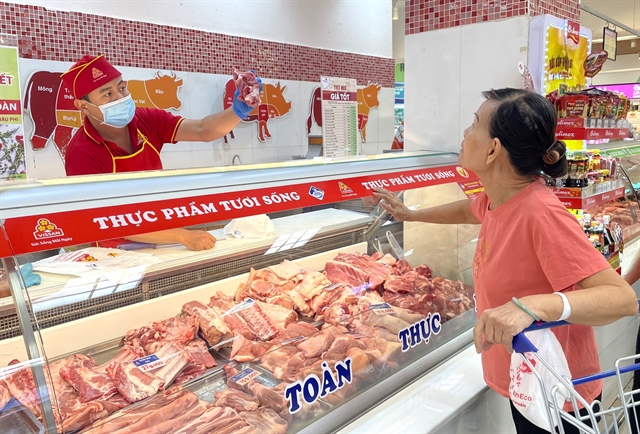
| Pork is processed at a slaughter facility in HCM City, as the city prepares to pilot exchange-based trading to improve price transparency and market efficiency. — VNA/VNS Photo |
HCM CITY— Hồ Chí Minh City is set to pilot pork trading on the Việt Nam Commodity Exchange, marking the first initiative of its kind nationwide, as part of efforts to enhance price transparency, quality control and traceability in the pork market.
According to the municipal Department of Industry and Trade, pork will be listed and traded on the exchange, helping to address longstanding issues such as fragmented pricing, multiple intermediaries and difficulties in tracing product origins.
The city is currently the country’s largest pork consumption market, with daily demand estimated at 13,000 to 14,000 pigs, equivalent to an annual market value exceeding VNĐ25 trillion (nearly US$1 billion).
However, the market continues to face challenges, including price opacity, unstable supply and demand, and limited control over quality and food safety standards.
To tackle these issues, the department has coordinated with relevant stakeholders to develop a pilot scheme for listing and trading pork on the commodity exchange.
Nguyễn Nguyên Phương, deputy director of the department, said the model would enable consumers and businesses to access pork at more reasonable prices while ensuring food safety and clear origin tracking.
At the same time, livestock farmers would benefit from more stable returns and reduced risks associated with supply demand imbalances.
“The city expects that trading pork via the exchange will help improve price transparency, strengthen quality control and ensure traceability, thereby harmonising benefits among farmers, distributors and consumers,” Phương said, adding that communication and training efforts would be strengthened to help market participants gradually adopt the new trading model.
Under the proposed framework, traded products will primarily be pork carcasses after slaughter, meeting strict standards on quality, food safety and traceability.
The pilot will be implemented on a voluntary basis and will operate alongside traditional distribution channels to avoid disruptions to the existing supply chain.
Trần Hữu Linh, director general of the Agency for Domestic Market Surveillance and Development under the Ministry of Industry and Trade, emphasised the need to restructure the pork market towards greater openness and transparency.
“Linking price listing with traceability will not only improve product quality and food safety but also help regulate supply and demand, gradually forming a transparent benchmark pricing mechanism,” Linh said.
He added that businesses and traders would still be able to participate in the market, but under more standardised and transparent conditions in terms of pricing and product quality, contributing to improved market efficiency and better protection for farmers.
Authorities will continue to support HCM City throughout the pilot process, including providing guidance on regulatory frameworks to ensure compliance with existing laws.
If successfully implemented, the pilot scheme is expected to pave the way for broader adoption in other localities, contributing to the development of a more transparent, stable and professional pork market nationwide. — VNS
Economy
 Economy
 Economy
 Economy
 Economy
 Economy
 Economy
 Economy
 Economy
 Economy
 Economy
 Economy
 Economy
Economy
Economy
 Economy