 Economy



Việt Nam, New Zealand convene 14th political consultation
1.
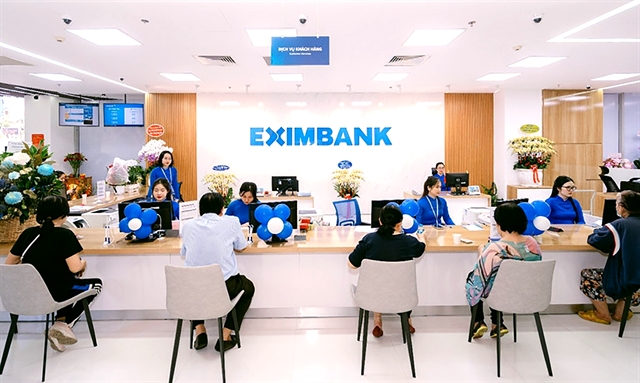 |
| Customers talk to Eximbank's banking tellers at its transaction office. — Photo vietnamplus.vn |
HÀ NỘI — The upcoming season of annual shareholder meetings in the banking sector promises to be a pivotal period for Việt Nam's financial industry in 2026, characterised by significant executive personnel changes and multi-billion-dollar mergers and acquisitions (M&A).
As banks prepare to restructure and position themselves for a new growth cycle, these developments are expected to take centre stage.
In the first two months of 2026, the market has already witnessed a flurry of governance restructuring among major banks. The scheduling of annual general meetings is taking place amid urgency, with the primary focus on appointing and replacing board members and supervisory committee members.
For instance, Eximbank (EIB) is set to undergo a comprehensive overhaul. Its annual general meeting is scheduled for April 28 in Hà Nội, where the board has reportedly received resignation letters from four board members and four members of the supervisory committee from the current term (2025–30). Key figures resigning include Nguyễn Cảnh Anh, Nguyễn Hà Phương, Phạm Tuấn Anh and Hoàng Thế Hưng, all citing personal reasons.
Following these resignations, the board is left with just one member, chairwoman Phạm Thị Huyền Trang, who was elected in December 2025 to replace Nguyễn Cảnh Anh.
Eximbank aims to restructure its board to include seven members, planning to elect six new positions, marking a pivotal shift in its governance strategy. Earlier, on December 4, 2025, the board accepted Nguyễn Cảnh Anh's resignation and elected Phạm Thị Huyền Trang as chairperson, who also serves as the legal representative of the bank. That same day, deputy general director Trần Anh Thắng resigned for personal reasons.
Sacombank (STB) will also hold its annual general meeting in Phú Thọ Province on April 22, with plans to significantly change its board of directors by proposing the election of four new members for the 2022–26 term. The current board consists of seven members, including chairman Dương Công Minh and vice chairman Phạm Văn Phong, among others.
A key bottleneck at Sacombank is the 32.5 per cent stake held by a group linked to former vice chairman Trầm Bê, which the Vietnam Asset Management Company (VAMC) currently represents. Trầm Bê's financial misconduct, which first emerged in 2017, has reportedly resulted in losses amounting to thousands of billions of đồng.
This share has yet to be divested due to legal complications. The bank has submitted a proposal to the State Bank of Vietnam (SBV) for a share auction to recover bad debts.
SSI Securities anticipates that Sacombank's recovery plan may receive approval in the latter half of 2026, potentially allowing for the recovery of around VNĐ12 trillion (US$457.3 million).
MBBank (MBB) has scheduled its annual general meeting for April 18 and plans to elect an additional board member for the 2024–29 term. The cut-off date for participation rights in the meeting is set for March 18.
M&A activity
Alongside these personnel changes, 2026 marks a significant period for M&A activity in the Vietnamese financial sector. Pressures to increase capital in line with the Basel III standards, combined with shifts in the regulatory environment, are attracting foreign investors.
State-owned BIDV (BID) has set the stage by attracting 33 major investors, including State Capital Investment Corporation, Dragon Capital and Manulife Vietnam, through a private placement that is expected to generate more than VNĐ10 trillion.
However, the most anticipated deal is Vietcombank's (VCB) plan to sell 6.5 per cent of its shares, potentially raising between $1.3 billion and $1.4 billion. This move is crucial for solidifying its leading position and strengthening its financial capacity after years of planning.
In late January 2025, Vietcombank invited consulting entities to participate in a valuation for this private placement, a significant step following a six-year hiatus.
Previously, its 2025 annual general meeting approved a plan to sell up to 6.5 per cent of its shares to a maximum of 55 investors between 2025 and 2026.
In the private banking sector, the most anticipated transaction revolves around the sale of 32.5 per cent of Sacombank's shares, referring to the shares previously pledged by Trầm Bê's group to VAMC to address liquidity pressures following the 2015 merger.
The arrival of Nguyễn Đức Thuỵ at Sacombank alongside potential new board members has heightened market expectations that new shareholder groups could emerge soon.
Vietnam International Commercial Joint Stock Bank (VIB) is expected to welcome new foreign stakeholders following the exit of Commonwealth Bank of Australia, while SHB Bank is actively seeking strategic partners.
Currently, more than ten banks have foreign ownership ratios below 5 per cent, suggesting significant room for new deals as the need for capital becomes increasingly apparent.
Notably, the Government has permitted an increase in the foreign ownership limit to 49 per cent for institutions involved in restructuring weak banks. Three notable publicly listed banks, HDBank, MBBank and VPBank, lead the sector in operational efficiency and financial strength.
HDBank reported profit before tax exceeding VNĐ21.3 trillion in 2025, up more than 27 per cent from 2024. It also posted a capital adequacy ratio of 16.7 per cent and a return on equity of 25.3 per cent, both among the highest in the industry.
HDBank's share price has surged more than 50 per cent over the past year, with MBB and VPBank also recording positive profit growth.
These banks are reinforcing their capital bases in preparation for a new growth phase, with expectations of higher credit growth limits, stronger retail banking, increased non-interest income, improved net interest margins and tighter cost control.
The expanded foreign ownership limit will give banks more space to attract international capital, supporting credit growth, strengthening retail operations and improving non-interest income.
The M&A wave in 2026 reflects a deeper restructuring process within the banking system, with equity transactions emerging as a strategic tool for Vietnamese banks to reposition themselves. — BIZHUB/VNS
Economy
 Economy
 Economy
 Economy
 Economy
 Economy
 Economy
 Economy
 Economy
 Economy
 Economy
 Economy
 Economy
 Economy
 Economy
.jpg)