 Economy

Polish PM’s Việt Nam visit to strengthen bilateral ties: Ambassador
1.
 |
| Panelists at the “Vietnam’s Furniture Industry – Export Strategies to Win in the New Landscape” seminar in HCM City on March 4. — VNS Photo |
HCM CITY — Việt Nam has significant advantages in developing furniture products suited to the business-to-consumer model on global e-commerce platforms such as Amazon.
Speaking at the “Vietnam’s Furniture Industry – Export Strategies to Win in the New Landscape” seminar held last week, Phùng Quốc Mẫn, chairman of the Handicraft and Wood Industry Association of HCM City (HAWA), said Việt Nam’s wood industry achieved remarkable growth in the last two decades. Exports rose from just US$200 million worth in 2000 to around $17.3 billion in 2025, making the country one of the world’s largest exporters of wooden furniture.
But Mẫn noted that the global market was changing rapidly, with environmental standards becoming more stringent, global supply chains being reshaped, and trade models increasingly shifting from business-to-business to direct-to-consumer sales.
For many years most Vietnamese wood enterprises developed under the B2B model, producing goods for international brands, he said.
“This model helped the industry build strong manufacturing capabilities. But to increase value-added and become more resilient to market fluctuations, businesses need to gradually expand into B2C and reach consumers directly.”
While Vietnamese firms previously focused on manufacturing for global markets, the next stage would require them to learn how to sell directly to global consumers, he warned.
“The rapid growth of e-commerce is opening major opportunities for Vietnamese furniture companies. Businesses can now access millions of customers worldwide through digital platforms.”
Trần Xuân Thuỷ, southern regional manager at Amazon Global Selling Vietnam, said amid the rapid expansion of cross-border e-commerce, the US company outlined key strategic priorities for 2026 to support Vietnamese businesses.
One priority would be strengthening cooperation with government agencies and local authorities to help position Việt Nam as an e-commerce export hub in Southeast Asia, he said.
In recent years Amazon had implemented various programmes with ministries and localities to support cross-border trade expansion, with furniture being among the priority sectors, he said.
Another focus would be enhancing the visibility of the “Made in Vietnam” brand within Amazon’s ecosystem through branding support programmes, market data sharing and consumer insights, initiatives that are expected to help businesses improve product quality, upgrade design capabilities and meet international standards, gradually building globally recognised Vietnamese brands.
He added that his company had launched Amazon Global Logistics in Việt Nam, only the second country in Asia after China, to help businesses, particularly in the furniture sector, optimise logistics chains and improve export efficiency.
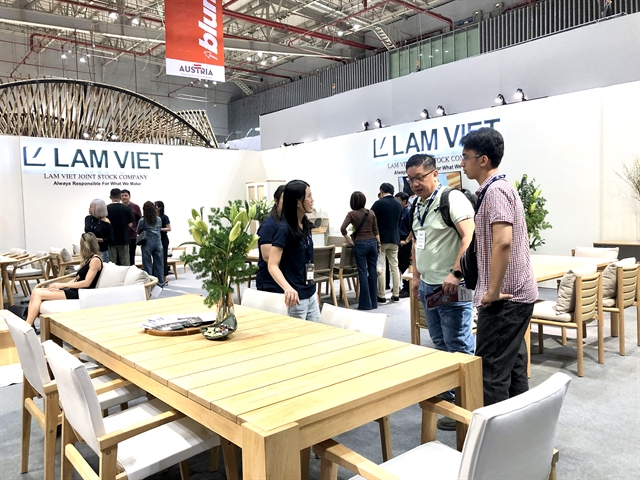 |
| Furniture on display at HawaExpo 2026 in HCM City. Việt Nam has strong potential to develop products suited to the business-to-consumer model on global e-commerce platforms. — VNS Photo Xuân Hương |
Phạm Thị Trang Đài, senior account manager at Amazon Global Selling Vietnam, said one promising strategy would be combining different materials to create mid-range products that appeal to a broader range of customers.
For example, Việt Nam’s strong textile industry would enable manufacturers to combine wood with fabrics to develop more diverse furniture designs.
Outdoor furniture would be another promising segment. Việt Nam has abundant timber resources such as acacia, which is well suited for outdoor products and provides a natural advantage for developing specialised product lines.
Lessons from successful businesses
Huỳnh Lê Đại Thắng, director of Nghĩa Sơn Wooden Furniture Company, said in 2022–23 many traditional B2B markets in Europe, the US and Japan weakened, causing orders to stall.
The company therefore decided to expand into e-commerce and launched the Victory Relax brand targeting the US market.
During the early stages it had to explore the online market largely on its own. Limited experience and the lack of a clear strategy led to costly lessons in both spending and B2C operations.
“The traditional B2B model cannot simply be applied to e-commerce.”
After learning from these challenges and receiving training from e-commerce platforms, the company gradually stabilised its online operations, has built steady revenue streams and is developing its brand in the US market.
However, selling on e-commerce platforms requires businesses to continuously learn and adapt to rapidly evolving technologies and market dynamics.
Based on practical experience, Thắng identified several key factors for success in furniture e-commerce in the US market, including clear legal structures such as establishing a company in the US, trademark protection, transparent financial systems, a dedicated e-commerce team, sufficient capital and product strategies tailored to each platform.
Logistics is another crucial element, according to Thắng.
Warehouses should be located near major demand centres to reduce delivery times, while companies must ensure competitive warehouse rental costs and adopt technology and professional processes to handle returns efficiently.
Investments are also significantly higher for e-commerce. Thắng estimated that capital investment could be two or three times higher than in the traditional B2B model, while the capital turnover cycle is about 2.5–2.8 times faster, placing heavy pressure on cash-flow management.
Building a professional media team is also essential, as product images and marketing concepts must be carefully designed to match the tastes and cultural preferences of consumers in target markets such as the US.
According to Đài, in a highly competitive environment, product quality and customer reviews play a decisive role.
For instance, the keyword “cutting board” on Amazon alone returns about 600 sellers, meaning customer feedback becomes a long-term asset that businesses must carefully cultivate.
Mẫn said HAWA would continue to support businesses in transforming their business models, gradually expanding from B2B to B2C sales through training programmes, knowledge sharing and partner connections. — VNS
Economy
.jpg) Economy
Economy
 Economy
 Economy
 Economy
 Economy
 Economy
 Economy
 Economy
 Economy
 Economy
 Economy
 Economy
 Economy
 Economy