 Economy



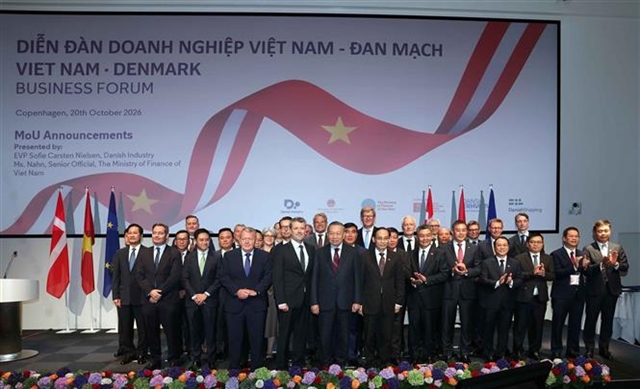
Việt Nam, Denmark issue joint statement on establishment of Comprehensive Strategic Partnership
1.
 |
| total venture capital investment in Việt Nam is estimated at about US$215 million in 2025. —VNA/VNS Photo |
HÀ NỘI — Venture capital investment in Việt Nam’s start-up ecosystem fell sharply in 2025, with funding increasingly concentrated on companies that had demonstrated their feasible business models, signalling a clear restructuring phase for the market.
According to the Việt Nam Tech & Venture Capital Outlook 2025: Reshaping Growth for a New Era, released by VinVentures, total venture capital investment in Việt Nam is estimated at about US$215 million in 2025 across 41 deals, down roughly 30 per cent year on year. The downturn extends a correction trend that began after the market peaked in 2021.
The report notes that this prolonged adjustment reflects not only tighter global capital flows but also a shift in investor mindset following a five-year observation cycle. As earlier investments have started to deliver results, investors have become more cautious toward unproven business models and early-stage ventures.
Beyond a decline in deal volume, capital allocation became more concentrated. Funding largely flowed into later-stage rounds with clearer market traction, typically in the range of $5-10 million. Notably, the top 10 deals accounted for as much as 72 per cent of total invested value, with most going to relatively resilient sectors such as EdTech, ClimateTech, and retail and e-commerce.
A similar pattern emerged in deal size distribution, with transactions worth between $1 and 5 million jumping from about 21 per cent in 2023 to roughly 41 per cent in 2025. Meanwhile, the small deals under $1 million kept dropping. This change points to a more cautious investment approach, with funds focusing on protecting capital and strengthening existing portfolios.
However, VinVentures stressed that the slowdown does not signal a full-scale withdrawal of capital, but rather a phase of “selective repositioning.” In a cautious environment, funds are tightening capital deployment, with about 60 per cent of resources allocated to follow-on and bridge rounds. These investments aim to extend financial runways and strengthen operational efficiency, rather than expand into new deals.
In 2026, venture capital inflows into Việt Nam’s start-up ecosystem are expected to recover gradually, though in a more selective manner. VinVentures forecasts that capital will focus on start-ups that have survived the rigorous screening of 2024–2025, possess clear business models, strong commercialisation capacity, and the ability to generate real cash flows. — VNA/VNS
Economy
 Economy
.jpg) Economy
Economy
 Economy
 Economy
 Economy
 Economy
 Economy
 Economy
 Economy
 Economy
 Economy
 Economy
 Economy
 Economy