 World
World


InterContinental Penang Resort to open this December, marking the brand’s first resort in Malaysia
1.
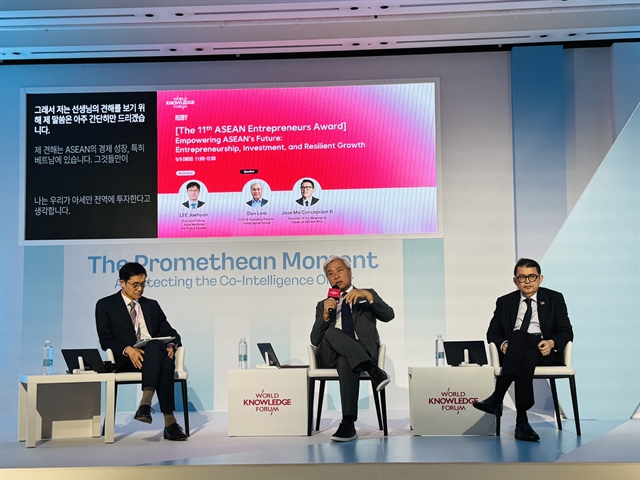 |
| Don Lam, CEO and founding partner of VinaCapital Group, and Jose Ma Concepcion III, founder of the Philippine Center for Entrepreneurship, share their insights into ASEAN’s business environment and opportunities for greater ASEAN-Korea cooperation. VNS Photo Thu Vân |
Thu Vân
SEOUL — ASEAN businesses must achieve greater scale, strengthen regional cooperation and ensure that economic growth benefits smaller enterprises, two prominent business leaders said after receiving the 11th ASEAN Entrepreneurs Award in Seoul.
The award, jointly organised by the ASEAN-Korea Centre and Maekyung Media Group, was presented this year to Don Lam, CEO and founding partner of VinaCapital Group, and Jose Ma Concepcion III, founder of the Philippine Center for Entrepreneurship, known as Go Negosyo.
Since its launch in 2016, it has become a platform for business leaders from Korea and ASEAN to share their experiences and visions and explore new opportunities for cooperation.
Concepcion was recognised for promoting entrepreneurship and empowering micro, small and medium-sized enterprises, or MSMEs. Through the Philippine Center for Entrepreneurship, also known as Go Negosyo, he has promoted entrepreneurship as a pathway to inclusive growth.
As chair of the ASEAN Business Advisory Council Philippines, he continues to champion the interests of entrepreneurs across the region.
Lam was honoured for his leadership in investment and contribution to Việt Nam’s economic development. He played an important role in building VinaCapital into one of Southeast Asia’s leading investment management firms, with nearly US$4 billion in assets under management.
Kim Jae-shin, Secretary General of the ASEAN-Korea Centre, said the two winners demonstrated the strength of ASEAN’s entrepreneurial community.
“This year’s award embodies the dynamism and resilience of ASEAN’s entrepreneurial landscape,” he said.
“Their achievements not only bring pride to their respective countries but also inspire the entire ASEAN region, reminding us that true entrepreneurship is not only about profit, but also about purpose.”
Scale essential to competitiveness
Following the ceremony, the two award winners discussed ASEAN’s business environment, economic resilience and prospects for greater cooperation between the region and South Korea.
Concepcion said ASEAN’s ability to bring its member states together and create greater scale was essential to its competitiveness.
Drawing on his own experience in business, he said companies operating within individual national markets often lacked the scale needed to compete internationally.
“This is why ASEAN was formed, to be able to join forces with the other ASEAN countries to create scale,” he said. “And with scale, you can be more competitive.”
However, he argued that ASEAN cooperation must create tangible benefits for MSMEs rather than concentrating mainly on facilitating the activities of large companies.
Most entrepreneurs in the Philippines operate at the micro level, including sari-sari store owners and other family-run businesses. Many earn enough to survive but struggle to expand their businesses and substantially improve their living standards.
To address this, Go Negosyo has developed mentoring programmes that connect small business owners with experienced entrepreneurs and executives. Many of the sessions are held at shopping malls, where businesspeople provide direct advice to those seeking to establish or expand an enterprise.
Concepcion described the model through what he calls the “three Ms”: mentorship, money and market.
“You need a mentor to guide you through. You need money to fund your business, and of course you need a market to sell your product,” he said.
Around 500 mentors now participate in the programme, supported by the Government, microfinance institutions and major Philippine companies.
“An economy will only grow if everybody participates in that economic growth,” he said. “Prosperity cannot just be for us in this room.”
ASEAN’s growth opportunities
Don Lam said ASEAN remained one of the world’s most attractive investment destinations, although investors needed to understand the differences among its member states.
Despite increasing regional integration, ASEAN countries have different market conditions and levels of political and economic stability, he said.
Lam noted that Korean businesses had recognised the region’s potential earlier than many of their international competitors, supported by the ASEAN-Korea Free Trade Agreement established about two decades ago.
“South Korean companies already saw the opportunity within ASEAN well before the world began to see ASEAN as a single market,” he said.
ASEAN continued to record some of the world’s highest economic growth rates, while its rapidly expanding middle-income population presented particularly strong opportunities for investors and exporters.
Turning to Việt Nam, Lam said the country’s ambitious growth plans were being driven largely by manufacturing, infrastructure development and continued efforts to attract foreign direct investment.
South Korea is Việt Nam’s largest foreign investor, with major corporations such as Samsung and LG establishing an extensive presence in the country. Cultural connections have also expanded through the popularity of South Korean music, television and other forms of entertainment.
“Culturally, Việt Nam and Korea are quite close, both in terms of investment, culture and trade,” he said.
Lam said Việt Nam’s balanced foreign policy had helped position it as a “connector economy” between major markets, particularly China and the United States.
“People can come to Việt Nam and manufacture, and also trade with China and the US at the same time,” he said.
He suggested that ASEAN could similarly position itself as an economic connector between the world’s two largest economies.
Sustainability strengthens resilience
Addressing the relationship between financial performance and sustainability, Lam said environmental, social and governance standards had become an important consideration in VinaCapital’s investment decisions.
The firm invests in between 70 and 80 companies and projects each year and publishes an annual ESG report assessing businesses in its portfolio.
Strong ESG performance also helped companies become more resilient, particularly those exporting to Europe and the United States, where buyers increasingly examine environmental and social standards when choosing suppliers.
“For us, it is important that when we invest, the company scores highly on ESG,” Lam said.
Concepcion, meanwhile, highlighted the importance of regional cooperation in strengthening food security.
Through the ASEAN Food Security Alliance, he has sought to bring major agricultural businesses together and help them share knowledge, technology and experience with smaller farmers.
The initiative follows a “big brother, small brother” approach, under which large agricultural companies mentor smaller producers and help them improve productivity and achieve greater scale.
Initially developed in the Philippines, the programme has now expanded to the ASEAN level, connecting businesses and farmers working in rice, sugar, tobacco, durian and other agricultural products.
Concepcion said cooperation across national borders could allow producers in the same sectors to form larger clusters, lower costs and become more competitive.
Looking ahead, both leaders said closer engagement would be vital to stronger cooperation between ASEAN and Korea.
Concepcion said more face-to-face meetings were needed to build trust, identify shared challenges and create commercial partnerships. While ASEAN had strengthened its production capacity, its common marketplace remained relatively underdeveloped.
Asked to leave one message for young entrepreneurs, Lam urged them to design their businesses for regional and global markets from the outset.
“Think big,” he said. “You cannot survive with a single-country market. When you think about your product or your start-up, it has to be for a regional market and then a global market.” — VNS
World
 World
World
 World
World
 World
World
 World
World
 World
World
 World
World
 World
World
 World
World
 World
World
 World
World
 World
World
 World
World
 World
World
 World
World