 World
World

AIMCONNECT 2026 Held in Singapore, Bringing Global Automotive Leaders Together to Explore the Future of AI, Trust and Connected Mobility
1.
|
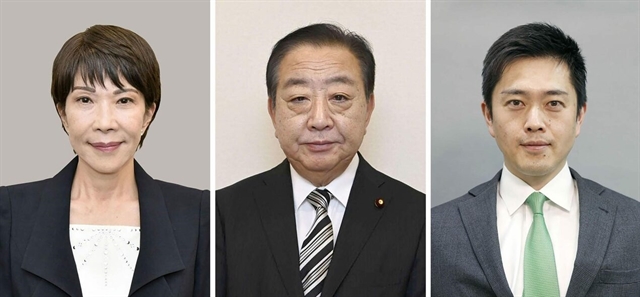
| Composite file photo shows Japanese Prime Minister Sanae Takaichi (L), head of the ruling Liberal Democratic Party, Hirofumi Yoshimura (R) of the Japan Innovation Party, the LDP's coalition partner, and Yoshihiko Noda, co-leader of the main opposition Centrist Reform Alliance. — KYODO/VNA Photo |
TOKYO — Official campaigning began across Japan on Tuesday for the House of Representatives election on February 8, as Prime Minister Sanae Takaichi seeks a fresh mandate in continuing her economic and security policies with her Liberal Democratic Party's coalition ally.
Over 1,270 candidates are expected to vie for the lower house's 465 seats in its first contest since Takaichi took office on October 21 and the LDP ended its 26-year partnership with the Komeito party and formed a coalition with the Japan Innovation Party.
The LDP-led ruling bloc aims to secure a combined majority in the chamber, or at least 233 seats, the number it held before the lower house was dissolved last Friday.
To compete with the conservative camp, the Constitutional Democratic Party of Japan and Komeito have formed a united front, launching the largest opposition force, the Centrist Reform Alliance, earlier this month.
With the ruling and opposition camps pushing to suspend or scrap the consumption tax on food amid prolonged inflation and concerns about Japan's fiscal health, securing alternative funding and deciding when to implement it are taking center stage in the campaign.
Other key themes include Takaichi's pledges, including her commitment to "responsible yet aggressive" fiscal policies, her diplomacy with China and with the United States, Japan's close security ally, and whether to introduce an optional separate-surname system for married couples.
While enjoying relatively high approval ratings, Takaichi's government has been unstable, as the LDP-JIP coalition remains a minority in the House of Councillors, forcing it to rely on opposition parties to pass bills.
Takaichi's decision to suddenly call a general election has also drawn criticism for prioritizing political considerations, as it is certain to delay parliamentary enactment of the initial budget for fiscal 2026, which was originally expected by the end of March, ahead of the April start of the fiscal year.
The dissolution of the lower house marks the first at the opening of an ordinary Diet session since 1966. It will be the first time since 1990 that a lower house election is held in February -- a time when students across Japan take university entrance exams and some regions see heavy snowfall.
The election comes less than a year and a half after the previous lower house election in October 2024 under Takaichi's predecessor, Shigeru Ishiba. Japan's Constitution stipulates that lower house members serve four-year terms, unless the chamber is dissolved.
In the election, each voter casts two ballots, one to choose a candidate in a single-seat constituency and the other to select a party for proportional representation. There are 289 constituencies, with 11 proportional representation blocs for the remaining 176 seats.— KYODO
World
 World
World
 World
World
 World
World
 World
World
 World
World
 World
World
 World
World
 World
World
 World
World
 World
World
 World
World
 World
World
 World
World
 World
World